

























































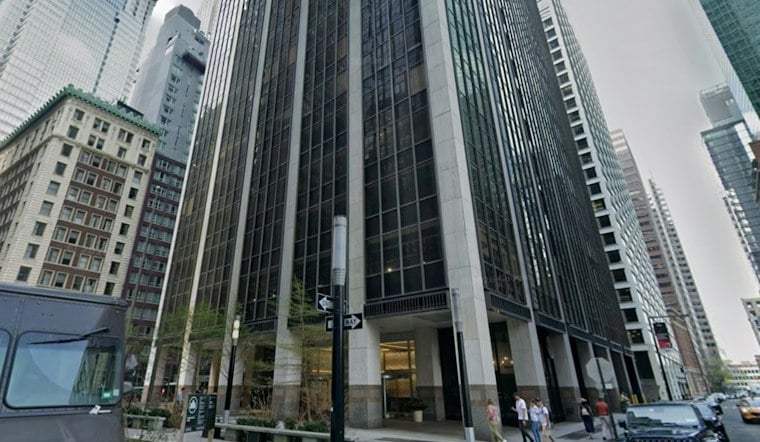
A 29-story tower at 100 Wall Street is about to become one of the Financial District's most closely watched hybrid buildings, with floors 2 through 11 transforming into 168 residential rental apartments while floors 15 through 29 stay put as nearly fully leased office space. The project just secured a $219 million first mortgage construction loan to make it happen, retiring the existing debt on the property and funding the buildout of a full-service amenity package that includes a pool, fitness center, sports simulator, theatre, and rooftop deck with an outdoor kitchen.
The loan comes from Northwind Group, the Manhattan-based real estate private equity firm and debt fund manager, which announced the origination of the $219 million construction loan for the 463,000-square-foot office building. Rather than starting from scratch, Northwind expanded its initial $95 million pre-development loan into the full construction package, according to the same announcement. The conversion is led by a joint venture between BLDG Management, headed by Lloyd Goldman, and David Werner Real Estate Investments, which acquired 100 Wall Street in July 2024. That acquisition came at a steep discount — BLDG and Werner paid $116 million, a 57% drop from the $270 million Barings paid for the debt-free tower in 2015, according to ABS Real Estate.
A Building Built for Splitting in Two
Completed in 1969 and designed by Emery Roth & Sons, the firm behind dozens of post-WWII Manhattan commercial towers, 100 Wall Street has the bones to support this kind of split identity, according to Commercial Property Executive. The tower has efficient floor plates that provide spacing between windows and the building core, two distinct elevator banks for separate residential and office access, and four sides of natural light and air feeding the future residential units. Office tenants were relocated from the base of the building into its top floors as the joint venture advanced the property through planning and predevelopment.
“100 Wall Street is uniquely suited for adaptive reuse and can support 168 luxury residences while retaining a Class A office component,” said Justin Kleinman, executive vice president and COO of BLDG. David Werner, president of David Werner Real Estate Investments and a figure in commercial real estate for more than 40 years, said Northwind Group “has been an excellent partner to DWREI and has unparalleled certainty of execution in the marketplace.” Northwind founder and managing partner Ran Eliasaf noted that the office component at 100 Wall Street is over 95% occupied and cash flowing — the financial anchor that lets the residential conversion move forward on the lower floors.
Northwind's Growing Conversion Portfolio
Triton Construction will serve as construction manager on the project, fresh off completing The Orchard, a 70-story residential skyscraper in Long Island City, while Gensler Architecture, Design & Planning has been engaged as executive architect. Northwind Group was represented by John Vavas of Polsinelli Group in the deal. Founded by Eliasaf in 2008, Northwind has since executed over $11 billion in real estate transactions across more than 400 properties in 28 states, and has now financed eight conversion projects in New York City.
This is not Northwind's only recent Lower Manhattan-adjacent conversion bet. The firm previously backed $90 million for 675 Third Avenue and — as Hoodline reported — $208 million for the office-to-residential conversion at 141 Willoughby Street in Brooklyn. The firm's ties to David Werner extend beyond New York, too, including a $58.5 million loan tied to Werner's purchase of a Chicago office tower.
Why Lower Manhattan Keeps Converting
The 100 Wall Street deal fits into a broader regulatory push reshaping the borough's skyline. New York State's RPTL 467-m, enacted as part of the governor's 2025 budget, can offer up to a 90% property tax exemption for as long as 35 years, depending on the applicable tier and permit timing; the 35-year tier closed for permits pulled after June 30, 2026. Qualifying projects must set aside at least 25% of units as affordable housing, including at least 5% meeting the 40%-of-AMI requirement, with the weighted average of income bands at or below 80% of AMI, according to the Farrell Fritz. In December 2024, New York City adopted the City of Yes for Housing Opportunity zoning amendment, expanding flexible residential conversion rules citywide to cover commercial buildings built as recently as December 31, 1990, per MGNY Consulting.
Those tailwinds are landing amid a dramatic demographic shift. Lower Manhattan's residential population has roughly doubled since 2000, driven largely by commercial-to-residential conversions, while the area's total housing stock rose by nearly 24,000 units from 2000 to 2025, according to the New York State Comptroller. Citywide, conversion starts reached 5 million square feet in 2025, the highest single-year total in at least 20 years. Meanwhile, Lower Manhattan's office availability rate stayed above 20% into mid-2026, and the share of local jobs in financial services fell from 48.5% in 2000 to 33.6% in 2025, according to the Commercial Observer, a shift that has pushed more buildings toward the kind of split office-residential model now taking shape at 100 Wall Street.





