

























































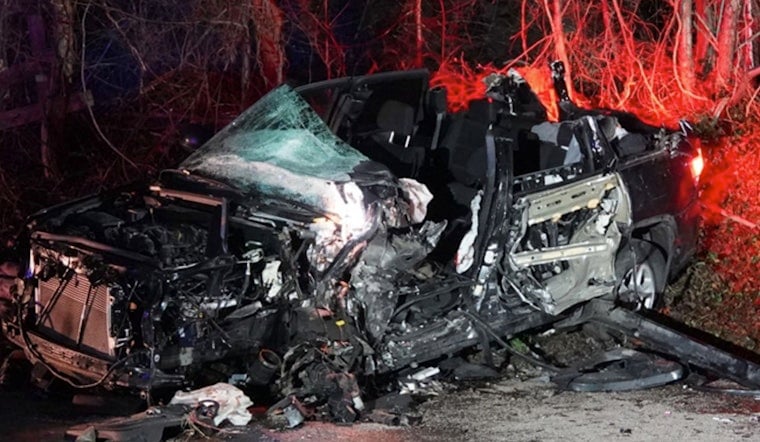
Raphaela Weinsweig was 26, working as a preschool teacher and hoping to become a nurse, when a Ford F-150 crossed the center line on Woodfield Road in rural Gaithersburg and hit her Jeep head-on. She died more than a month later from injuries doctors said were too severe for her to have a meaningful life. The driver who caused the crash, Jorge Moran Hernandez, had been cited for his eighth DUI less than two months earlier and had already served time for a seventh.
The crash happened on March 15, according to WJLA, when Hernandez was driving northbound on Woodfield Road and Weinsweig was headed southbound on her way to a party with Zack Ugaz. Police said Hernandez crossed the center line and struck her vehicle head-on. Weinsweig, according to police, was not under the influence of alcohol at the time. Hernandez, a father of four from Guatemala, died at the crash site; his blood alcohol concentration was measured at 0.28 percent, according to police, more than three times Maryland's legal limit of 0.08 percent.
Weinsweig's mother, Tamar Weinsweig, transferred her daughter to the University of Maryland's Shock Trauma Center in Baltimore after the crash, but Raphaela suffered severe lacerations of her liver and spleen and died on April 18. WJLA's reporting notes that Tamar Weinsweig now travels from Poolesville to Garden of Remembrance Memorial Park cemetery three to four times a week.
A History of Warnings Ignored
Hernandez's record of impaired driving stretched back years before the fatal crash. In February 2023, Maryland State Police found him passed out behind the wheel of a Honda Civic on Rockledge Drive in Montgomery County, according to the same report. His license was suspended at the time, with six prior DUIs and alcohol restrictions already on record, per Maryland State Police. Officers said he had two opened beer cans in the vehicle, failed a field sobriety test, and refused a breathalyzer test.
That February 2023 arrest led to a sentence, handed down in December 2024, of 10 years with nine years suspended for his seventh drunk driving offense. As part of that sentence, Hernandez was ordered to totally abstain from alcohol, attend group therapy counseling, and attend a victim impact panel, and he received five years of supervised probation. He was released after 91 days of incarceration and was eligible for parole after serving just one quarter of his one-year sentence.
An Eighth DUI, Then Silence
On January 18, 2026, Hernandez was cited for his eighth DUI in Frederick, Maryland, again failing a field sobriety test, according to WJLA's reporting. He violated the conditions of his earlier probation that same day. His probation agent had met with him monthly in January and February, but Hernandez did not attend his February 24 preliminary hearing for the Frederick DUI and did not notify his parole officer about the new charges.
Hernandez was scheduled to meet his probation agent again on March 18, 2026, three days after the crash that killed Weinsweig. According to court documents, prosecutors sought a warrant for his arrest in May. Montgomery County District Judge Carlos F. Acosta signed the order for Hernandez's arrest on June 8, but by then Hernandez had already been dead for nearly three months.
The Maryland Department of Public Safety and Correctional Services said the responding law enforcement department alone decided whether to detain or arrest Hernandez after the January citation. A spokesperson for the Maryland Judiciary declined to comment on specific legal matters and judicial deliberative processes. A spokesperson for the Montgomery County State's Attorney's Office said penalties had increased with each of Hernandez's subsequent convictions, but that the community still experienced a tragic outcome.
Officer and Advocate Say Jail Time Was the Answer
Montgomery County Police Officer Jayme Derbyshire, who has advocated for tougher penalties for repeat drunk drivers, said incarceration would have prevented Hernandez from causing the fatal crash. That argument sits at the center of a broader push by Maryland families and law enforcement for tougher DUI laws targeting repeat offenders.
Under Maryland law, the gap Derbyshire and others point to is structural. As Alpert Schreyer Criminal Defense Attorneys explains, Maryland Transportation Code § 21-902 classifies DUI as a misdemeanor regardless of how many prior convictions a driver has, unless the incident causes death or serious bodily harm — meaning the state has no standalone felony DUI law for repeat offenders. Vehicular homicide and manslaughter charges under the Criminal Law article become felonies only after someone is killed or seriously hurt.
What Lawmakers Have Already Changed
State legislators have tightened DUI penalties in recent years without going as far as a felony statute. In October 2019, Maryland updated Transportation Code § 21-902 to raise the maximum sentence for drivers with more than three prior DUI convictions from three years to as much as 10 years, according to the Anne Arundel County Government. Under § 21-902(f), judges must also impose non-suspendable minimum jail sentences for repeat offenders — at least five days for a second DUI within five years and at least 10 days for a third or subsequent DUI in that window, per FrizWoods.
Separately, Maryland's Motor Vehicle Administration handles license consequences on its own track: a second DUI conviction within five years triggers a license revocation of up to one year and 12 points, independent of whatever a criminal court decides. More recently, lawmakers closed a loophole in Noah's Law — the Drunk Driving Reduction Act first passed in 2016 after the death of Montgomery County Police Officer Noah Leotta, who was killed by a repeat drunk driver while working a holiday DUI task force in Rockville. Effective October 1, 2024, House Bill 105 began requiring all drivers who receive probation before judgment for impaired driving to install an ignition interlock device, a fix that closed a gap that had previously let roughly 60 percent of DUI offenders avoid interlocks altogether, according to MADD.
The Numbers Behind the Push
Impaired driving remains a persistent driver of traffic deaths statewide. Zero Deaths Maryland data shows impaired driving accounts for roughly one-third of all motor vehicle fatalities in the state, averaging 158 deaths and 2,743 injuries a year. The Maryland State Police Impaired Driving Reduction Effort, a specialized unit created in 2013, has made more than 4,600 DUI arrests in high-risk corridors across the state.
The broader trend has actually been improving. Preliminary state data released in February showed Maryland traffic fatalities fell 18 percent in 2025 to 480 deaths, the first time the state's annual toll dropped below 500 since 2014, with officials crediting high-visibility enforcement and infrastructure investments. Nationally, NHTSA data for 2024 found alcohol-impaired crashes caused 11,904 deaths, about 30 percent of all traffic fatalities and roughly one death every 44 minutes, though that figure had fallen 3.9 percent from the year before.
None of those statewide gains change what happened on Woodfield Road. For Tamar Weinsweig, the case is not an abstract policy debate but a route she now drives several times a week to a cemetery in Poolesville, carrying the record of a man whose eighth DUI came after warnings that a judge, a parole officer, and the state's own sentencing guidelines had already tried, and failed, to stop.





