

























































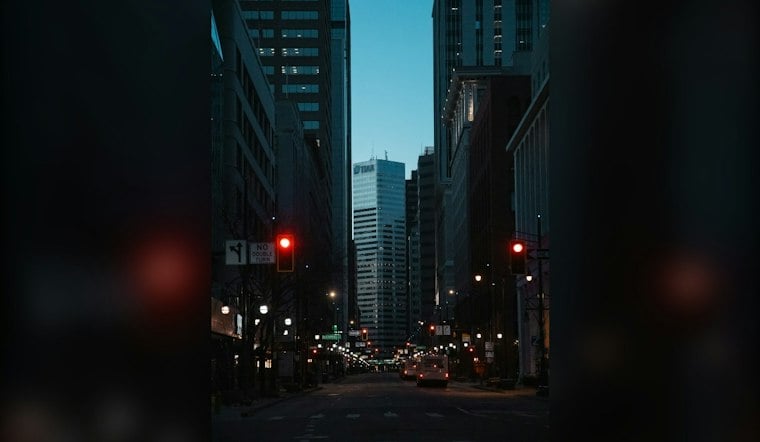
The California landlord that once controlled four historic office buildings across Denver is down to its last one — and now that building is on the market too. Harbor Associates has hired JLL to market the vacant, nine-story Vault building at 821 17th St., a 105,000-square-foot property at the corner of 17th and Champa streets that once served as a WeWork hub before the coworking giant pulled out.
The listing, reported by The Denver Post, describes the Vault as fully unencumbered by existing leases, giving a buyer the option to keep it as office space or pursue an adaptive reuse, residential, or hospitality conversion. Harbor purchased the building for $17.6 million in 2017, and it was the first of four Denver properties the firm acquired between 2017 and 2019, according to the same report. A Harbor executive did not respond to a request for comment, per the Post's reporting.
A Century-Old Concrete Landmark
Built in 1907 as the Ideal Building for cement industrialist Claude Boettcher, the property was the first multistory office building constructed of reinforced concrete west of the Mississippi River, according to History Colorado. Architects Montana Fallis and John Stein designed it using Colorado Portland Cement specifically to showcase the material's structural potential. A 1930s redesign, completed when 17th Street was known as “The Wall Street of the West,” featured Ronnebeck friezes and Thompson murals, according to the Denver Public Library Special Collections and Archives.
Before Harbor bought the property in 2017, it served as headquarters for Colorado Business Bank and was home to The Broker Restaurant, a steakhouse where diners once ate inside the building's original steel bank vaults, according to Bisnow's account of Harbor's 2017 purchase. Local developer NAI Shames Makovsky had completed a full historical restoration of the building in 2001.
WeWork's Exit Left a Big Hole
Harbor leased 40,000 square feet in the Vault building to WeWork in 2018, and that footprint later expanded to 73,000 square feet, according to CoStar data cited in the Post's reporting. WeWork shut down its Vault location in 2021. The coworking company's broader collapse followed its 2023 Chapter 11 bankruptcy filing, during which it sought to reject leases, per Bisnow.
Harbor has since poured $22.4 million into renovations at the Vault, according to JLL's listing, including a new lobby and a redone exterior facade. Eight of the building's nine floors are now fully renovated and move-in ready, per the listing, with furnished spec suites available on floors six through nine. JLL's marketing materials note that the renovated floors offer immediate occupancy without the cost, risk, or timeline of executing a capital program. The listing does not include an asking price, though the Denver assessor values the building at $13.9 million.
A Portfolio in Freefall
The Vault sale attempt caps a rough stretch for Harbor's Denver holdings. The firm bought the Symes Building at 820 16th St. in 2018 and had planned to convert its office space into apartments, but lender Thorofare Capital foreclosed on the property in late January 2026, derailing a planned 116-unit conversion that had conditionally secured $17 million in public loan backing, as Hoodline reported in its February coverage of the foreclosure.
Harbor's 155,000-square-foot Capitol Center complex in Uptown fared little better. Ownership changed hands via a note sale in late 2024 after occupancy dropped to 18%, leading to an online auction in August with bids starting at $1.5 million — a steep drop from the $29 million Harbor paid for the complex in 2018, as Hoodline detailed in its report on the Capitol Center auction. Joon Choi told BusinessDen that a note sale was involved in that ownership change. Harbor also bought a three-building office complex in Greenwood Village in 2019, then sold it in 2025 for nearly 50% less than it paid.
Why Upper Downtown Keeps Bleeding Value
Harbor's struggles reflect a broader reckoning across Denver's central business district. Downtown office vacancy hit a record 38.9% in the first quarter of 2026, with Upper Downtown vacancy exceeding 40% to 46% compared to Lower Downtown's roughly 20% rate, according to The Real Deal. That geographic split has hit older core towers like the Vault far harder than transit-rich LoDo properties.
The pricing resets can be dramatic. Developers acquired two office towers at 621–633 17th St. for just $3.2 million in April 2025 — down from a 2008 valuation topping $100 million — to propose a 712-unit adaptive reuse housing project, according to Developing MyCity. Denver voters expanded the Downtown Development Authority's tax-increment financing district in 2024, establishing a $570 million fund that allocated its first $100 million wave in 2025 to subsidize downtown adaptive reuse conversions, per Usaj Realty. But Harbor's own Symes conversion shows those subsidies can stall out: the project had a conditional DDA award in place, yet still collapsed when private construction financing could not be finalized.





