

























































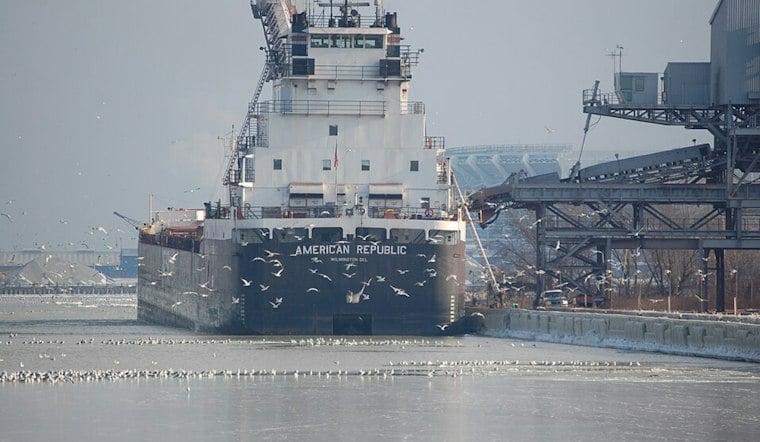
Longshoremen at the Port of Cleveland say they are absorbing the fallout of President Trump's steel tariffs, with union leaders reporting a roughly 30% reduction in manhours since April. The port employs about 120 registered longshoremen who earn a minimum of $36 an hour plus benefits, but the work simply is not there the way it used to be, according to the union representing them.
“We're feeling the hurt because of tariffs,” John Baker, president of International Longshoremen's Association Local 1317, said, as reported by Cleveland.com. Baker attributed the reduced work to tariffs on goods from Canada and Europe, and said dockworkers experienced a 20% reduction in manhours in 2025 before conditions worsened further this year. More than half of Cleveland's general cargo is steel, mostly from Canada and Europe, and that cargo includes coils, tin plate, wire rod, bars, cement, containers and large construction items, per the same report.
The numbers tell the story in ship traffic alone. Cleveland received nearly three general-cargo ships per week in 2022, according to David Gutheil, dropping to 2.4 ships per week in 2023, then 2 per week in 2024, about 1.5 per week in 2025, and only about one ship per week so far in 2026, Cleveland.com reports. General cargo tonnage fell in step, from nearly 405,000 metric tons in 2024 to about 288,000 metric tons in 2025 and just 143,000 metric tons through the first eight months of 2026.
Steel Imports From Key Trading Partners Plunge
The tariff pressure shows up clearly in country-specific import data cited in the report: Canadian steel imports declined 42% for the year ending in July 2026, German steel imports fell 35%, and Dutch steel imports dropped 37%. President Trump used Section 232 of the Trade Expansion Act of 1962, which allows the president to tax imports deemed a threat to national security, to raise the steel tariff to 50% in 2025 after imposing a 25% tariff on steel products during his first term.
Canada responded by imposing its own 50% tariff on U.S. steel earlier in September 2026, and Baker said he opposed that rate even while supporting some protection for the domestic steel industry. Canadian tariffs, however, have had little effect on the Port of Cleveland itself, according to the report.
The trade war's broader reach was underscored last month when the Trump administration announced a 50% tariff on $20 billion of Canadian goods, a move Jason Card of the Chamber of Marine Commerce said would push up the cost of raw materials shipped across the Great Lakes, including road salt and construction cement, according to WCMU. Card added that the auto industry is particularly vulnerable to price shocks tied to those raw materials.
Domestic Steel Producers See a Different Picture
While dockworkers describe a squeeze, the tariffs have been a boon for domestic steelmakers. U.S. steel production is up a little over 5% year-to-date compared with the same period last year, and the industry's capacity utilization stands at 82.3%, per Cleveland.com's report. Kevin Dempsey, president and CEO of the Iron and Steel Institute, credited the tariffs with boosting domestic steel output.
Sue Helper, a professor of economics at Case Western Reserve University's Weatherhead School of Management, said Trump uses tariffs to generate revenue and leverage for trade deals, according to the same account. That dynamic has split the fortunes of Cleveland's port terminals: the general cargo side, dominated by imported steel, has slumped, while the Cleveland Bulk Terminal has seen increased shipments driven by demand for iron ore.
That iron ore ultimately feeds the Cleveland-Cliffs steel plant, which uses ore delivered through the bulk cargo terminal and carried in ships measuring more than 1,000 feet long. The divergence mirrors a wider pattern documented across the Great Lakes-St. Lawrence Seaway system, where tariffs have hit high-grade steel imports even as domestic steel demand props up bulk cargo. According to Seaway Review, the Port of Cleveland handled 3.1 million metric tons of cargo in 2025, with dry bulk making up 75% of the total, and the Cleveland Bulk Terminal performed well in the year's third and fourth quarters thanks to domestic steel demand. The port's revenues stayed strong regardless, port official David Gutheil said, because of numerous Foreign Trade Zone activations that Cleveland uses as a tool to mitigate tariff impacts.
A Seaway-Wide Slowdown, With Some Bright Spots
St. Lawrence Seaway cargo shipments overall were down 6.79% through April 2026 compared with the same period the year before, per Seaway Review, even as iron ore shipments on the Seaway rose 11.81% to 577,000 metric tons over that same stretch. Other Great Lakes ports have reported a similar split: HOPA Ports saw a steep decline in steel imports due to tariffs but still moved 10.8 million metric tons of cargo in 2025, while Ports of Indiana-Burns Harbor handled more than 362,100 metric tons of Seaway cargo that year, with steel products making up more than 72% of its primary cargo.
The Port of Cleveland remains one of only two U.S. Great Lakes ports capable of handling containerized cargo, with more than $105 million invested in infrastructure over the past decade and an annual capacity of 13 million metric tons across steel, containers, bulk cargo and heavy machinery, according to the American Great Lakes Ports Association. Logistec has operated the Cleveland Bulk Terminal since 2017 and the General Cargo Terminal since 2019, per Maritime Magazine. For now, port officials expect ship traffic to pick back up before the St. Lawrence Seaway closes for the season, even as Baker and the roughly 120 longshoremen he represents wait to see whether that seasonal bump translates into steadier paychecks.





