

























































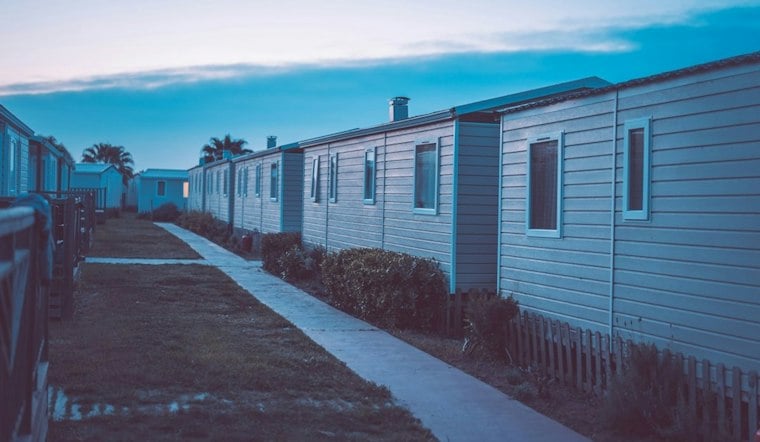
Summit County's median household income sits at $109,000, but its median home now sells for roughly $1 million — a gap so wide that developers and housing officials across Colorado's high country are supplementing traditional construction with mobile-home preservation and deed-restriction purchases to expand affordability. From Eagle County's nearly $1.2 million median sale price to Pitkin County's $1.8 million, mountain communities are increasingly turning to mobile-home preservation and deed-restriction purchases to keep essential workers from being priced out entirely.
Colorado mountain towns have long grappled with high housing costs that keep workers from living where they work, but the imbalance has only sharpened since the pandemic, according to Bisnow. By comparison, Denver's median home sale price hovers around $618,000 — a fraction of what buyers face in Summit, Eagle, or Pitkin counties. Kelly Foote said projects moving forward in Summit County and other mountain communities will need either an employee-housing or market-rate housing component built in from the start, per the outlet's reporting.
Mobile Home Parks Become a Preservation Battleground
Rather than building new units from scratch, the West Mountain Regional Housing Coalition has helped residents raise $16 million in subsidies to preserve affordable mobile-home communities, and it is currently helping preserve a 100-unit mobile home park listed for $23 million, Bisnow reports. The stakes are significant: the Roaring Fork and Colorado River valleys had two mobile home parks with more than 500 members and 140 housing units listed for a combined $42 million in 2025. One mobile home park community has already raised $11.6 million toward a $12 million subsidy goal, according to the outlet.
These preservation deals lean on statutory protections written into Colorado's Mobile Home Park Act, which provides a 120-day opportunity-to-purchase period when a park goes up for sale, according to Justia Law. The coalition has said a large percentage of the Roaring Fork and Colorado River valley workforce lives in mobile home parks, making their preservation central to keeping essential workers in the region, per Bisnow's reporting.
Deed Restrictions Fill the Gap Building Can't
Beyond mobile homes, the coalition's Good Deeds buy-down program contributes 30% of a home's purchase price at closing in exchange for a permanent, price-capped deed restriction, targeting properties priced below $1.5 million in parts of Pitkin County and some neighboring communities, with lower limits of $1.2 million and $800,000 in other areas. Eight local governments in the Roaring Fork Valley formed the coalition to convert market-rate housing into permanently affordable employee homes without new construction, according to Aspen Public Radio. The program has helped purchase 25 homes over the last two years at an average purchase price of $235,000, per Bisnow, and buyers receive deed restrictions that integrate affordability directly into existing market-rate neighborhoods rather than isolating it in a separate development.
The approach has already produced concrete results. A Glenwood Springs hospital nurse became the program's first beneficiary in September 2024, securing a primary residence through the coalition's 30% contribution, according to The Sopris Sun. The case illustrates how buy-down subsidies can serve workers who fall outside other program requirements.
Why Buying Beats Building in the High Country
Brad Hagedorn said land contribution alone no longer makes new housing projects financially viable, Bisnow reports, and the numbers explain why deed restrictions and mobile-home preservation look increasingly attractive by comparison. New affordable housing construction can take five to seven years to reach groundbreaking, according to the outlet, while purchasing a home on the free market can close in one to two months. Mountain communities are also focusing on preserving older 1960s and 1970s housing inventory and Class-C properties that already carry affordability components, rather than starting from bare land.
Part of the pressure comes from who is buying in the first place. Pitkin County homes sold to out-of-towners increased from about 40% before the pandemic to 70% since, per Bisnow's reporting — a shift that has pushed local workers further out of the market even as construction-cost and land-availability obstacles persist for developers who do want to build.
A Patchwork of Funding, Not a Uniform Fix
Money for these efforts varies sharply by jurisdiction. Pitkin County's 1% real estate transfer tax generates more than $25 million annually and funds dedicated affordable housing, but Basalt and Carbondale lack a comparable tax, according to Bisnow. That disparity comes amid Colorado's Taxpayer's Bill of Rights, the 1992 constitutional amendment with voter-approval requirements, according to a 2016 analysis published by DOKUMEN.PUB. Within Aspen city limits, a 1.5% transfer tax splits between affordable housing and the Wheeler Opera House, while unincorporated Pitkin County charges no transfer tax at all, per the City of Aspen.
State-level programs are trying to close some of that gap. Colorado's Proposition 123, approved by voters in November 2022, dedicates 0.1% of state income tax revenue — roughly $300 million annually — to the State Affordable Housing Fund, requiring participating municipalities to commit to a 3% annual increase in their local affordable housing inventory, according to the Colorado Office of Economic Development and International Trade. Colorado lawmakers have introduced SB26-040, which would expand buyer eligibility and adjust financial-assistance caps, per the Colorado Senate Democratic Majority.
Modular Construction Offers a Narrow Path Forward
Where new construction does move forward, modular building has emerged as a way to work around the mountains' short building seasons. SAR+ Architects worked on a $60 million, 332-bed workforce housing complex in Winter Park that broke ground in late 2022 and welcomed its first employee residents in early 2024, according to Bisnow. Modular construction allowed components to be built off-site before winter and stacked together once the snow melted, providing what the outlet described as cost certainty and speed.
But modular isn't a universal fix. Neal Drobenare said Summit County has identified no savings from modular construction versus stick-built methods, per Bisnow's reporting, while modular construction makes more economic sense in Telluride and Aspen, where construction costs run double those in Summit County. The state is nonetheless betting on the approach broadly: Colorado has directed more than $70 million in Proposition 123 funding, alongside separate Innovative Housing Incentive grants, according to Tax Credit Advisor.
Employers Step In Where Government Can't Reach
Some of the largest institutions in the high country have taken employee housing into their own hands. Pitkin County, Aspen Snowmass, and Aspen Valley Hospital have all built and managed their own employee housing, according to Bisnow's reporting. But smaller Roaring Fork Valley employers typically cannot afford to provide housing independently, which is why April Long said smaller employers are increasingly pooling resources to address the problem collectively, per the outlet.
Summit County has an ADU Assistance Program, according to the Colorado Division of Local Government. Together, these overlapping strategies — mobile-home preservation, deed-restriction buy-downs, state modular financing, and employer-pooled housing — reflect a region that has largely concluded it cannot build its way out of the crisis and must instead fight to keep the affordable housing it already has.



