

























































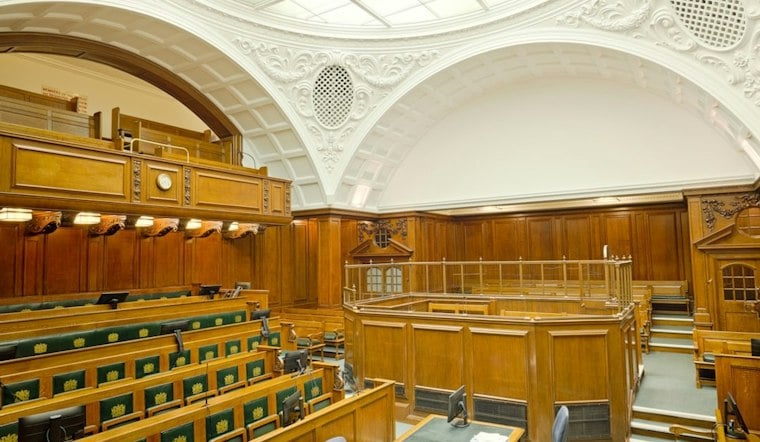
Colorado’s criminal courts have temporarily reversed the state’s default approach to online public access. Chief Justice Monica Márquez’s Chief Justice Directive 26-01 pauses the requirement that qualifying criminal proceedings be livestreamed through Dec. 14, 2026, while allowing individual judges to continue streaming when they consider it appropriate, according to the Colorado Judicial Branch.
That directive creates a direct conflict with Colorado’s 2023 transparency law. House Bill 23-1182 created the state’s real-time remote-observation requirement for open criminal proceedings, subject to case-specific judicial findings supporting a restriction, according to the Colorado General Assembly. The new policy therefore does more than alter courtroom technology: it tests whether the state’s highest court may suspend an enacted access requirement through its own administrative authority.
What the pause changes
The pause concerns one-way livestreaming for members of the public who are observing a proceeding. It does not close physical courtrooms, and it does not eliminate two-way virtual hearings in which participants appear remotely, according to the Judicial Branch’s directive announcement. A judge may still authorize a livestream, but the presumption has shifted from access unless restricted to no livestream unless affirmatively allowed.
The distinction matters because remote participation and remote observation serve different purposes. A defendant, lawyer or witness may need a video connection to take part in a hearing; a journalist or member of the public may want a one-way stream to watch without entering the courthouse. The directive leaves the first category in place while making the second dependent on a judge’s decision.
The Judicial Branch has cited misuse of courtroom video as the reason for the temporary experiment. The Denver Post reported that recordings were edited and rebroadcast on monetized social-media platforms and that online commentary included attacks and threats involving court participants and personnel, according to The Denver Post. The 90-day period is intended to give the court system time to assess safeguards, staff practices and enforcement options; the details of any permanent policy remain unsettled.
A widening statutory framework
Colorado lawmakers expanded the reach of remote observation this year through House Bill 26-1134. The measure requires virtual observation for all in-custody municipal-court proceedings and addresses the prompt resolution of municipal cases, according to the Colorado General Assembly. That expansion means the pause arrives as the legislature is extending, rather than retreating from, the broader idea that members of the public should be able to observe criminal proceedings remotely.
The central legal question is unresolved. The directive asserts that the Colorado Supreme Court’s constitutional authority permits the temporary suspension, while access advocates have questioned whether a judicial directive can override a statute. The Denver Post reported that any challenge would present an unusual problem because the directive came from the state’s highest court and is not ordinarily reviewable by another state court. Whether that position survives a future legal challenge is not established by the temporary order.
Colorado’s approach is unusually open—and unusually unsettled
The federal system provides a contrasting baseline. The Administrative Office of the U.S. Courts says there is generally no remote public access to federal criminal proceedings, although judges may authorize live audio access in certain civil and bankruptcy matters, according to the U.S. Courts. Federal courts have also generally prohibited electronic media coverage of criminal proceedings under Federal Rule of Criminal Procedure 53 since 1946, according to the courts’ historical overview at U.S. Courts.
California illustrates a middle course rather than either extreme. Its courtroom-broadcasting rule creates no presumption for or against permission; a judge must decide whether to allow coverage after considering issues such as privacy, witness safety, jurors and courtroom administration, according to the Judicial Branch of California. In Santa Cruz County, for example, nonconfidential hearings remain open to the public in person, but the court says the public and media have no remote observation option and may not record or take screenshots, according to the Superior Court of Santa Cruz County.
Those comparisons highlight what is distinctive about Colorado’s dispute. The state legislature has attempted to make remote observation a general public-access right, while the judiciary is temporarily restoring judge-by-judge control because of privacy, security and misuse concerns. The Dec. 14 expiration date may bring back the statutory presumption, produce a revised system or leave the underlying separation-of-powers question for litigation.





