

























































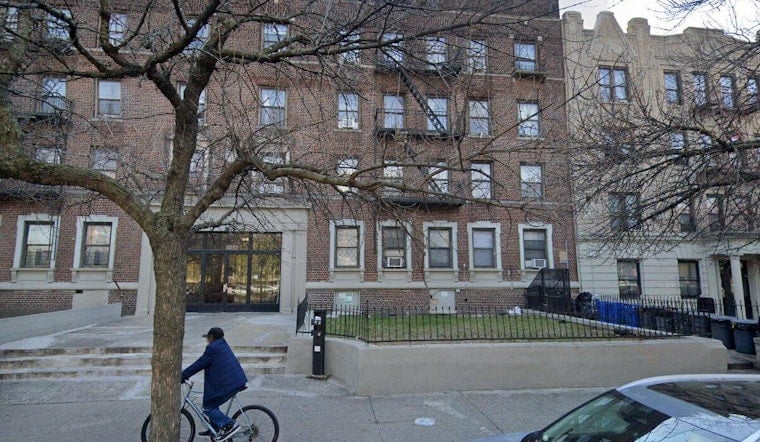
Three rent-stabilized buildings in Crown Heights that racked up nearly 1,000 open code violations under one of the city's most notorious landlords have officially changed hands, capping years of tenant organizing, housing court battles, and city enforcement. The properties — 1018 Eastern Parkway, 1074 Eastern Parkway, and 1392 Sterling Place — have moved to new ownership under real estate investor Mark Schwartz, who also serves as Mayor of Teaneck, New Jersey.
The Mamdani administration celebrated the transfer, according to Bisnow, with the Department of Housing Preservation and Development and the Mayor's Office to Protect Tenants both pledging to work with Schwartz and tenants going forward. Mayor Zohran Kwame Mamdani personally celebrated the deal, and city officials say the agreement with Schwartz commits to rehabilitating all three buildings with tenant oversight, moving toward eventual resident ownership. HPD and the Mayor's Office to Protect Tenants say they will ensure 88 units are rehabilitated as part of the arrangement.
Dina Levy, cited in the same report, said tenants deserved congratulations for finally moving away from a predatory owner. The Dukler Tenant Union, which officially formed in 2025 after tenants began organizing at the three buildings back in 2018, reached its own agreement with Schwartz that tenant advocates describe as a hard-won step after nearly a decade of pushing for repairs and a change in ownership away from the Dukler family.
A Landlord's Long, Documented Record of Neglect
The buildings' troubled history traces back to Rubin Dukler, who died in February 2021; the properties were later transferred. Dukler landed on the New York City Public Advocate's Watchlist of the city's worst landlords twice, ranking 11th in 2017 and 17th in 2019, according to Patch. Separately, tenants cited 561 open housing-code violations in a lawsuit.
In February 2019, 18 tenants across Dukler's Crown Heights portfolio filed a housing court lawsuit citing 561 open building code violations, including lack of heat, vermin infestations, and uncapped radiator valves, according to Legal Services NYC, which also sought court penalties for tenant harassment with support from the city's Anti-Harassment and Tenant Protection program. The following year, HPD brought Dukler to housing court in an effort to force repairs, per Bisnow's reporting.
The financial disputes ran just as deep. In January 2020, 22 rent-stabilized tenants at 1074 Eastern Parkway sued Dukler and management firm Iris Holdings Group for $2 million in illegal rent overcharges, alleging rents had been unlawfully raised for nearly two decades despite a 2002 rent freeze the state Division of Housing and Community Renewal had ordered over uncorrected building-wide defects. Per court records cited by Bisnow, Dukler allegedly ignored that rent-freeze order for years. Iris Holdings had taken over day-to-day operations of all three buildings from Dukler's Rikud Realty in early 2018, a management shift that prompted tenant rallies over fears of gentrification and continued neglect.
How the City's Enforcement Tools Came Into Play
The three properties landed in HPD's Alternative Enforcement Program, a mechanism created under Local Law 29 of 2007 that lets the city select 250 of its most distressed residential buildings each year for mandatory repairs, frequent inspections, and emergency repair fees. According to the NYC Department of Housing Preservation and Development's Alternative Enforcement Program Year 9 Report, buildings are selected based on open violations per dwelling unit and emergency repair activity. The program targets buildings with the most severe violations, and under it the city can step in to make repairs itself and then bill landlords for the cost. HPD says owners who fail to correct qualifying conditions under the Alternative Enforcement Program may face emergency repair charges, liens and significant fees. To be discharged, buildings must correct specified categories and percentages of violations, pay or arrange for fees and charges, and maintain a valid property registration, per NYC HPD.
The scale of the problem extends well beyond Crown Heights. In February 2026, the city designated 250 buildings housing 7,038 units and 54,909 open violations for the Alternative Enforcement Program, with owners collectively owing nearly $4.5 million for city-funded emergency repairs, according to the City of New York. Mamdani has increased enforcement of housing rules more broadly since taking office, per Bisnow, though the city notably does not take over properties outright under the program as of February 2026. Separately, unsafe buildings can also fall under court-appointed administrators through the city's 7A program, and properties with unpaid tax bills may be transferred through the city's Third Party Transfer program and lien sale.
In a separate Brooklyn case, The Legal Aid Society said it filed an Article 7A lawsuit against Food First on 18 Apr 2024 on behalf of six of the nine tenants living at 201 Pulaski.
Unanswered Questions and a Push for New Legislation
Even as officials touted the deal, the city's precise legal role in facilitating or approving the sale to Schwartz remains unclear, and Bisnow reports that new deeds for the properties have not yet been recorded publicly. That ambiguity has fueled renewed advocacy for legislative fixes tenant groups say would make transfers like this one systematic rather than case-by-case.
Arielle Hersh advocated for both the Community Opportunity to Purchase Act and the SAFER Homes Act as tools tenants need going forward, according to Bisnow's report. The Community Opportunity to Purchase Act, reintroduced as Intro 905, would give qualified nonprofits and community land trusts a 20-day window to express interest and 70 days to make a purchase offer before a residential building of four or more units hits the open market — with first right of refusal for certain nonprofits and joint ventures, per the New Economy Project. The bill passed City Council in late 2025 but was vetoed before being reintroduced in May 2026.
Bisnow reported that a community land trust made a historic acquisition of a 21-unit Brooklyn apartment building on 18 Mar 2024, with plans to keep it affordable.
The SAFER Homes Act would expand the definition of distressed properties and allow more third-party transfers going forward, according to City & State New York. The original Third Party Transfer program was paused in 2019 after concerns arose over unfair seizures from small property owners; the SAFER Homes Act would allow more third-party transfers going forward.
New Owner's Own Track Record Draws Scrutiny
Questions also linger about Schwartz himself. Beyond his role as Mayor of Teaneck, New Jersey, Schwartz is a real estate investor whose New York City residential holdings have previously faced local criticism over accumulated housing violations, per the same Bisnow report.
The pattern of disrepair and organizing extends beyond these three addresses. Elsewhere in Crown Heights, HPD recorded 88 tenant complaints and 33 housing violations at 1722 Union Street in mid-2026, alongside 61 open violations at 1245 Eastern Parkway, according to Hoodline's reporting, which documented conditions at the buildings. For the Dukler Tenant Union, the transfer to Schwartz marks a milestone, but with deeds unrecorded and a new landlord's history still under scrutiny, tenants and city officials alike say the real test will be whether the promised repairs and path to resident ownership actually materialize.


