

























































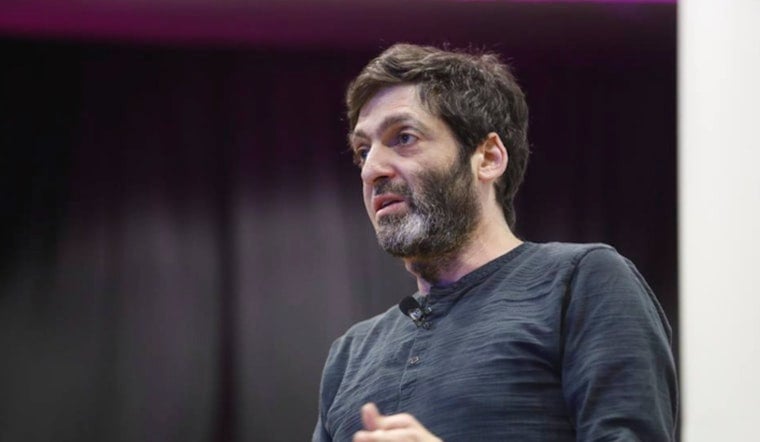
Dan Ariely, the Duke University psychology professor famous for writing about human dishonesty, showed up at Israel's legislature on Monday wearing a pirate hat. He had just landed the No. 3 spot on the Pirate Party's 25-person slate for October's national elections, a symbolic bid given Israel's steep electoral threshold. The appearance came just days after a journal retracted one of his most influential studies and months after his name surfaced more than 700 times in Justice Department emails tied to Jeffrey Epstein.
Ariely founded Duke's Center for Advanced Hindsight and built a career, including the bestseller “Predictably Irrational,” studying why people make irrational decisions and why they lie. According to the Raleigh News & Observer, he communicated with Epstein from 2010 to 2018, and the released emails show Epstein booked Ariely a private tour of the Ferrari factory in 2017. In one exchange described by the paper, Ariely wrote that he wanted to meet a woman again because she seemed very smart, and separately asked Epstein for the name and email of a redhead Epstein had introduced him to.
Ariely has said politics is fun, and told reporters the documentary record about his experiments was insufficient to answer questions raised about them, citing his memory as insufficient after more than two decades and hundreds of experiments. Duke did not answer whether Ariely is still teaching courses there, though the university said it is evaluating potential personnel actions related to the concerns and takes them seriously, per the News & Observer's reporting.
A Second Retraction Lands Days Before the Campaign Launch
On September 2, the journal Psychological Science officially retracted a 2002 paper on deadlines and procrastination that Ariely coauthored with Klaus Wertenbroch, according to Retraction Watch. The retraction followed a failed replication attempt and forensic work by Data Colada, the research-fraud watchdog blog that has now scrutinized multiple Ariely-linked papers. The 2002 study had been cited more than 2,100 times and was considered a foundational text in behavioral economics on self-control and external deadlines, per the same reporting.
Data Colada researchers believed the data for one experiment in the Ariely and Wertenbroch paper were severely tampered with or fabricated, and wrote that they could not generate a benign explanation for all the anomalies they found. Other researchers separately found evidence of data fraud while attempting to replicate Ariely's study, as reported by the Duke Chronicle and cited in the News & Observer's account. Ariely addressed the findings in a statement posted to his own website.
This is not the first time Data Colada has flagged Ariely's work. In August 2021, the blog published evidence that data in a 2012 field experiment on auto insurance policyholders, which argued that signing honesty pledges at the top of forms rather than the bottom reduced fraudulent reporting, had been fabricated, prompting the Proceedings of the National Academy of Sciences to retract the study, according to Data Colada. That 2012 honesty paper was formally retracted in 2021. Then in June 2023, Data Colada reported that a separate experiment within the same paper had also been tampered with, this time by a second individual, revealing two independent instances of data fraud in one publication; the paper's coauthors included former Harvard Business School professor Francesca Gino, who was later subject to a separate misconduct probe at Harvard.
Duke's Internal Review Cleared Him of Falsification, but Faulted His Vetting
Duke's own investigation concluded there was no evidence Ariely had falsified data, but found he should have done more to prevent the tampered data's publication and should have better vetted and preserved his files. Duke has said it is committed to the highest standards of research integrity, though the university has consistently declined to detail faculty personnel evaluations or disciplinary outcomes, citing privacy policy.
Ariely's Epstein connection first drew scrutiny after the Justice Department released roughly 3.5 million pages of FBI investigative files in January under the Epstein Files Transparency Act, in which Ariely's name appeared 636 times in emails spanning 2009 to 2019, according to Poets&Quants. Student journalists at Duke first reported his appearance in the documents, prompting Ariely to publish an op-ed in the Duke Chronicle in February describing his contact with Epstein as infrequent, largely logistical, and often mediated by assistants, while maintaining he had no knowledge of or connection to Epstein's illegal activities.
Fallout Has Already Hit His Publishing Business
The reputational damage has bled into Ariely's commercial ventures. In April, major publishing platforms including Penguin Random House and Amazon canceled pre-orders and pulled listings for his children's book series, “Professor D Takes Control,” following media scrutiny of his Epstein correspondence, according to reporting cited by Poets&Quants. Ariely had launched the series in late 2023 to teach decision-making concepts to young readers, building on the mainstream fame that followed “Predictably Irrational,” his 2008 bestseller that was later adapted into the 2023 NBC drama “The Irrational,” starring Jesse L. Martin.
A Long Shot on the Pirate Party's Ballot
The Pirate Party, which advocates for intellectual property reform and freedom of information, had its 25-person candidate list accepted by Israel's Central Elections Committee on Monday, placing Ariely third on the slate for the 26th Knesset. Israel requires party slates to clear a 3.25% nationwide vote threshold, equivalent to four parliamentary seats, and the Pirate Party is not expected to win any seats in the election, according to the News & Observer. Ariely, who was born in New York in 1967 and raised in Israel, has said politics is fun even as his academic record continues to face scrutiny on two continents. Ariely did not respond to the News & Observer's request for comment before publication.





