

























































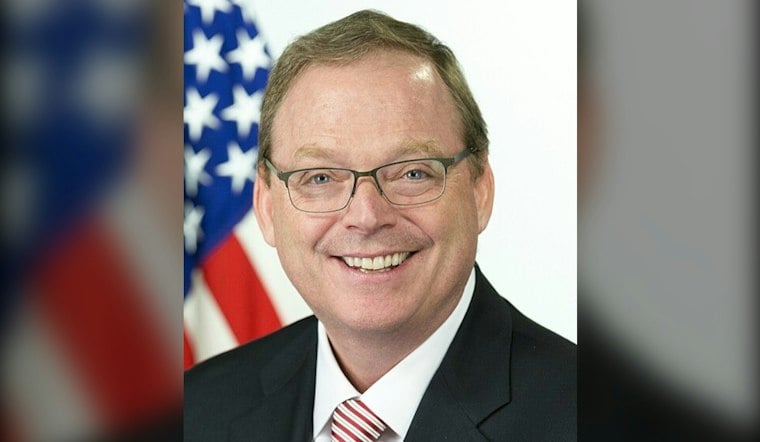
Nearly 11 months into President Trump's second term, National Economic Council Director Kevin Hassett still had not fully divested from Coinbase, the cryptocurrency exchange he formerly advised, even as the administration reshaped federal policy toward digital assets. Hassett reported holding between $1 million and $5 million in vested Coinbase shares at the end of 2025. The available reporting did not establish whether he still held those shares after that point.
The arrangement was first detailed by CNBC, which reported that Hassett advised Coinbase from 2021 until January 2025, when he joined the White House. Separately, according to Crypto News, Hassett served on Coinbase's Academic and Regulatory Advisory Council during that same span, earning more than $50,000 in advisory fees along with vested equity stock options, a role that concluded when he took his current position. The White House has said Hassett is recused from all cryptocurrency-related matters and remains in full compliance with ethical requirements, per the same CNBC report.
Why Recusal Instead of a Full Sale
Hassett has said he received guidance from ethics officials in June 2025 and stayed out of crypto matters while officials addressed his investment, according to CNBC. He also said he had not sold the Coinbase shares because he did not want to create the appearance of timing a sale. Federal conflict-of-interest law under 18 U.S.C. § 208 bars executive branch officials from personally participating in matters that directly affect their financial interests, according to Cornell Law School.
The Office of Government Ethics says a Certificate of Divestiture can allow an appointee to defer capital-gains taxes when selling a conflicting asset and reinvesting the proceeds in permitted property, according to the U.S. Office of Government Ethics. The mechanism is intended to make required divestitures possible without imposing an immediate tax cost.
What the public ethics record shows
The public records cited here do not identify a separate Office of Government Ethics ethics agreement or compliance certification for Hassett describing the Coinbase recusal or a required divestiture. His 2026 annual financial disclosure, posted by the White House, does include an agency ethics official's conclusion that he was in compliance with applicable laws and regulations, subject to any comments in the report: Hassett's 2026 annual disclosure.
OGE says most ethics-agreement actions, including divestitures of potentially conflicting assets, generally must be completed within 90 days of confirmation, while a Certificate of Divestiture can defer capital-gains taxes when proceeds are reinvested in permitted property, according to its 2024 Nominee Guide. A separate OGE-posted agreement illustrates that approach: Katharine MacGregor's March 17, 2025, agreement required her to divest specified interests, including Amazon, Apple and Netflix, within 90 days of confirmation.
Virginia Canter, chief counsel and director of ethics and anti-corruption at Democracy Defenders Fund and a former SEC ethics lawyer, told CNBC that Hassett's Coinbase holding created a major conflict of interest or the appearance of one. A broad crypto recusal could also have sidelined Hassett from a significant part of his job, according to the report, creating the tension between recusal and divestiture at the center of the matter.
A Different Path Taken by Another White House Crypto Adviser
Hassett's situation stands in contrast to that of David Sacks, the White House Special Advisor for AI and Crypto, who chaired the President's Working Group on Digital Asset Markets. Sacks sold all of his personal cryptocurrency holdings before entering government service, according to The Block, and served 130 days in the role before transitioning in March 2026 to co-chair the President's Council of Advisors on Science and Technology.
The digital-assets working group's final report listed Robin Colwell, deputy assistant to the president for national economic policy, as the NEC's representative rather than Hassett himself. Yet Trump's executive order establishing the group, signed January 23, 2025 according to the White House, included Hassett or his designee as a member and required the group's final recommendations to reach Trump through Hassett's office.
An Administration All In on Crypto
The White House established the working group within the National Economic Council three days after Trump took office, part of what the administration has made a major policy initiative. The group's 160-page report, released July 30, 2025, recommended sweeping regulatory changes to digital-asset markets, banking, stablecoins and taxation, proposing a statutory framework passed by Congress in place of prior enforcement-led regulation.
The administration's crypto push has moved on multiple fronts. The SEC dismissed with prejudice its 2023 enforcement lawsuit against Coinbase — which had charged the exchange with operating an unregistered securities exchange and failing to properly register its staking program — in February 2025, according to the U.S. Securities and Exchange Commission. And in March 2025, Trump established a government bitcoin reserve, an initiative detailed by records showing the federal government holds more than 320,000 bitcoins seized through law enforcement actions.
Trump himself reported more than $1.4 billion in income from his family's cryptocurrency ventures in 2025, per the CNBC report. Coinbase CEO Brian Armstrong has met repeatedly with Trump and senior White House officials, attending the White House crypto summit in March 2025, meeting privately with Trump again in March 2026, and returning to the White House in August 2026.
Money, Politics and a Looming Senate Vote
Coinbase was a major financial backer of the Fairshake Super PAC and its affiliates during the 2024 elections. The pro-crypto Super PAC and its affiliate committees raised over $260 million during that cycle and entered 2026 with more than $193 million in cash on hand, according to Axios, with major contributors including Coinbase, Ripple Labs and Andreessen Horowitz. Coinbase has since pledged another $25 million in spending ahead of the 2026 midterms.
That spending arrives as the Senate prepares for a pivotal test. Majority Leader John Thune has scheduled a procedural 60-vote cloture test on the CLARITY Act for Tuesday, according to CryptoSlate, which reports that key Democratic senators have insisted on ethics provisions restricting senior administration officials from profiting off crypto businesses as a condition for support. Armstrong has said the bill was ready for a yes vote ahead of the Senate action, and separately that SEC and CFTC rulemaking would still provide greater regulatory clarity even if the CLARITY Act fails.
Coinbase has a key role in the industry's broader push for a new federal regulatory framework, one that Hassett — even while recused — sits close to as the NEC director whose office the working group's recommendations were required to pass through on their way to the president.



