

























































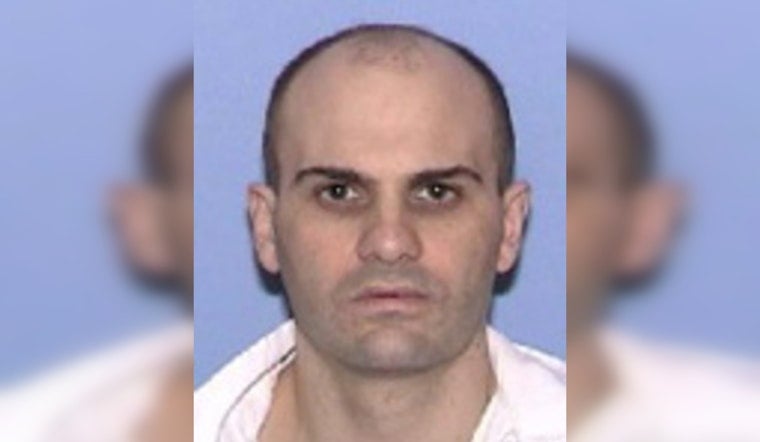
Jeffrey Prible has spent nearly 24 years on death row for the 1999 murders of Steve Herrera and Nilda Tirado, a Houston couple found shot to death in their North Houston home in a fire that also killed their three children from smoke inhalation. Prible was convicted in October 2002 largely on DNA evidence and jailhouse testimony, and he has maintained his innocence throughout. Now the DNA expert whose testimony helped convict him says he got it wrong, or at least that prosecutors twisted what he actually said.
William Watson, the forensic analyst who testified at Prible's trial, filed a declaration on August 28 stating that it is not scientifically possible to determine which of three DNA samples was deposited first, undercutting the state's theory that Prible sexually assaulted Tirado moments before she was killed. According to The Intercept, Watson said he would offer more thorough and nuanced explanations if testifying today, and accused Harris County prosecutors of distorting his conclusions to win a conviction. Watson said prosecutors misrepresented his testimony in opening and closing statements and made inflammatory remarks that distorted both the science and his opinions.
Prible was linked to the crime by DNA from semen collected from Tirado's mouth. Prosecutor Kelly Siegler argued at trial that the semen was evidence of a sexual assault occurring seconds before Tirado was shot, and told jurors there was no innocent explanation for the DNA. Prible told investigators he and Tirado had been having an affair and had engaged in oral sex earlier that evening, a detail his legal team says is consistent with the science Watson now says was misapplied. Per the same reporting, spermatozoa can survive in a living person's oral cavity for up to 15 hours, and longer in a deceased person, according to Prible's legal team.
A Second Expert Calls the Original Testimony Unsupportable
A second DNA expert has since reported that recent scientific advances make Watson's original testimony wholly unsupportable, according to the same account. Texas law, under Article 11.073 of the Code of Criminal Procedure, allows defendants to challenge convictions when new scientific evidence undermines the forensic testimony used against them, a mechanism the State Bar of Texas notes was enacted in September 2013 as the first statute of its kind in the country. Prible has filed a state habeas petition invoking that law, seeking to overturn his 2002 conviction.
Prible's attorney, Nat Lombardo, said the evidence supports Prible's account of what happened that night, and argued that if Prible were tried today, the state would have no case. Prible's legal team has argued that Watson's recantation further undermines a conviction already shadowed by prior findings of prosecutorial misconduct. Vic Wisner, the prosecutor who argued alongside Siegler, had told jurors that Prible forced Tirado to perform oral sex at gunpoint before killing her, a theory that formed part of the basis for his conviction.
A Federal Judge Already Found Misconduct Once
This is not the first time Prible's conviction has been challenged over Siegler's conduct. U.S. District Court Judge Keith Ellison overturned Prible's conviction in 2020, finding that Siegler withheld key information about her dealings with informants from Prible's defense, according to the Houston Chronicle. Federal appeals witnesses testified that informants offered Siegler false evidence against Prible in exchange for help reducing their own sentences, and Siegler's informants cooperated with her under similar arrangements.
Texas appealed Ellison's ruling to the 5th U.S. Circuit Court of Appeals, which reinstated Prible's conviction on procedural grounds in August 2022 without ruling on the merits of Siegler's alleged misconduct, according to Justia Law. The panel held that Prible had failed to exhaust his informant-related claims in state court within required federal deadlines. The U.S. Supreme Court declined to review the case in June 2023, leaving procedural default as the standing federal ruling and his death sentence intact.
The Prosecutor Who Later Became a TV Star
Siegler was an assistant district attorney in Harris County for nearly 22 years, during which she won 19 death sentences across 20 capital trials and maintained a streak of 68 murder convictions without a loss before resigning in 2008. She later became a true-crime television personality, hosting Oxygen's Cold Justice series. Siegler reexamined the evidence in Prible's case before trial and did not respond to a request for comment for the recent reporting.
Siegler's record has drawn scrutiny before. In July 2015, State District Judge Larry Gist cited 36 separate instances of prosecutorial misconduct by Siegler in the 2007 murder trial of David Temple, recommending a new trial because she suppressed evidence favorable to the defense, a finding later upheld when the Texas Court of Criminal Appeals overturned Temple's conviction, according to CBS News. In 2004, the 5th Circuit overturned the death row conviction of Howard Guidry after determining Siegler improperly used an illegally coerced police confession and hearsay during his 1997 trial; Guidry was later retried and reconvicted in 2007.
When Houston police first questioned Prible on April 24, 1999, he voluntarily surrendered his clothing and DNA, and investigators released him without charges due to a lack of physical evidence, accelerants, or a murder weapon linking him to the scene. He was not indicted until two years later, while serving time in federal prison for bank robbery. The state's primary trial informant against Prible was Michael Beckcom, a convicted murderer serving time at FCI Beaumont for killing a federal witness, who claimed Prible confessed to him behind bars in 2001 and received a sentence reduction in exchange for that testimony.
A County With a History Under Scrutiny
A 2016 report by the Fair Punishment Project designated Harris County a national outlier in capital prosecutions, citing a history of overzealous prosecution and repeated Brady discovery violations in death penalty cases; the county has historically accounted for more executions than any other in the United States. That backdrop looms over Prible's case as it now moves through the state habeas process under the junk-science statute.
The Intercept previously reported on Prible's case in a three-part series published in 2023. Prible, for his part, has said his best days in life are still to come, even as his legal team argues that Watson's recantation, layered atop Ellison's earlier misconduct findings, leaves the state's original case against him in tatters.


