

























































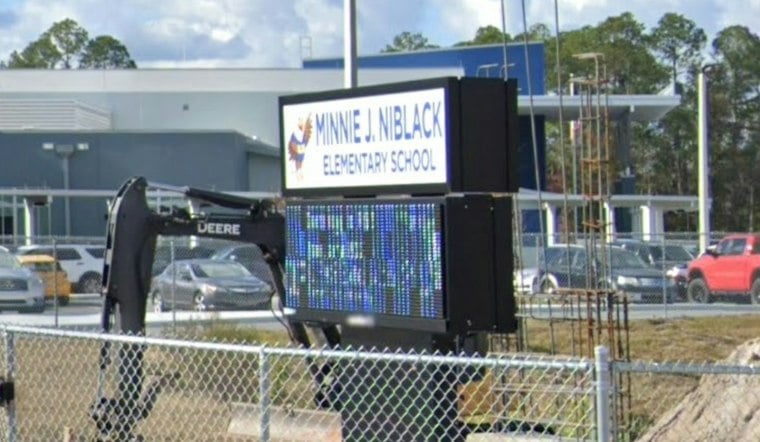
A 12-year-old student at Minnie J. Niblack Elementary School in Lake City was arrested and charged with making electronic threats to carry out a mass shooting after a student in Hernando, Mississippi, reported threatening group-chat messages, News4JAX reported. Investigators told the outlet that the Florida student admitted sending messages describing a planned mass shooting at his school.
According to News4JAX, the case began when a student in Hernando, Mississippi reported receiving threatening messages from the Florida boy in a group chat. The Hernando Police Department then worked with the Columbia County Sheriff's Office over several days, sharing digital evidence across state lines before deputies moved on the tip. That kind of interstate cooperation underscores how easily group chats can connect students across regional and even state boundaries, regardless of where a threat is ultimately meant to land.
According to the News4JAX account, CCSO school resource deputies went to the student's Lake City home on Sept. 11, and his mother consented to a cellphone search. Investigators linked the phone number associated with the messages to the 12-year-old, who admitted sending them. The outlet reported that the messages were sent on more than one occasion and that investigators reviewed firearm images and photographs described as the student's walk to school.
What Investigators Found — and Didn't
News4JAX reported that investigators characterized the threats as verbal and found that the student did not have access to firearms. The student reportedly said the firearm images belonged to an out-of-state family member, and investigators determined he did not intend to carry out an actual shooting. He was nevertheless charged with making electronic threats to carry out a mass shooting.
Florida Statute 836.10 makes transmitting an electronic threat to commit a mass shooting or act of terrorism a second-degree felony carrying up to 15 years in state prison and a $10,000 fine, according to Online Sunshine. The statute does not require a threat to be sent directly to its target; it can qualify when posted or shared where others can see it.
School Threat Reporting and Response
The Columbia County Sheriff's Office praised its investigative partners in the case, which involved Minnie J. Niblack Elementary School.
The arrest comes as officials address youth digital school threats. Officials have leaned on tools like FortifyFL, established by the Florida Legislature under the 2018 Marjory Stoneman Douglas High School Public Safety Act.
Northeast Florida has seen a string of similar arrests this month. Hoodline previously reported that Clay County deputies arrested a 12-year-old after writing a death note listing target names at Argyle Elementary School. Threats made by minors can result in felony charges.
How Common Are Arrests After Threat Assessments?
How often students who undergo school threat assessments face formal law enforcement action remains an important question. Florida requires multidisciplinary threat management teams in public schools to evaluate student risk and determine when law enforcement should get involved.
Whether felony prosecution or behavioral intervention is the right response for pre-teens who make non-credible verbal threats online remains an open question that public awareness campaigns like #ItsNoJoke have not resolved. In Columbia County, law enforcement agencies respond to reports involving local schools and students.
What Florida's Reporting and Juvenile Process Involves
The available state reporting framework is broader than a single school-threat tally. According to the Florida Department of Education, the School Environmental Safety Incident Reporting system collects reports in 26 categories of crime, violence and disruptive behavior occurring on school grounds, on school transportation or at off-campus, school-sponsored events. The Columbia County School District says students, educators, parents and members of the public can also report school-safety concerns anonymously to law enforcement and school administrators through the FortifyFL app or website.
A felony allegation does not by itself determine whether a 12-year-old's case proceeds through court. The Florida Office of the State Courts Administrator's juvenile delinquency benchbook says the State Attorney's Office may refer a juvenile case judicially or nonjudicially, with some nonjudicial referrals diverted outside the court system; the Florida Department of Juvenile Justice also describes diversion and intervention services intended to keep children from progressing deeper into the system. In a separate March 9, 2025, Sanford case, CNN reported that police arrested a 17-year-old after an anonymous tip about a video threatening Seminole High School; police said the weapons shown were extremely realistic Airsoft replicas, making that case different in both the student's age and the reported weapon access.
Officials are urging parents to check what their children post, send, and receive online, to report concerning behavior immediately, and to keep open conversations going about social media use. Anyone with information on this case can contact CCSO at 386-719-2005, or submit an anonymous tip to Crime Stoppers of Columbia County at columbiacrimestoppers.net.





