

























































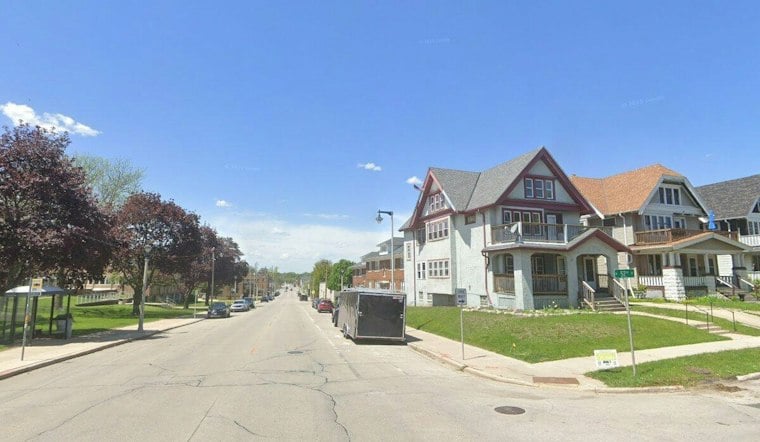
Milwaukee chef Paris Dreibelbis, 35, faces one felony count of strangulation and suffocation and one misdemeanor count of battery over an alleged May altercation with his girlfriend at his West Vliet Street apartment, the Milwaukee Journal Sentinel reported. The allegations are set out in a criminal complaint; a charge is not a finding of guilt.
According to the complaint as described by the Journal Sentinel, police went to the apartment in the 5200 block of West Vliet Street on May 25 after a battery report. His girlfriend told officers that Dreibelbis had slapped and choked her. Officers noted red marks on her throat and bruises on her knees. She alleged that, after drinking, he slapped her, knocked her down and held his hands around the front of her neck for about five seconds, making it difficult to breathe.
Police initially found Dreibelbis asleep on a couch and were unable to wake him, the Journal Sentinel reported. He was not taken into custody during that response. In a later conversation with officers, he reportedly said that both he and his girlfriend had been intoxicated and that he could not remember what the argument was about.
How Wisconsin law treats strangulation
Wisconsin’s strangulation-and-suffocation statute, Wis. Stat. § 940.235, makes the offense a standalone Class H felony. The Van Severen Law Office describes the statute’s maximum penalty as six years in prison and a $10,000 fine. Separately, the Journal Sentinel reported that the maximum exposure across the charges Dreibelbis faces is six years and nine months in prison and $20,000 in fines. Those are potential penalties, not a prediction of the outcome.
The statute took effect in 2008 after Wisconsin enacted 2007 Wisconsin Act 127, according to Gimbel, Reilly, Guerin & Brown. The firm also explains that visible injury is not required to prove the offense; the legal question includes whether a person intentionally impeded normal breathing or blood circulation. These general rules do not establish what happened in Dreibelbis’ case.
Research and statewide figures provide context, not a case prediction
A study by Glass and co-authors, based on the Chicago Women’s Health Risk Study, found lethality in 4.8% of 289 incidents involving partner or ex-partner strangulation, compared with 1.0% of 4,722 incidents involving other violence. The reported association is one finding from that study; it does not predict an outcome in this Milwaukee case or describe Wisconsin cases generally.
Wisconsin’s statewide figures measure a different outcome: the Wisconsin Examiner reported that End Abuse’s 2023 report counted 66 domestic-violence-related homicide incidents resulting in 54 victim deaths. The report’s broader death count also included family members and perpetrators who died in those incidents. Those figures concern fatal cases, not the frequency of nonfatal strangulation, and say nothing about the allegations against Dreibelbis.
Local support
For people seeking help, Sojourner Family Peace Center says it has served as the 24-hour domestic violence hotline for Milwaukee and surrounding communities since 1986. It also offers restraining-order assistance to Milwaukee County residents at the Milwaukee County Courthouse, Room 711, 901 N. 9th Street, according to Sojourner and its restraining-order information.



