

























































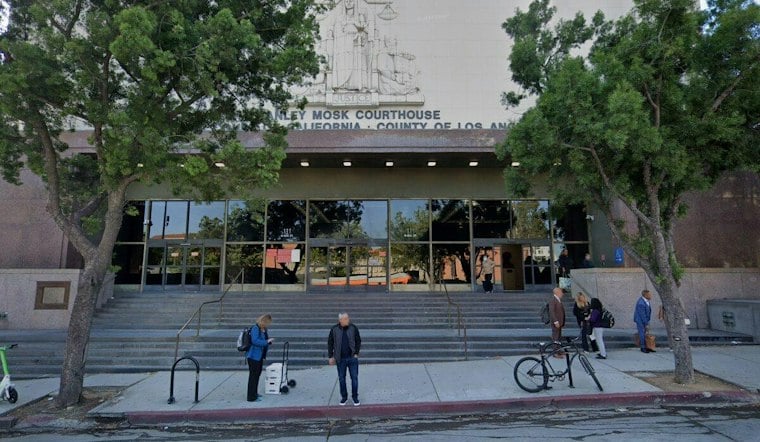
A pilot accused of slamming a flight attendant's hand onto a galley table during a flight bound for Mountain View has lost his bid to escape a California courtroom. Judge William Weinberger denied Stephen Barnhouse's motion to quash the California summons in the lawsuit brought by flight attendant Rosette Aquino, ruling that the factors at play weigh in favor of litigating the case in California.
The lawsuit, filed April 2, alleges Barnhouse grabbed Aquino's right hand and wrist and flung it down onto a galley table as she tried to break free from his grip, according to mynewsla.com. Aquino, who stands 5 feet 2 inches tall, says her wrist struck the table and left her in pain. The alleged assault happened on October 21, 2024, during a flight from Los Angeles International Airport to a federal airfield in Mountain View — widely understood to be Moffett Federal Airfield, which NASA Ames Research Center leased to Google subsidiary Planetary Ventures in 2014 under a 60-year, $1.16 billion agreement, according to NASA.
Barnhouse, who lives in Vero Beach, Florida, and flies for Vista America, argued that defending the suit in California would impose a significant personal and financial burden on him. He acknowledged the alleged attack occurred in California airspace, but contended he should not have to answer for it in a California court. Aquino's attorneys countered that a California court has personal jurisdiction over him regardless of where he resides, and the judge agreed.
Why California Courts Can Claim Jurisdiction
The ruling rests on California's long-arm statute, Code of Civil Procedure Section 410.10, which allows state courts to exercise personal jurisdiction to the full extent permitted by the U.S. and California Constitutions. That means out-of-state defendants can be sued in California when their alleged wrongful conduct happens within the state's territory or airspace, according to Justia Law. Aquino alleges she was assaulted and sustained her injuries in California, which the court found sufficient to anchor the case there even though both Aquino and Barnhouse live in Florida.
Barnhouse is not necessarily out of options. Under Code of Civil Procedure Section 418.10(c), a defendant whose motion to quash is denied has 10 days after written notice of the ruling to petition an appellate court for a writ of mandate before he has to file a formal response to the lawsuit, per FindLaw.
Allegations of a Pattern Toward Female Crew
Beyond the galley table incident, the suit alleges Barnhouse displayed a pattern of hostile and demeaning conduct directed toward female cabin crew, including condescension, aggression and disrespect, according to the suit. The complaint describes Barnhouse leaving the flight deck during the flight, with the first officer taking control, before he entered the cabin. At the time, Aquino was conducting an inventory using her phone before the alleged confrontation occurred; the suit also says Barnhouse began vacuuming and took cleaning supplies from her galley before the altercation.
Aquino was hired by Vista America after previously working for JetBlue as a flight attendant and hostess. Her duties on the charter flight included ensuring safety for crew and passengers, providing service, checking inventory, cleaning the aircraft, and assisting customers with luggage.
Federal Rules Also Cover Cabin Crew Safety
Vista America launched in November 2023 as the primary U.S. flight operations brand for parent company Vista Global, coordinating leased charter aircraft through FAA-licensed carriers Western Air Charter, Inc. and Jet Select, LLC for VistaJet and XO clients, according to Vista Global. Vista Global itself operates private charter aviation services across more than 200 countries and territories, running a global fleet of ultra-long-range Bombardier and Gulfstream aircraft for corporate and high-net-worth clients, per The Business Times.
Federal safety rules add another layer of exposure beyond the civil suit. Under Federal Aviation Regulation 14 CFR § 135.120, which governs on-demand charter and private aviation operations, it is prohibited for any individual to assault, threaten, intimidate, or interfere with crew members performing safety and operational duties. Separately, assaulting, threatening, or intimidating a flight crew member aboard an aircraft in U.S. jurisdiction is a federal crime under 49 U.S.C. § 46504, punishable by up to 20 years in federal prison, according to the U.S. Department of Justice. The current lawsuit is a civil action seeking damages and does not allege that federal criminal charges have been filed.
The Federal Aviation Administration can also assess civil administrative penalties of up to $43,658 per violation against individuals who assault or interfere with aircraft crew members. Through August, the FAA reported receiving 1,163 unruly passenger and flight crew disturbance reports in 2026, resulting in 89 formal investigations and $1.5 million in civil fines, per TravelPulse. Globally, airlines recorded roughly one cabin disruption incident per 355 flights in 2025, according to the International Air Transport Association, underscoring that crew interference remains a persistent operational safety challenge across both commercial and charter aviation.


