

























































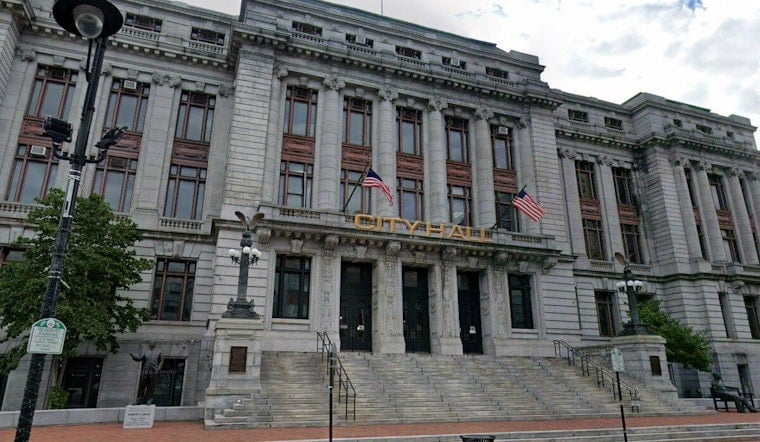
Newark's City Council put the brakes on a 25-year property tax break for a 42-unit residential project planned along Dr. Martin Luther King Jr. Boulevard, voting unanimously to defer the ordinance rather than approve it on the spot. Members of the public cheered when the vote came down, a sign of just how touchy long-term tax abatements have become in a city where most residents rent rather than own.
The project at the center of the fight belongs to 636 MLK Urban Renewal LLC, an entity tied to developer Ascension Capital Partners, which plans to build three four-story buildings totaling 42 units and 11 parking spaces, according to Jersey Digs. Two of the buildings would front MLK Boulevard with 30 apartments between them, while a third, 12-unit building would be accessible from Baldwin Street. The unit mix includes 16 one-bedroom apartments, 17 two-bedroom units, and 9 three-bedroom units, and nine of the 42 units are set aside as affordable housing.
The Newark City Council had already passed the ordinance on first reading back on July 15, but Central Ward Council Member Amina Bey moved to defer adoption before the scheduled public hearing, saying she had not received new information she requested from the city administration in July. Council President Luis Quintana asked that a member of the city administration walk the body through an overview of the deal before any final vote. No new date for the public hearing has been set, per the same report.
What the Developer Would Pay Instead of Property Taxes
Under the proposed PILOT deal, the project would pay an annual service charge rather than conventional property taxes, with the amount set at whichever is greater: a minimum charge or a percentage tied to project revenue. Market-rate units would generate a service charge equal to 10% to 13% of annual gross revenue, affordable units would be charged at 7.5%, and other project components would fall under a 15% rate, according to the Jersey Digs report.
That structure follows New Jersey's Long-Term Tax Exemption Law, which allows municipalities to keep 95% of those service-charge payments while sending just 5% to the county — and nothing directly to local school districts, according to the Transit Friendly Planning Newsletter. That same state law is why developers seeking these long-term exemptions must incorporate as special-purpose Urban Renewal Entities, whose profits and operations are bound by financial agreements with the host municipality, as outlined in a presentation from the Town of Newton. According to AuthoritiesNJ.gov, long-term PILOT payments are awarded under the Long-Term Tax Exemption Law, for which the state provides a standard quarterly-report template. The Town of Newton School District says county or municipal tax-abatement agreements will not directly affect a school district's local tax revenue.
The lot itself has a modest paper trail: it carries an assessed value of $130,000, was sold for $92,000 back in September 1980, and last changed hands for $61,080 in October 2024, per Jersey Digs. The parcel spans more than 17,400 square feet, and the site plan secured a lot-coverage variance along with a parking variance, since the project's 42 required spaces were reduced to the 11 actually planned.
Why Nine Affordable Units, and Who Qualifies
The nine affordable units trace back to Newark's Inclusionary Zoning Ordinance, which requires residential developments of 15 units or more to set aside at least 20% of units for low- and moderate-income households — a rule Newark enacted in 2017, as detailed by NJ Spotlight News. Those units are meant for households earning between 40% and 80% of area median income, per Jersey Digs, but the benchmark used to calculate that income cap is itself under political scrutiny.
Newark's area median income sits at $138,400, the regional HUD figure, while the city's own median household income was reported at $52,060 by the U.S. Census Bureau for 2020–2024. Mayor Ras Baraka introduced a legislative package in August that would recalculate affordable housing eligibility using Newark's local median income of $58,490 instead of the higher regional benchmark, NJ Spotlight News reports — a gap that helps explain why council members are wary of locking in decades-long financial terms before those reforms shake out. Once created, affordable units in Newark must be marketed exclusively to Newark residents during an initial 90-day application window, per the City of Newark, and listed on the city's housing search portal.
A Renter City Watches Closely
The scrutiny lands amid a citywide backdrop that makes tax abatements for private housing a lightning-rod issue. Census tenure data compiled in August 2026 shows roughly 76% of Newark's housing units, or 85,720 units, are renter-occupied, compared to just 24% owner-occupied, according to RentCafe. Average monthly rent in Newark was reported at $1,784, with a 3.7% year-over-year increase, per RentCafe, and more than 58% of Newark renter households are cost-burdened, including 42% who spend more than 30% of their income on housing.
That tension played out publicly in December 2024, when the council approved a 20-year tax abatement for the 216-unit Cosmo 440 redevelopment at 440 Elizabeth Avenue, which carried a reduced 10% affordable set-aside in exchange for developer payments into the city's housing trust fund — a deal that drew sharp pushback over tax subsidies for market-rate housing. The 636 MLK project's own path through city approvals moved faster: Newark's Central Planning Board approved the project's site plan application in August 2024.
For now, the 636 MLK Boulevard project remains in limbo, with no hearing date on the books and Bey's questions about the administration's numbers still unanswered. The unanimous deferral, and the cheers that followed it, suggest Newark's council is in no rush to hand out another quarter-century of tax relief without a clearer public accounting first.





