

























































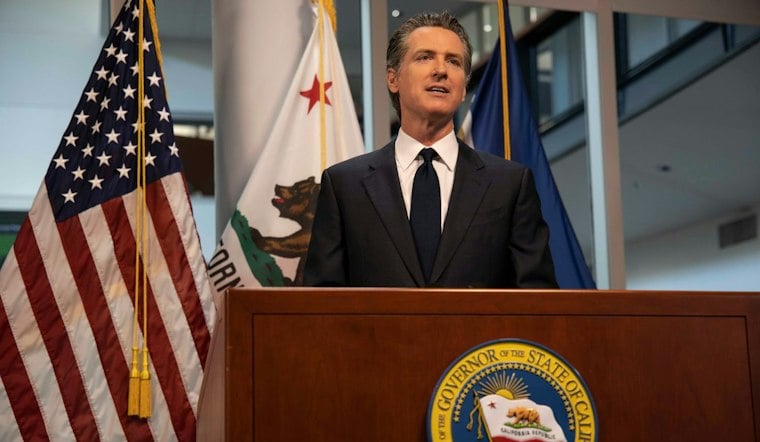
California Gov. Gavin Newsom has until the end of Wednesday to decide the fate of a bill that would bar many former federal immigration officers from landing jobs as police officers, sheriff's deputies, or other public employees across the state. Assembly Bill 1896, nicknamed the GTFO Act, was sent to his desk earlier this month and remains one of several immigration-related measures still awaiting his signature or veto.
What the GTFO Act Would Actually Do
As reported by the Sacramento Bee, AB 1896 would disqualify people who were personally involved in immigration enforcement — including contractors — from being hired by California police or sheriff's departments unless they are approved for the state's basic training course. The bill would also make former immigration officers ineligible for other city and county government jobs, according to the Bee's reporting. Beginning Jan. 1, 2028, the measure would make a person ineligible for California public employment because of prior personal involvement in immigration enforcement as a sworn officer or individual contractor, subject to exceptions, per CalMatters Digital Democracy's bill tracker.
The legislation would require anyone applying to become a police officer, or seeking enrollment in the state's basic training course, to disclose under penalty of perjury whether they previously engaged in immigration enforcement, the Sacramento Bee reports. Lying on that disclosure form would itself count as perjury under the bill. CalMatters' bill tracker adds that hiring agencies would be allowed to weigh news articles, verified social-media posts, and civil-complaint filings when investigating an applicant's background, and that the state's POST commission would have to deny suitability for its basic course to applicants with prior enforcement involvement unless the hiring agency itself grants an exception.
Sponsors Say the Bill Responds to Trump-Era Enforcement
AB 1896 was authored by Assemblymember Mark González of Los Angeles and Assembly Speaker Robert Rivas of Hollister, according to the Sacramento Bee. The two lawmakers said the bill responds to President Donald Trump's effort to rapidly increase deportations through more aggressive operations, and said those operations have resulted in officers killing or seriously injuring protesters and people they were trying to detain, per the Bee's account. González and Rivas said the bill sends a message that people following the Trump administration's orders “are not above the law and have no right to serve people in California,” the outlet reported.
The bill's backers also pointed to a federal hiring spree that offered signing bonuses, student loan payments, and other incentives to fill immigration-enforcement ranks quickly, according to the same Sacramento Bee report — a spree that raised concerns federal officials were lowering standards to fill positions fast. A U.S. Department of Homeland Security spokesperson pushed back, telling the Sacramento Bee that ICE officers stepped up to keep “criminal illegal aliens” off California's streets and that sanctuary-state politicians were casting federal law enforcement as villains while officers were being targeted, threatened, and doxxed for doing their jobs.
Conflicting Accounts of the Training Exception
Exactly how AB 1896 handles exceptions has been described differently across outlets. The bill's sponsor, in a presentation from González's office, described it as disqualifying individuals who engaged in immigration-enforcement activity between Jan. 20, 2025, and Jan. 20, 2029, from state, county, or local public employment, with exceptions for conduct already permitted under SB 54. Separately, the Los Angeles Times reported the bill would allow an exception for officers who are accepted to a police agency and complete the state's basic police training course. The dossier does not resolve how these two descriptions of the exception relate to one another.
Newsom's spokesperson, Diana Crofts-Pelayo, declined to comment on whether the governor planned to veto AB 1896, the Sacramento Bee reported. Spokespersons for González and Rivas did not respond to requests for comment on Newsom's lack of a signature as of Tuesday, according to the same report.
Part of a Larger Immigration Fight
AB 1896 is not the only immigration-enforcement employment bill sitting on Newsom's desk. Senate Bill 938, which Newsom also has not yet acted on, would prohibit former immigration and U.S. Customs and Border Protection officers from using their federal experience to obtain waivers from California's basic training course, per the Sacramento Bee. Another bill, Assembly Bill 1627, would disqualify people who engaged in serious misconduct or had their law-enforcement certification revoked during immigration-enforcement operations from working as police officers or sheriff's deputies — but would not go as far as AB 1896, the Bee reports. The Los Angeles Times separately reported that a bill blocking police and other officers from taking second jobs or contractor work with federal immigration enforcement was also awaiting Newsom's decision as of Tuesday.
Newsom announced he had signed more than 20 bills intended to protect immigrants and push back against enforcement actions driven by the Trump administration, according to the Sacramento Bee. Among the measures Newsom has already signed is a law prohibiting federal agents from becoming police officers in California if their federal badge was revoked for misconduct, the Los Angeles Times reported. The broader package Newsom signed also included a ban on law enforcement's use of electric shock gloves, restrictions on using state property for immigration operations, and new taxes on detention centers, according to POLITICO.
“California is taking action to strengthen transparency, accountability, and oversight around immigration enforcement in our state,” Newsom said, according to POLITICO's report. The governor also said, per the Sacramento Bee, that California would make clear that if the federal government operates in the state, it would hold it accountable. Critics have argued that some of the bills might not survive legal challenges, according to the Los Angeles Times.



