

























































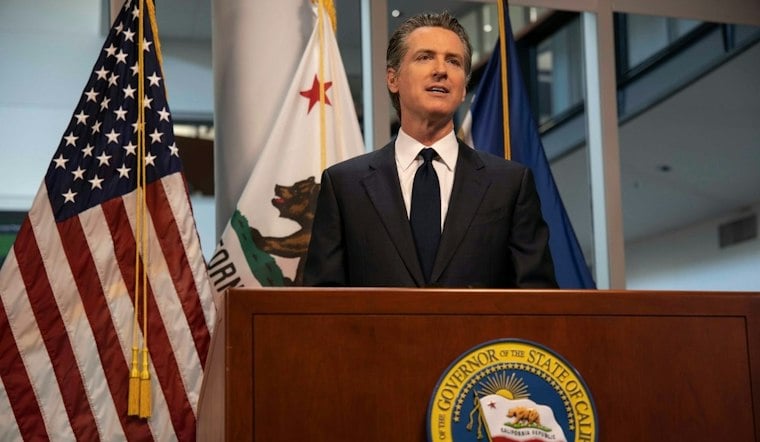
California companies will now be required to disclose when they use artificial intelligence-generated actors to sell a product or service, after Gov. Gavin Newsom signed Senate Bill 1050 into law. The signing took place at the Los Angeles headquarters of SAG-AFTRA, the union representing film and television performers.
As reported by The Sacramento Bee, the new law, known as the Advertisement Integrity Act, adds AI performers to California's existing list of deceptive marketing practices, which are currently classified as a misdemeanor under state law. Newsom said the measure boils down to a simple principle of honesty in advertising. “Californians deserve to know when the person selling them something is not a person,” he said, according to the Sacramento Bee's report.
What the Law Actually Requires
SB 1050 requires that synthetic figures used in advertisements be labeled as synthetic, according to the Sacramento Bee. The bill was sponsored by state Sen. Angelique Ashby, who represents Sacramento, and was presented on her behalf during a legislative hearing earlier this year. During that hearing, the measure was described in detail as requiring advertisements using AI-generated performers to include a disclosure when the performer is not real, according to CalMatters Digital Democracy's coverage of the proceedings.
The hearing record describes synthetic performers as humanlike digital figures that convincingly appear, speak, move and act like real people, per CalMatters Digital Democracy. SAG-AFTRA identified itself as a sponsor of the bill and helped write it, according to the Sacramento Bee. The union's National Executive Director and Chief Negotiator, Duncan Crabtree-Ireland, has been among the voices pressing for the measure.
Union and Lawmaker Reaction
SAG-AFTRA said the law is intended to protect consumers from deceptive AI practices while also safeguarding human creativity and consent, and that it gives consumers greater transparency when they encounter synthetic rather than human performers, according to the Sacramento Bee. During the June hearing, the union framed the stakes in blunt terms: “It's about protecting consumers when the image or voice trying to convince them to buy a product is not real,” a SAG-AFTRA representative told lawmakers, per the same CalMatters Digital Democracy hearing transcript.
Ashby called the law a victory for Hollywood workers who have lost job opportunities to synthetic performers, and said it provides important protections for California's creative economy, according to the Sacramento Bee. Hollywood talent had pressured Newsom to support AI security and safety-reporting requirements more broadly, the Sacramento Bee reports, and the governor has signed a number of AI bills in recent years as lawmakers have begun to consider more guardrails around the technology.
Industry Pushback During Hearings
Not every group welcomed the bill as written. TechNet opposed SB 1050 unless amended, telling lawmakers during the June hearing that it wanted disclosure requirements tied specifically to material deception rather than applied broadly, along with additional enforcement safeguards, according to CalMatters Digital Democracy. The Motion Picture Association raised a similar objection, arguing that the bill as drafted would require labeling for all ads using synthetic performers rather than limiting the requirement to advertisements that actually mislead consumers, the hearing record shows.
How California's Approach Compares to New York's
California is not the first state to take on this issue. New York became the first state in the nation to require businesses to label AI-generated actors in commercial advertisements, according to A&F Law. That state's synthetic-performer law took effect June 9, requiring covered ads to include a clear and conspicuous disclosure, as detailed by Honigman. New York's law defines synthetic performers as digitally-created media that appear as a real person and applies to advertisements in any medium, according to CT Mirror.
New York backs its disclosure rule with real money on the line, imposing a $1,000 penalty for a first violation and $5,000 for each subsequent violation, per A&F Law. Since the law took effect, four complaints alleging undisclosed AI use in advertisements have been filed and were under review by the state attorney general's office, according to Mashable.
CT Mirror notes that New York's law is one of many proposed or enacted across U.S. states aimed at boosting job security for human workers or curbing privacy and safety risks tied to artificial intelligence. Honigman similarly suggests New York's measure likely will not be the last state law addressing AI's role in advertising, a prediction California's new signing now appears to bear out.



