

























































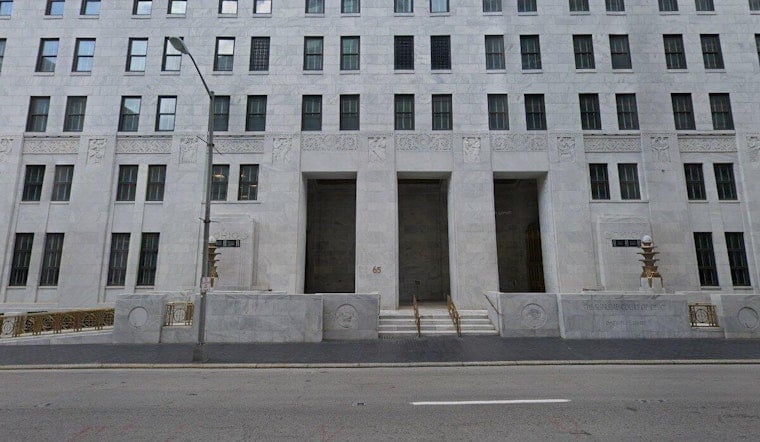
Ohio's Supreme Court has unanimously held that the current versions of state laws restricting how businesses can contact crime and accident victims stand, reversing a 2024 ruling from Cleveland's Eighth District Court of Appeals that had struck the provisions down. The decision did not determine whether the original 2019 Ohio budget provisions complied with the Ohio Constitution's one-subject rule. Issued August 27, it means restrictions on soliciting accident victims and rules shielding certain phone numbers from public records will remain in effect, even though the case now heads back to the Eighth District for unresolved questions.
The fight traces back to 2019, when lawmakers tucked victim-contact provisions into the state's operating budget bill signed by Governor Mike DeWine that July, according to the Ohio Legislative Service Commission. A group of Northeast Ohio chiropractic practices — First Choice Chiropractic LLC, Prestige Chiropractic & Injury LLC, and Allied Health & Chiropractic LLC — along with patient referral service Schroeder Referral Systems Inc., sued in Cuyahoga County Common Pleas Court before the provisions took effect in October 2019, according to Courthouse News. As Cleveland.com reports, the businesses argued that lawmakers violated Ohio's constitutional one-subject rule by burying the restrictions inside an unrelated budget bill.
That one-subject rule, found in Article II, Section 15(D) of the Ohio Constitution and dating back to the state's 1851 constitution, is meant to stop legislators from bundling unrelated policies into a single bill, according to Cleveland State University's College of Law. The original 2019 law barred direct contact with motor vehicle accident parties, crime victims, or witnesses for 30 days, generally requiring any solicitation during that window to go out through the U.S. mail. It also let the Ohio attorney general fine violators $5,000 for a first offense and $25,000 for subsequent violations, per the seed reporting.
Years of Litigation Over a Budget-Bill Origin
The Cuyahoga County court sided with the businesses early on, issuing a preliminary injunction in July 2020 that halted enforcement of the solicitation restrictions before granting the plaintiffs full summary judgment in June 2023, according to Court News Ohio. A Cuyahoga County judge ruled the provisions violated the one-subject rule, and the Eighth District Court of Appeals upheld that conclusion in May 2024. The appeals court reasoned that later legislative amendments could not retroactively validate provisions that were unconstitutionally enacted in the first place.
While that litigation dragged on, lawmakers didn't leave the underlying statutes untouched. According to the seed reporting, the original contested provisions were repealed and replaced with amended language through House Bill 151, enacted in 2020. Lawmakers also amended the public-records provision twice while the case was pending: House Bill 110 changed it in September 2021 by separating crime victims and witnesses from people involved in motor vehicle accidents, and Senate Bill 284 created an exception in March 2021 allowing insurers and insurance agents investigating accident claims to obtain otherwise shielded phone numbers.
What the Current Law Actually Allows
The version of the solicitation law now in effect permits one phone contact during a 48-hour window beginning 24 hours after an accident, plus one contact each by email, text message, and mail, per Cleveland.com's reporting. It prohibits in-person solicitation altogether, exempts certain previous customers from its restrictions, and retains the 30-day restriction for crime victims and witnesses who were not parties to a motor vehicle accident. Rather than the attorney general levying fines directly, the current law requires the relevant professional licensing agency to hold proceedings and suspend a license after three separate violations.
On the public-records side, the current statute excludes phone numbers for crime victims and witnesses listed in law-enforcement records from public disclosure, with the exemption for motor vehicle accident phone numbers ending on the 30th day after the accident. A new version of the public-records statute taking effect this month leaves those phone-number provisions unchanged.
Similar concerns about access to accident information have surfaced elsewhere. According to the Michigan Legislature, House Bill 4770 would restrict access to a motor vehicle accident report for a period of 30 days after the accident to certain listed individuals.
Supreme Court Sides With the State, Reverses Cleveland's Appeals Court
Writing for the unanimous court, Justice Megan Shanahan held that the later amendments changed the very language the plaintiffs had originally challenged, meaning a defect in the 2019 budget bill does not by itself render the later, standalone versions void. Chief Justice Sharon L. Kennedy and Justices Fischer, DeWine, Brunner, Deters, and Hawkins all concurred, according to the Supreme Court of Ohio's slip opinion. The court ruled that constitutional challenges to the two laws must now focus on their current versions rather than the original budget-bill text, and notably, the plaintiffs had not challenged the later amendments themselves under the one-subject rule.
The high court's reasoning focused on the effect of later amendments on the challenged language. A separate federal challenge to the 30-day solicitation restriction had already failed years earlier: the U.S. Court of Appeals for the Sixth Circuit upheld the restriction in August 2020 in First Choice Chiropractic v. DeWine, according to Justia Law. That left the one-subject procedural argument as the plaintiffs' last real avenue of attack.
What Happens Next in Cleveland's Appeals Court
The Ohio Supreme Court sent the case back to the Eighth District, which will now consider the state's remaining arguments involving class-action certification and the preliminary injunction that had been in place for years. Those questions were not resolved by the high court's ruling, meaning the scope of who could be covered by any class action, and the exact parameters of the injunction, remain open for the Cleveland-based appeals court to sort out. For now, though, the statewide restrictions on contacting accident victims and the public-records exceptions shielding certain phone numbers stand as enforceable law.





