

























































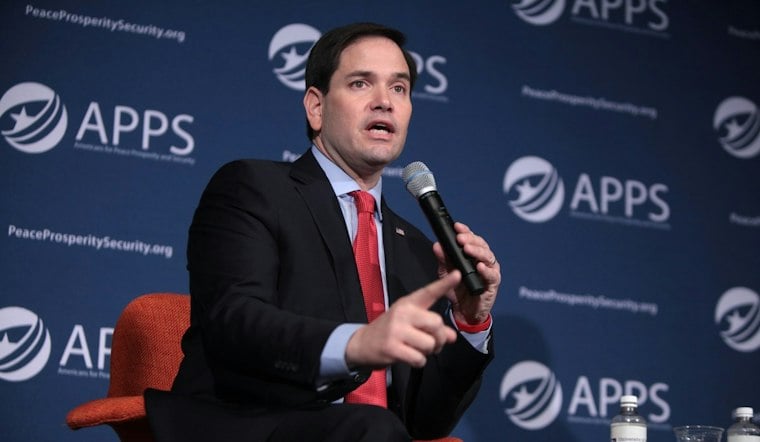
Secretary of State Marco Rubio said Tuesday that Iran's fingerprints are visible on the Houthi missile and drone barrage that slammed into Saudi oil infrastructure and civilian sites across four southern cities, injuring 73 people as crude prices surged toward $100 a barrel. The attack struck Abha, Jazan, Najran, and Khamis Mushait, setting fires at Saudi Aramco's Jazan refinery and a distribution center in Abha.
“The Houthis are agents and proxies of the Iranians, and some of these attacks clearly involve an Iranian hand,” Rubio said, according to WOAI. He added that the Trump administration was tracking developments very closely. Rubio made the remarks days after delivering an address at the Foundry School launch event at the U.S. Institute of Peace in Washington on September 3, a national program the administration describes as training skilled workers to help rebuild American manufacturing, launched under the State Department's Pax Silica initiative in partnership with Stanford University, according to Jewish Insider.
Houthi military spokesperson Yahya Saree, a brigadier general, claimed responsibility for the attacks in a video statement, warning that the strikes are not over and that operations will continue deep inside Saudi Arabia and target its military until what the Houthis call the aggression stops and the siege is lifted. Saree said the barrage renewed threats to the Red Sea and threatened the security of maritime navigation there, the same WOAI report notes.
Saudi Arabia Demands an End to the Escalation
Saudi Arabia's Ministry of Foreign Affairs confirmed that the Houthi strikes on energy infrastructure injured 73 civilians, including women and children, and warned that continued attacks on civilians and civilian facilities could carry consequences. The ministry called for an immediate halt to all forms of Houthi escalation as Saudi oil facilities sustained damage from the fires.
The strikes landed just two days after U.S. Central Command forces struck and disabled three Iranian oil tankers near Kharg Island, off Jask, and in the Gulf of Oman, after Iranian forces fired ballistic missiles at U.S. warships, according to The Washington Post. Hoodline previously reported on those tanker strikes, which were carried out under what officials called a tanker-for-tanker doctrine authorized by the military earlier this month.
Iran Threatens a New Exclusion Zone Near Hormuz
Iranian Supreme National Security Council Secretary Mohsen Rezaei said Iran will use new missiles to preempt threats and that Tehran will announce a restricted maritime exclusion zone outside the Strait of Hormuz in the coming days and weeks. Rezaei said the zone would begin at the line of the U.S. naval blockade and extend toward the strait and into the Persian Gulf, framing it as a response to economic warfare with a maritime exclusion zone across the Gulf to the blockade perimeter.
Rezaei also said Iran's operational posture toward U.S. warships and bases has been fundamentally recalibrated, and the Iranian regime has threatened to extend its grip beyond the Strait of Hormuz. Separately, Rezaei announced on September 6 that Tehran and Oman had agreed on a new international shipping corridor through the strait, with entry and exit points controlled by Iranian authorities, according to Al-Monitor. Maritime tracking data cited by The National showed commercial shipping traffic through the Strait of Hormuz had dropped to its lowest level since May, averaging roughly 10 commodity vessels a day by September 7 — a chokepoint that normally handles about 20 percent of global petroleum liquids. According to the U.S. Energy Information Administration, about 20% of global liquefied natural gas trade transited the Strait of Hormuz in 2024, primarily from Qatar. According to the U.S. Energy Information Administration, Saudi Arabia accounted for 38% of total crude flows through the Strait of Hormuz in 2024, or 5.5 million barrels per day.
Washington Escalates Its Sanctions Campaign
The U.S. Treasury announced a new batch of sanctions Tuesday targeting Iran's aviation industry, with the Office of Foreign Assets Control designating 36 targets tied to Mahan Air front companies and foreign intermediaries while suspending three commercial aviation authorizations, according to the U.S. Department of the Treasury. The action falls under Operation Economic Outcast, the pressure campaign Treasury Secretary Scott Bessent formally launched on August 24 by expanding secondary sanctions under Executive Order 13902 to cover Iran's aviation, digital assets, gold, shipping, and technology sectors, per Gibson Dunn.
Bessent warned that businesses dealing with Iran's remaining airlines risk being cut off from the global financial system. Days earlier, on September 4, Treasury sanctioned Türkiye-based Golden Global Bank and its subsidiaries under the same operation for facilitating tens of millions of dollars in correspondent banking transactions for the IRGC-Qods Force. Iranian Foreign Minister Abbas Araghchi dismissed the new sanctions as ineffective, saying Washington responded to failed sanctions or war by imposing more sanctions.
A Government Accountability Office report dated February 25, 2013, said that laws and executive orders had expanded the Treasury Department's authority to implement financial sanctions against Iran. According to the Government Accountability Office's GAO-10-375 report, some cases involved efforts to ship goods to Iran through intermediaries in other countries.
A Wider Pattern of Pressure and Retaliation
The sanctions and strikes fit a pattern Hoodline has tracked for months. In May, the State Department sanctioned three Chinese commercial satellite firms — Meentropy Technology, The Earth Eye, and Chang Guang Satellite Technology — for allegedly providing Iranian forces with geospatial imagery used to plan attacks on U.S. military bases, as Hoodline reported at the time. And in February, Rubio formally designated Iran as a State Sponsor of Wrongful Detention, the first nation to receive that label, authorizing specialized sanctions, visa restrictions, and passport limitations under a September 2025 executive order.
Brent crude traded close to $100 a barrel Tuesday as the twin shocks of direct military strikes and threatened blockades rattled energy markets. Whether Washington's sanctions campaign against foreign intermediaries — from Turkish banks to Chinese satellite operators — can isolate Tehran, or whether it will instead accelerate the kind of asymmetric retaliation seen in Saudi Arabia this week, remains an open question hanging over the region.



