

























































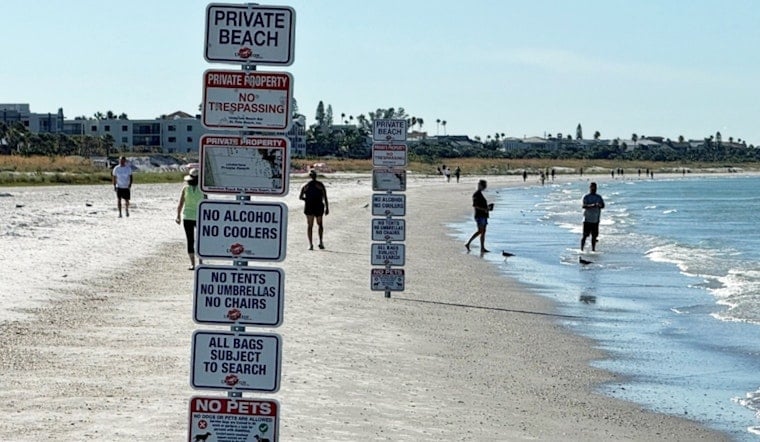
A stretch of sand south of St. Pete Beach's public beach has turned into a full-blown federal court battle, with a hotel owner and a neighboring bar suing the city over its ban on permanent private-property signs near the waterline. The dispute has pulled in decades-old Florida property law, a controversial mothball-scattering criminal case, and beachgoers who just want to know where they're allowed to lay their towels.
The lawsuit centers on Ordinance 2026-11, which the St. Pete Beach City Commission approved in June 2026 to establish a 50-foot Gulf-front buffer barring permanent sign structures, posts, and stakes, while still allowing temporary, removable A-frame signs outside that buffer, according to St. Pete Catalyst. Under the rules, property owners cannot put up permanent private-property signs within 50 feet of the waterline, though hotels can still use temporary removable signs during the day to mark off private guest areas. Plaza Beach Motel LLC and Undertow Beach Bar jointly filed the federal suit, arguing the sign ban violates their First Amendment rights and makes it harder to identify private property or enforce trespassing rules, according to WUSF.
As Tampa Bay 28 reports, the Plaza Beach Hotel owner sued the City of St. Pete Beach specifically for the right to keep private-property signs up, and the case is now headed to federal court with no trial date yet scheduled. Beachgoer Stephen Pruitt told the outlet he recently observed cones and a sign marking off part of the beach as private, a scene he said he found troubling. Pruitt, who said he's visited St. Pete Beach every year since he was 10 years old, starting in 1967, said he'd never seen anything like this dispute before. He called the beach a national treasure he wants to preserve, adding that he believes people should be able to live together next to the public beach and hopes visitors can enjoy the shoreline regardless of obstacles.
City Leans on a 1970s Legal Precedent
Not everyone on the sand is bothered by the standoff. Beachgoer Keith Loescher told Tampa Bay 28 the blocked-off area didn't concern him personally, since people could still walk along the rest of the beach. The city, for its part, has said blocking the beach creates a public safety hazard and obstructs a path used by beachgoers for years, per its own statements cited by Tampa Bay 28.
In its August 19 federal court answer, St. Pete Beach filed a 20-page response leaning on the customary-use doctrine, which holds that the public may retain access to dry sand a hotel owns by deed if that sand has been used peacefully and continuously by the public for generations. The city cited the 1974 Florida Supreme Court case City of Daytona Beach v. Tona-Rama, Inc. as its primary precedent, according to The Gabber Newspaper. That 1974 ruling established that ancient and uninterrupted public recreational use can create public access rights that can't be revoked. To build its case, the city launched a public evidence-gathering effort in August 2026, asking residents for historical photos and records documenting long-term recreational use along the half-mile stretch of shoreline south of the public beach, the paper reports.
Where Wet Sand Ends and Private Property Begins
Florida's constitution complicates the picture further. Under Article X, Section 11 of the state constitution, public ownership automatically extends to wet sand seaward of the mean high-water line, while dry sand above that line can be privately owned unless a court has declared customary public rights over it, according to a legislative analysis posted on FLSenate.gov. The legal landscape shifted further when Florida lawmakers passed Senate Bill 1622, repealing 2018's HB 631 and restoring local governments' authority to pass customary-use protections for dry sand, as Sarasota Magazine reported. That earlier law had forced cities through lengthy court processes before they could enforce public beach rights, making the current fight one of the first tests of the restored authority.
A Separate Criminal Case Shadows the Lawsuit
The federal sign dispute isn't the only legal trouble facing the hotel's ownership. Plaza Beach Hotel owner Robert Czyszczon was arrested in July 2026 for scattering roughly 1,500 mothballs along the beach, according to Tampa Bay 28. Florida Fish and Wildlife Conservation Commission officers arrested Czyszczon and neighboring bar owner Christopher Monroe on July 29, charging both with felony commercial littering for economic gain and misdemeanor harassment of a state-listed threatened species, per St. Pete Catalyst's earlier reporting. FWC suspected the mothballs, which contain chemicals toxic to coastal wildlife, were scattered to keep birds from nesting on the sand.
Investigators tied the two men to the scattering through Walmart purchase receipts, surveillance video, cellphone tower data placing them at the beach, and text messages expressing intent to stop shorebirds from nesting behind the hotel, according to Beacon Media. Pinellas County beaches support roughly 10% of Florida's total nesting population of black skimmers, a state-listed threatened shorebird that lays its eggs directly in shallow scrapes on open sand, per WUSF. Coastal development and beach disturbance are considered the primary threats to the species' survival in Florida.
The fallout from the arrest has followed Czyszczon well beyond the courtroom. He filed an emergency motion in Pinellas County court on August 4 asking that his contact information and home address be shielded from public records, citing death threats he received after his arrest, The Gabber Newspaper reported. It's a sign of how heated the broader fight over St. Pete Beach's sand — who can fence it off, who can walk it, and who gets to decide — has become, even as the federal sign lawsuit and the criminal mothball case wind through court on separate tracks.
For now, the ordinance stands, the federal case has no trial date, and beachgoers like Pruitt and Loescher are left to navigate a stretch of shoreline where the line between public and private sand is still being drawn — in court.
Hoodline previously reported on the mothball mystery before arrests were made, and on the city's ongoing debates over funding coastal infrastructure fixes and managing beach parking pressures.





