

























































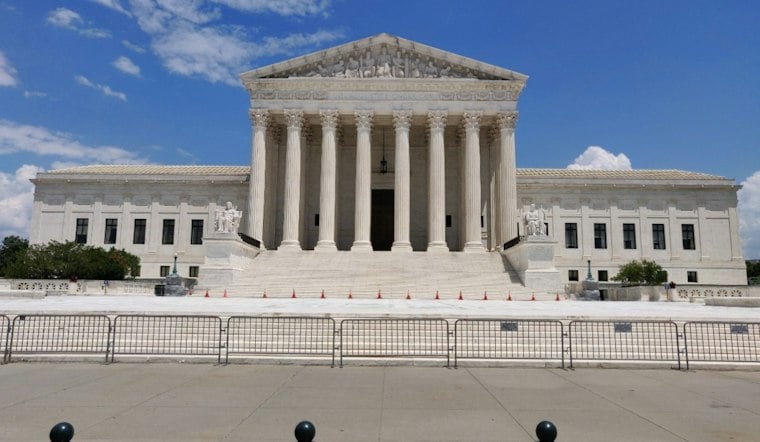
The Supreme Court cleared the way Tuesday, September 29, 2026, for the Trump administration to resume swiftly deporting migrants to countries other than their own, temporarily blocking a lower court ruling that had required advance notice and a chance to raise fear-based claims before such removals. Three justices dissented sharply from the order, warning it could expose people to persecution, torture, or death.
The apparent 6-3 order halts, for now, a ruling from the 1st U.S. Circuit Court of Appeals that had gone into effect just days earlier. Justices Sonia Sotomayor, Elena Kagan, and Ketanji Brown Jackson dissented from the decision, with Sotomayor warning that executing rapid third-country removals without notice risks subjecting migrants to persecution, torture, or death, according to NBC News. The high court has also agreed to hear arguments on whether migrants must have a meaningful chance to object before being sent to countries where they have no ties, as reported by the Associated Press.
A Legal Fight Rooted in a 2025 Class Action
The dispute traces back to *D.V.D. v. Department of Homeland Security*, a 2025 class-action lawsuit brought by noncitizens with final removal orders who said they were being deported to countries where they had no prior connections and no real chance to seek protection, per Wikipedia's summary of the case. Plaintiffs argued the practice violated both the Due Process Clause and the Convention Against Torture.
On September 18, a unanimous three-judge panel of the 1st Circuit ruled that DHS's third-country removal guidance violated federal due process by denying migrants advance notice and an opportunity to present fear-based claims, according to the same Associated Press report. Writing for the panel, Judge Seth Aframe stated that a migrant's statutory right to contest removal based on fear of persecution is meaningless without prior notice of their intended destination, a point Reuters highlighted in its coverage of the ruling.
DOJ Moves Fast After Late-Night Order
The 1st Circuit's decision did not sit dormant for long. After the appeals court issued a late-night order on September 23 putting its ruling into effect, Attorney General Todd Blanche announced the following day that the Department of Justice would appeal to the Supreme Court, calling third-country deportations an essential enforcement tool, according to The Guardian.
Federal attorneys told the justices that the appeals court's injunction had already forced DHS to cancel a deportation flight carrying about 70 people bound for three African countries, underscoring how quickly the legal back-and-forth translated into halted logistics on the ground. The AP report notes that the case had already reached the Supreme Court once before, when the justices allowed deportation flights to temporarily continue while the litigation proceeded.
25,000 Deportations to More Than Two Dozen Countries
Since January 2025, the Trump administration has deported roughly 25,000 people to more than two dozen countries, sending the vast majority to Mexico, per the Associated Press. The removals extended far beyond neighboring nations, reaching at least 29 third countries, including South Sudan and the Central African Republic.
Internal DHS guidance established in March and July of last year allowed ICE to carry out third-country removals with as little as 24 hours' notice, relying on broad diplomatic assurances from receiving governments, according to the 1st Circuit's own court record. The administration has said it sends people with final deportation orders to third countries when they cannot be returned to their homelands or when their native countries refuse to accept them, and that group includes some people with criminal convictions.
Third-country governments have provided assurances that deportees would not be persecuted or tortured once they arrived, the Associated Press reports. But attorneys for immigrants say many of those deported had no criminal convictions at all and were at real risk of torture or persecution — some were imprisoned in countries they had never heard of before arriving, faced serious safety risks, or were effectively returned to the very home countries they had originally fled.
An Earlier Supreme Court Action
The Supreme Court had previously allowed deportation flights to continue while the litigation proceeded, the Associated Press reported. Under a separate May 2025 arrangement, the U.S. government agreed to pay $5.1 million to the African nation of Eswatini to accept up to 160 noncitizen deportees who could not be returned to their homelands, according to Mother Jones — an agreement Hoodline has previously reported on in connection with a Cuban deportee still fighting his case from Eswatini.
The administration has pledged to deport millions of people living illegally in the United States, and the AP notes that one recent group of migrants was transported across the McAllen-Hidalgo-Reynosa International Bridge in McAllen, Texas, by U.S. Immigration and Customs Enforcement agents as part of that broader push. With oral arguments now set for December, the underlying question of whether migrants are entitled to notice and a chance to object before being sent to unfamiliar third countries remains unresolved — even as the flights themselves are cleared to resume.





