

























































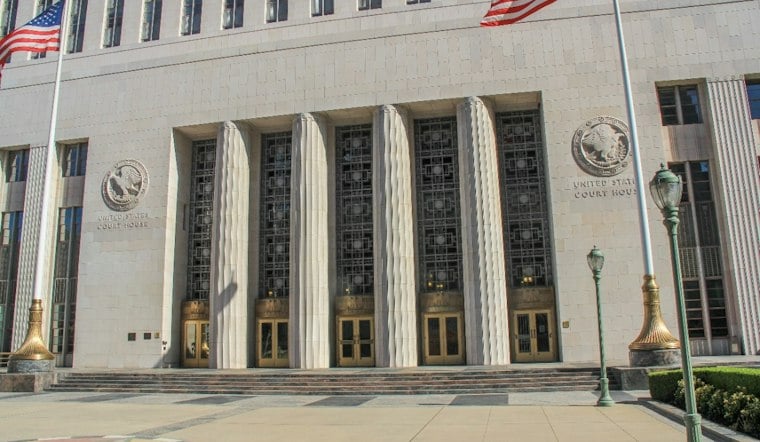
U.S. District Judge Wesley L. Hsu has indicated in a tentative ruling that he plans to deny Sam Smith and Normani’s latest motion for summary judgment in the copyright case involving their 2019 song “Dancing With a Stranger.” The ruling is not yet a written decision. If it stands, disputes over the songs’ similarities and the protectability of the claimed musical elements would continue toward a jury trial, according to Law Commentary.
Why the case returned to the trial court
The lawsuit, filed in 2022, accuses Smith and Normani’s hit of copying the hook of a 2015 song written by Jordan Vincent and Christopher Miranda. Hsu dismissed the case in September 2023, but a three-judge Ninth Circuit panel reversed that result in April 2025. The panel included Circuit Judges Michelle T. Friedland and Daniel A. Bress and Senior Circuit Judge Danny J. Boggs, according to the Metropolitan News-Enterprise.
The appeals court did not decide that Smith and Normani infringed the earlier song. Instead, it held that a jury could assess whether the selection and arrangement of common musical elements in Vincent’s song was sufficiently creative to receive protection and whether the later song was substantially similar. The decision therefore sent those factual and legal questions back to the trial court rather than resolving the infringement claim as a matter of law, the Metropolitan News-Enterprise reported.
What the parties are arguing now
How copyright law treats common musical elements
The Ninth Circuit has previously recognized that otherwise unprotectable musical building blocks may receive copyright protection when they are selected or arranged in a creative, original way. In its September 28, 2018, opinion in a separate Led Zeppelin case, the court criticized jury instructions that suggested such elements could never support protection, according to the U.S. Court of Appeals for the Ninth Circuit. That framework helps explain why the present dispute concerns not only whether the songs share common features, but also how those features were combined in the 2015 work.
How copyright law treats common musical elements
The federal case is separate from the Copyright Claims Board, a three-member tribunal created under the CASE Act to handle certain copyright disputes involving up to $30,000. The U.S. Copyright Office says the board is intended as a separate, more accessible channel for qualifying small claims; the office reported on February 13, 2026, that more than 1,700 claims had been filed since the tribunal opened on June 16, 2022, according to its 2026 update.
Smith and Normani sought summary judgment again in July. Vincent has abandoned the argument that distribution of the 2015 song established access, leaving the plaintiffs to rely on striking similarity. Under the standard described by Music Business Worldwide and Law Commentary, the similarities must be so strong that independent creation would be virtually impossible.
Defense attorney Peter Anderson argues that the plaintiffs have identified only a limited combination of musical features that also appear in other songs. Without evidence of access, he contends, that overlap cannot meet the demanding striking-similarity standard. The defense has also cited Cyndi Lauper’s 1989 song “Dancing With a Stranger” and Regina’s 1997 “Dancing With an Angel” in arguing that the alleged similarities are not unique, according to Law Commentary.
The defense separately contests whether portions of the 2015 song are protected by copyright. Its lawyers claim that the disputed hook incorporates unauthorized samples from Masters at Work’s “The Ha Dance” and Lyn Collins’ “Think (About It),” and argue that the alleged sampling affects the plaintiffs’ copyright claim. Vincent’s attorney, Alfred J. Fluehr, maintains that the disagreement over the songs and their musical elements presents a factual issue for jurors, according to Music Business Worldwide and Law Commentary.
Issues left for the trial judge or jury
Hsu declined to exclude testimony from two experts supporting the copyright claim, finding that their opinions had enough analytical support to remain in the case. He also indicated that disputes over the hook and the alleged samples should not be resolved at the summary-judgment stage. The judge took the motion under submission at the end of Friday’s hearing, Law Commentary reported.
The copyright to the 2015 song, originally created under the duo name SKX, is held by Sound and Color LLC, which is owned by Vincent, Miranda, and songwriter Rosco Banlaoi. The defendants include Smith, Normani, co-writers Jimmy Napes and Stargate, Mikkel S. Eriksen and Tor E. Hermansen, as well as UMG Recordings, Sony Music Publishing, and Downtown Music Publishing, according to the Metropolitan News-Enterprise and Music Business Worldwide.




