

























































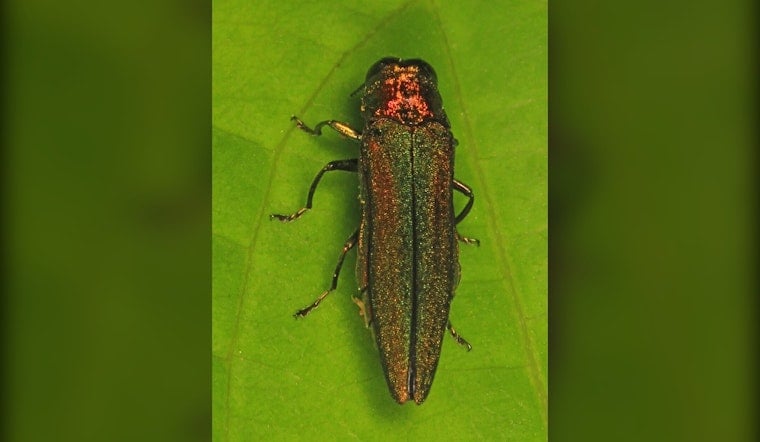
An invasive metallic-green beetle has killed millions of ash trees nationwide and is now established across nearly all of New York, with state officials confirming infestations in every county except Hamilton and Lewis. The emerald ash borer feeds beneath ash tree bark, damaging the internal systems trees rely on to move water and nutrients, and infested trees typically die within two to four years, according to New York's Department of Environmental Conservation.
A Beetle That Already Reshaped the Landscape
The pest was first found in New York in 2009, and as reported by FOX 5 New York, it has since spread to nearly every corner of the state. Ash trees make up nearly 8% of all trees in New York, and the DEC says all native ash species in the state are at risk. Statewide, ash accounts for an even larger share of the broader canopy: New York is home to more than 900 million ash trees, roughly 7% of all trees across its rural and urban landscape, according to the NYS DEC.
The insect arrived in the United States by accident, carried in infested crates and pallets, per the DEC. It was first detected in North America in 2002 near Detroit, Michigan, after arriving in infested solid wood packing materials, according to the Cornell Cooperative Extension of Oneida County. In its native range in East Asia, natural predators keep the beetle in check; in North America, it has met no such resistance.
What to Look For on Your Own Trees
Spotting an infestation early starts with the beetle itself. Adult emerald ash borers are metallic green, roughly three-eighths to five-eighths of an inch long, and typically fly less than a half-mile from the tree where they emerged, though the same species notes a single mated female can range up to 100 miles over her lifetime according to research cited by Rutgers Plant and Pest Advisory. The larvae, meanwhile, are off-white, worm-like organisms about an inch long that tunnel beneath the bark in winding, S-shaped patterns as they feed.
Visible warning signs include thinning, yellowing or browning leaves near the top of a tree, distinctive D-shaped exit holes in the bark, and S-shaped tunnels exposed where bark has split or fallen away. Woodpeckers add another clue: their search for larvae strips away dark outer bark in a process called blonding, leaving lighter patches visible from the ground.
Firewood Rules Fill the Gap Left by Federal Rollback
New York restricts firewood movement to within 50 miles of its source and advises residents to buy wood where they intend to burn it, since people can move the beetle long distances by transporting infested firewood or nursery stock. That state-level approach has taken on added weight since the USDA Animal and Plant Health Inspection Service ended its domestic EAB quarantine regulations in January 2021, shifting federal funding toward nonregulatory options to mitigate and control the pest, according to the Federal Register. Federal officials concluded the 18-year quarantine had not effectively slowed the beetle's natural expansion.
Residents who suspect an emerald ash borer sighting in Essex, Hamilton or Lewis counties are asked to contact the DEC directly. An infested tree does not automatically require removal, per the DEC, but dead or declining ash can become a hazard near homes, roads or other structures, and property owners are encouraged to contact a qualified arborist or tree service to assess their options.
Treatment Options and Wider Stakes
For high-value trees, systemic emamectin benzoate trunk injections used to protect ash trees from emerald ash borer are labeled by Wisconsin Horticulture for two years of protection per application, often at a lower overall cost than removal, according to Wisconsin Horticulture. Nationally, economic studies estimate the cumulative cost of treating, removing and replacing ash trees on developed land across EAB-affected communities at between $10 billion and $25 billion, per an ArcGIS StoryMap analysis.
The losses extend beyond street trees and lumber. Ash wood has long been used for furniture, flooring and baseball bats, and black ash in particular is important to Haudenosaunee traditional basket making. Ash trees also provide food for birds and mammals.
Biological Controls and a Search for Resistant Trees
In forest settings where chemical treatment is impractical, biological-control efforts target emerald ash borer with parasitic wasps — including Tetrastichus planipennisi, Spathius galinae and Oobius agrili — that parasitize EAB eggs and larvae. Partners monitor release sites such as SUNY Oswego's Rice Creek Field Station using yellow pan traps, according to SLELO PRISM.
Separately, Cornell Botanic Gardens and regional conservation partners are propagating what researchers call lingering ash — rare mature native trees that have survived in areas where more than 95% of surrounding ash has died — in hopes of breeding EAB-resistant rootstock. Scientists graft scion wood from these survivors onto rootstock in conservation banks to test for genetic resistance, according to Cornell Botanic Gardens. New York City counted the beetle's arrival in Brooklyn's Prospect Park back in October 2017, underscoring that the fight against the pest spans from rural forests to city sidewalks alike.





