

























































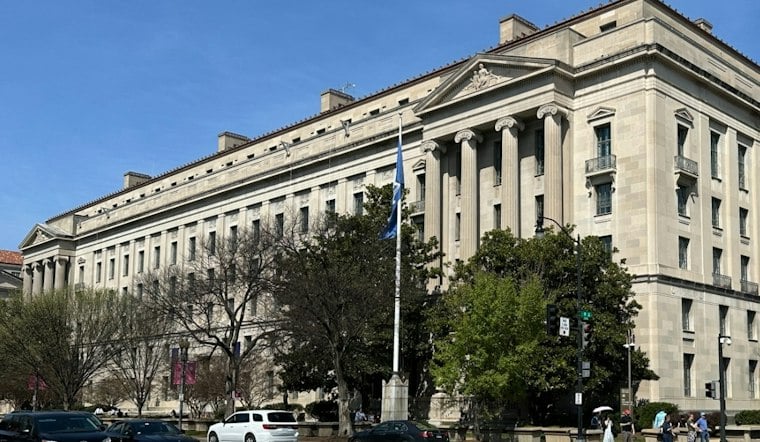
The United States government has formally inserted itself into Elon Musk's legal battle with European regulators, asking a Luxembourg court for permission to back X Corp. and Musk in their fight to overturn a €120 million fine. The Justice Department filed its request to intervene on Thursday, arguing that the European Commission reached beyond its jurisdiction when it penalized companies it says were not operating within the European Union's borders.
The fine traces back to a December 5, 2025 decision, when the European Commission found X Internet, X Holdings, and Musk personally liable for violations of the EU's Digital Services Act, or DSA, and imposed a €120 million penalty on them jointly and severally. According to Justice News, that fine was calculated based on the total worldwide annual turnover of the single economic unit ultimately controlled by Musk, or that of X Holdings Corp., per the commission's own accounting. Assistant Attorney General Brett A. Shumate of the Justice Department's Civil Division said the commission inappropriately attempted to expand its regulatory authority to reach American companies not present or operating within its jurisdiction, according to the Department of Justice.
How the Penalty Was Built
The €120 million figure was not a single lump sum but a combination of three separate violations. As reported by Euractiv, the commission's breakdown assigned €45 million to deceptive blue checkmark verification practices, €40 million to denying independent researchers access to platform data, and €35 million to advertising repository non-compliance. That decision marked the first-ever financial sanction issued under the DSA, according to the same outlet's reporting.
The penalty itself was well short of what regulators were legally entitled to seek. Under the Digital Services Act, the European Commission has statutory authority to levy administrative fines of up to 6% of an entity's total annual worldwide turnover for persistent non-compliance, per Wikipedia's summary of the law. Because regulators calculated turnover across all entities controlled by Musk, that 6% cap could theoretically extend to his broader corporate group well beyond X itself.
The Road to Luxembourg
The commission's case against X did not appear overnight. The enforcement action followed a formal investigation opened on December 18, 2023, which issued preliminary non-compliance findings in July 2024 before the final penalty decision landed in December 2025, according to a filing with the SEC. X submitted formal observations challenging those preliminary findings back in September 2024.
X Internet, X Holdings, and Musk did not accept the fine quietly. On February 16, 2026, the companies and Musk filed three separate appeal petitions at the EU General Court in Luxembourg, alleging procedural errors and asserting that the commission's investigation was superficial, as reported by TechBooky. Those cases now carry official docket numbers, with X Internet and X Holdings v. Commission registered as T-114/26 and Musk v. Commission registered as T-121/26, both pending before the General Court of the Court of Justice of the European Union in Luxembourg.
Washington Weighs In
The Justice Department's filing this week seeks to align the U.S. government with both sets of applicants, supporting the applications to annul the commission's December 2025 decision on behalf of X Internet and X Holdings as well as Musk individually. Getting a seat at the table is not automatic. Under Article 40 of the Statute of the Court of Justice of the European Union, non-EU third parties and natural or legal persons may apply to intervene in General Court cases only if they can establish a direct legal interest in the outcome of the litigation, according to legal scholarship published via EUR-Lex. Unlike EU member states or EU institutions, outside applicants like the United States face strict interest requirements before a judge will let them formally weigh in.
Whether Washington clears that bar remains an open question the Luxembourg court has yet to answer. In the meantime, the financial exposure for X does not end with the flat fine. Beyond the €120 million penalty, the DSA empowers European regulators to impose daily periodic penalties of up to 5% of average daily worldwide turnover for every day a platform delays implementing ordered compliance remedies, per Wikipedia.
X Adjusts Its European Operations
Even as it appeals, X has begun making changes on the ground. Reports in March indicated that X Corp. prepared to modify its paid account verification system in Europe to comply with EU transparency mandates, according to TradingView, after regulators argued that selling blue checkmarks without identity verification misled users.
The fine and the DOJ intervention arrive amid a broader wave of European scrutiny of Musk's ventures. X and Musk face an April 2026 cybercrime investigation by Paris prosecutors involving X's AI chatbot Grok over alleged illegal deepfakes and child abuse material, a case Hoodline previously reported involved French prosecutors summoning Musk for voluntary interviews alongside parallel U.K. and U.S. inquiries.
The December 2025 fine against X was also just the opening move in a much larger enforcement push. It represented the first non-compliance sanction under the DSA, opening the door for subsequent actions such as a €200 million fine levied against e-commerce platform Temu in August 2026, according to the Institute for Strategic Dialogue. The DSA took effect for all covered digital intermediaries in February 2024, and European regulators have moved briskly since, having also ordered Meta's WhatsApp to reopen to rival messaging bots and rattled investors in Roblox over safety-related compliance concerns.





