

























































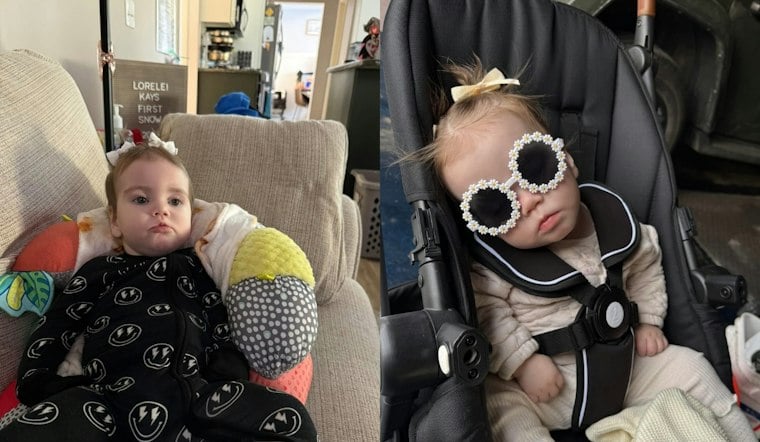
A 1-year-old girl in Waterford is one of only about 150 people in the world known to carry a mutation in a gene called CACNA1E, an ultra-rare disorder that causes severe hypotonia, a seizure disorder, and developmental delays. Lorelei Dunn relies on a feeding tube and takes three medications twice a day plus one more once daily, and this past spring her family nearly lost the insurance coverage that makes her care possible.
According to WDIV ClickOnDetroit, Lorelei's family could not find a single Michigan neurologist willing to take on her case back in May 2026, and they were told treatment options for her condition were scarce and nearly nonexistent. At the same time, a contract standoff between Blue Cross Blue Shield of Michigan and Michigan Medicine had put in-network coverage at risk for up to 250,000 patients, a dispute that was only resolved before the June 30 deadline, according to ClickOnDetroit. For a time, the Dunns faced the possibility of having to move and find a different neurologist entirely.
A Gene Discovered Less Than a Decade Ago
CACNA1E encodes what's known as the neuronal R-type CaV2.3 calcium channel, and the gene sits on the short arm of chromosome 1, at position 25.3, per the seed story's reporting. It is just one of an estimated 20,000 to 25,000 genes in the human body, but a mutation in it can upend a child's entire neurological development. The CACNA1E subunit helps form the channel pore through which ions flow, and in Lorelei's case, the mutation causes a gain-of-function change that keeps the channel open far longer than it should be.
That malfunction increases calcium ion influx into neurons, which in turn causes excessive neuron excitability, disrupting the release of neurotransmitters and the normal communication between neurons in the brain, per the same reporting. According to CACNA1E International, the disorder is associated with refractory seizures, developmental delay, joint contractures, and macrocephaly, and most affected individuals present in infancy with epilepsy alongside developmental delay or no development at all. The condition wasn't identified in medical literature until a 2018 study led by Dr. Katherine L. Helbig at Children's Hospital of Philadelphia, which analyzed 30 individuals with de novo CACNA1E mutations, according to a report published in the American Journal of Human Genetics. Lorelei's specific mutation is one of roughly 30 known cases, per the seed story.
A Possible Path Forward Through Gene Therapy
A University of Michigan Medicine neurologist has told Lorelei's family about a gene therapy that could help her, the family says. That approach likely resembles antisense oligonucleotide therapy, a technique that delivers synthetic single-stranded nucleic acids designed to bind to and degrade mutated pre-mRNA, effectively suppressing the faulty gene copy so cells can rely on the functional one, according to research published by the National Institutes of Health. The same research notes that ASO technology is actively being tested in N-of-1 trials for other pediatric genetic epilepsies, including SCN2A and KCNT1.
These individualized therapies remain difficult to access. Experts writing in Contemporary Pediatrics note that while personalized N-of-1 ASO trials have shown early promise in reducing seizure frequency and improving motor function in pediatric genetic epilepsies, development costs often reach millions of dollars per patient, and customized ASO therapies are currently offered mainly through specialized academic clinical trials. Existing pharmaceutical options aren't entirely absent, either: the 2018 discovery study found that five pediatric participants achieved complete seizure freedom using topiramate, an anti-seizure drug that targets R-type calcium channels, according to research indexed on PubMed.
Leaning on Ann Arbor and State Support
Lorelei receives specialized care through University of Michigan Health's C.S. Mott Children's Hospital, which was ranked the No. 1 children's hospital in Michigan by U.S. News & World Report for the 19th consecutive year in 2025 and is the only hospital in the state ranked across all 11 evaluated pediatric subspecialties, per University of Michigan Health. Families like the Dunns, who split their time between Waterford and Ann Arbor for appointments, can also turn to Children's Special Health Care Services, a Michigan Department of Health and Human Services program that helps cover specialist care, medical equipment, and travel regardless of household income; eligibility for the program was expanded up to age 26 in late 2023, according to the department.
A GoFundMe organized for the family detailed additional strain beyond medical logistics, including Lorelei's father's recovery from a work injury and her mother stepping back to part-time work to serve as Lorelei's primary caregiver. Lorelei was diagnosed at four months old, according to the fundraiser.
Awareness as a Lifeline
Lorelei's family says that awareness fuels research, and that a lack of public understanding about conditions like CACNA1E makes finding treatment difficult. They argue that research can open the door to lifesaving care, even for a disorder this rare. Nationally, the NIH's Genetic and Rare Diseases Information Center defines a rare disease as one affecting fewer than 200,000 Americans, and notes that collectively more than 10,000 rare diseases affect an estimated 30 million people across the country, with fewer than 5 percent of known rare diseases having an FDA-approved treatment.
Since Local 4 first reported on Lorelei's story in May, her insurance coverage has been extended, according to the outlet's reporting. Her family continues to push forward with her care team at Mott, hoping that greater visibility for CACNA1E might eventually widen the narrow path toward treatment for the roughly 150 people worldwide who share her diagnosis.




