

























































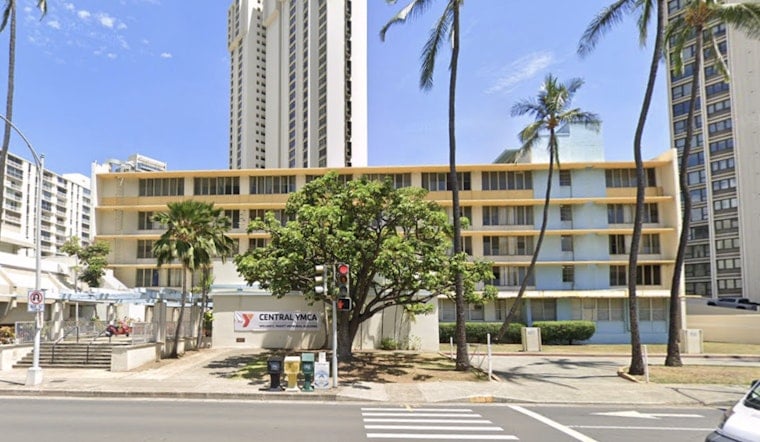
The YMCA of Honolulu is asking the City Council to strip a decade-old set of public benefits tied to its Central Y property at 401 Atkinson Drive, including a requirement that nearly a third of any future units be affordable rentals. The nonprofit has no buyer lined up for the 1.77-acre site, but says the existing conditions have scared off every prospective purchaser who has looked at the property so far.
What Bill 55 Would Actually Undo
Bill 55 would rezone the property from the AMX-3 high-density apartment mixed-use district back down to the A-2 medium-density apartment district, according to the Honolulu Star-Advertiser. That shift would cut the maximum building height on the site from 350 feet down to 150 feet and scrap a unilateral agreement containing ten separate conditions covering pedestrian access, street frontage, parking, traffic management, and bicycle facilities, per the same report. The A-2 district primarily allows residential uses, while AMX-3 permits residential development plus limited commercial uses like retail, dining, and general medical services, the Star-Advertiser notes.
The city's Department of Planning and Permitting has recommended eliminating all of the unilateral agreement's conditions, including the requirement that at least 30% of dwelling units be affordable rentals for households earning no more than 60% of area median income for 60 years. Based on HUD's 2026 median family income figure of $133,400 for Honolulu County, that 60% AMI threshold caps qualifying income at $64,680 for a single person and $92,400 for a family of four, according to the Hawaiʻi Housing Finance & Development Corporation. DPP also recommended removing the pedestrian easement and streetscape requirements, along with the 128-unit cap that had been tied specifically to the abandoned project, per the Star-Advertiser's account.
How a Failed Condo Tower Created the Current Rules
The whole arrangement traces back to Ordinance 13-34, which the Honolulu City Council passed in 2013 to rezone the property to AMX-3 and raise its height limit from 150 feet to 350 feet specifically so a 128-unit condominium tower called Aloha Kai could be built there. According to the Honolulu City Council, that ordinance also locked in the binding unilateral agreement now on the chopping block. The abandoned redevelopment plan called for the 128-unit apartment tower alongside a new three-story YMCA facility, but the YMCA of Honolulu ultimately ended its partnership with the Aloha Kai development.
The project's collapse triggered litigation between the YMCA and developers MB Property Acquisitions and Tama Home Co. after the developer defaulted on its purchase agreement, resulting in a court-confirmed $2 million arbitration award for the YMCA before the parties reached a confidential settlement in November 2018, the Hawaiʻi Public Radio reported. By May 2019, the YMCA's board decided the aging 1951 facility was too costly to renovate and voted to sell the entire parcel rather than build a scaled-down Y on site. The organization had already shuttered the property's health and fitness facilities in 2015 in anticipation of redevelopment, while keeping its hostel portion running as transitional housing.
Why No Buyer Has Bitten
During a May 2025 presentation to the Ala Moana-Kakaʻako Neighborhood Board, the YMCA's representative confirmed that multiple prospective buyers had walked away from purchasing 401 Atkinson Drive specifically because of the restrictive 2013 agreement's conditions, according to the City and County of Honolulu. Lisa Ontai said the YMCA wants to remove the unilateral-agreement restrictions to find a suitable purchaser and that the organization welcomes offers and wants the property returned to its original zoning, per the Star-Advertiser's report. Davis Pitner said the YMCA is ultimately seeking City Council approval of its zone-change request.
The Planning Commission approved the recommended zoning change by a 6-0 vote on August 5, and the City Council is set to consider the first of three readings of Bill 55 at 10 a.m. at 530 S. King St. The property currently operates a five-story, 113-room transitional-housing dormitory that houses about 90 people on an average day, and it also contains recreational facilities, residential units, offices, and storage, according to the same reporting. The YMCA of Honolulu, founded in 1869 and incorporated under the Kingdom of Hawaiʻi in 1882, is among the state's oldest nonprofits and currently serves more than 100,000 residents annually across Oahu, per HAWAIʻI Magazine. Sale proceeds are planned for reinvestment into other YMCA facilities and programs on Oahu.
Neighbors Push Back on What Would Be Lost
Jonathan Huynh opposed the Central Y's rezoning application, arguing that eliminating the unilateral agreement would remove public benefits without replacing them. He identified the 30% affordable rentals at 60% AMI for 60 years, the public pedestrian easement, bike infrastructure, and streetscape standards as the binding public benefits at stake, according to the Star-Advertiser. The Atkinson Neighborhood Community Association has separately raised concerns about a pedestrian easement linking Atkinson Drive to the Ala Wai Promenade that was closed around 2018 under agreements tied to the property, and the group has called for that canal access to be restored.
Lisa Ontai said any future developer would still need governmental oversight and clearance for the property's use, and DPP concluded that the proposed zone change is generally consistent with city land-use plans and policies. Future residential development on the site will be subject to the city's existing affordable-housing requirements even without the custom 2013 agreement, and the department noted that the surrounding dense urban area includes residential towers ranging from 15 to 40 stories, making the proposed A-2 zoning compatible with its neighbors. The Ala Moana transit-oriented development plan also addresses objectives related to pedestrian easements and streetscapes in the area. In June 2025, the YMCA's land-use consultant formally asked DPP to confirm that reverting the property to baseline A-2 zoning would not require a new environmental assessment or an amendment to the Primary Urban Center Development Plan, according to Hawaii Free Press. The Honolulu City Council holds final authority over whether the rezoning moves forward.





