

























































A bipartisan congressional panel says Webull, the stock-trading app based in St. Petersburg, Florida, is structurally linked to the Chinese government in ways that pose a national security threat to U.S. finance. The House Select Committee on China found that the company's ownership, technical workforce, technology infrastructure, cross-border data routing, corporate financing and compliance frameworks are all tied in structural ways to the People's Republic of China, even as the platform markets itself to American retail investors trading everything from stocks to digital assets.
The committee shared its findings exclusively with CNBC, which reported that the panel identified what it called a profound gap between Webull's public marketing as an American company and the actual control of the firm. The committee said national security concerns around Webull have escalated since October 2025, and it warned that the company's critical backend systems, personnel and data flows may remain exposed to Chinese Communist Party intelligence laws and coercive demands. China's laws can compel firms to cooperate with the government, including through data transfers, a dynamic the committee says makes Webull's structure especially concerning now that the company has begun carrying customer cash directly.
A Company With Roots in China, a Headquarters in Florida
Webull was founded in 2016 by Wang Anquan, who had previously managed operations at Alibaba and Xiaomi before launching the trading platform. The company traces its origins to Hunan Fumi Information Technology Co., Ltd., and today operates through a tangle of corporate entities: Webull Corporation is incorporated in the Cayman Islands, Webull Holdings (US) Inc. serves as its U.S. holding company, and Webull Technologies Pte. Ltd. is based in Singapore. The company also uses a mainland China-based subsidiary that supports technology development and platform operations, according to the committee's findings as reported by CNBC.
That mainland subsidiary, Hunan Weibu Information Technology Co., Ltd., employed 863 people as of December 31, 2025, representing 62 percent of the company's workforce as of that date, according to a Webull filing with the U.S. Securities and Exchange Commission. The House Select Committee on China has alleged that Webull misrepresented the number of its China-based employees, saying the company told the committee it did not have offices or employees based in the People's Republic of China and that all firm employees were located in the United States.
Lawmakers Say Software and Data Pipelines Remain China-Dependent
The committee's report describes Webull's software development, data pipelines and core engineering operations as dependent on China-linked infrastructure, meaning the platform depends on systems subject directly to Beijing's laws even as it serves American customers. Committee chair John Moolenaar said Webull's China-based operations put American investors and their data at risk, telling CNBC that the company exposes its data to the United States' foremost adversary through mainland China technology providers and an opaque, China-linked ownership structure.
Webull objected to the report and discussed its U.S. customer-data storage and access controls in response to CNBC's request for comment. The company, which trades on the Nasdaq Stock Exchange, counts Robinhood, Charles Schwab and E-Trade among its competitors, and it has grown rapidly even as scrutiny has mounted. Webull says it has 28 million global users and provides retail and institutional investors around-the-clock access to global financial markets, allowing trading in global stocks, ETFs, options, futures, fractional shares and digital assets.
Financial Growth Collides With Years of Scrutiny
The committee's report lands against a backdrop of strong financial results. Webull reported $24 billion in customer assets for the first quarter of 2026, a 90 percent year-over-year jump, according to the company's own release via PR Newswire. CNBC's report, citing the committee's findings, put the figure at $24.6 billion. Registered users climbed 15 percent year over year to 27.6 million, the company said, while equity notional volume reached $261 billion, up 104 percent from a year earlier. The same release said Webull offers investment services in 15 markets through its global network of licensed brokerages, while CNBC's report cited the figure as 18 markets. The company also touted recent regulatory wins, including permission to operate throughout the European Economic Area, the launch of its app in Germany, and FINRA's approval in April of Webull Securities US for self and correspondent clearing.
Scrutiny of Webull did not begin with this report. The House Select Committee on China requested information from the company in 2024, and on December 6, 2024, committee leaders Moolenaar and Raja Krishnamoorthi wrote to Webull's CEO alleging that, despite restructuring that may have been intended to create the impression the company is no longer a PRC-linked firm, Webull remains deeply intertwined with PRC entities including Fumi Technology and Hunan Weibu, according to a letter posted by the Select Committee on the CCP. The concerns stretch back even further: in 2022, Sen. Tommy Tuberville led a group of senators calling for an investigation into Webull Financial, LLC and Moomoo, Inc. over alleged ties to the Chinese Communist Party, a push detailed in a release from the senator's office.
State Investigators and Lobbyists Enter the Picture
Indiana Attorney General Todd Rokita said he was leading a multistate inquiry into whether Webull Financial may have exposed clients' personal information to the Chinese Communist Party, according to a notice from the Indiana Attorney General's office. More than a dozen state attorneys general have launched a probe into Webull's China ties and its handling of sensitive U.S. user data, as reported by POLITICO, which also reported that Webull retained a Mercury team to lobby on fintech issues, including Toby Moffett.
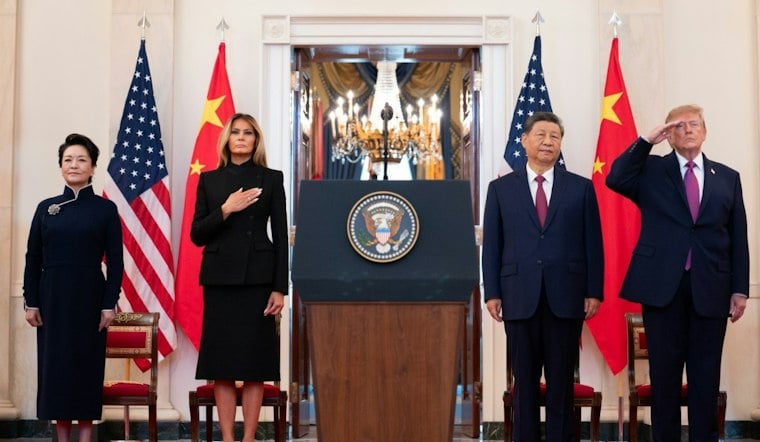
Separately, Webull's own SEC filings have acknowledged the stakes of data security, warning that failures to protect customer data and privacy, or to prevent platform security breaches, could cause economic loss, reputational damage, customer loss, and legal penalties and liability. The filing also cited the need to maintain effective compliance and risk-management infrastructure. The committee's report arrives after President Donald Trump and Chinese President Xi Jinping held a largely friendly summit in September, though the committee's findings on Webull reflect concerns that it said have been building since well before that meeting.




