

























































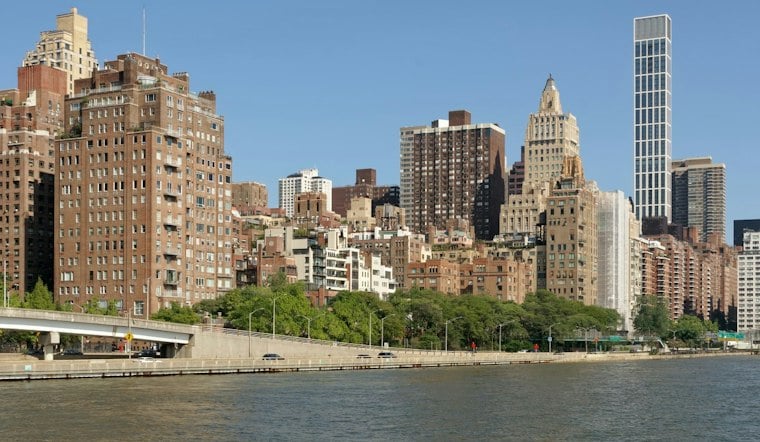
Manhattan's housing market is shrinking and heating up at the same time. Listings for available homes across the borough dropped 10.7% year-over-year in the third quarter, even as condo and co-op closed sales climbed 8% compared with the same period in 2025 — and the median sale price hit a record $1.25 million.
The figures, compiled by appraiser Jonathan Miller and The Real Deal, paint a picture of a market where buyers are competing harder for fewer homes. Luxury condo and co-op supply fell more than 14% year-over-year, while townhouse inventory collapsed by 33%. Luxury apartment deals still rose 7% from the third quarter of 2025, with the biggest jump in activity concentrated in the $2 million to $5 million range.
Not every price tier is sharing in the gains. The report notes that transaction activity underperformed at both the lowest and highest ends of the market, with buyers below $1 million described as more reliant on financing and more sensitive to swings in mortgage rates — a dynamic that lines up with a separate reading from FOX 10 Phoenix showing the 30-year fixed mortgage average climbing to 7.28% as of October 1, its highest level in roughly three years and up from 6.34% a year earlier.
New Development Supply Hits a 2014 Low
The new-development pipeline looks especially thin. New development apartment listings declined nearly 40% year-over-year, and Marketproof data cited in the same report puts Manhattan's new condo inventory at just 2,800 units at the end of August — the lowest level since 2014. Rising construction and financing costs have pushed developers to the sidelines, shrinking a pipeline that was already stretched thin.
Those development economics are tangled up with a 2024 state law. Under New York State Real Property Tax Law § 485-x, buildings with 100 or more units face mandatory $40-an-hour construction wage rules, which has pushed some developers to intentionally cap new filings at 99 units, according to CRE Daily. The 485-x program was created to replace the expired 421-a tax abatement, and its wage thresholds have become a quiet but significant constraint on how large new Manhattan buildings get built.
Despite the supply crunch, new development prices kept climbing. The median new-development sale price rose 14% year-over-year to just under $2 million, while the overall condo and co-op median was up 6% from the third quarter of 2025 to hit its record of $1.25 million.
Why Cash-Rich Buyers Keep Absorbing Inventory
Luxury demand remains strong even as luxury inventory keeps declining, limiting deal growth relative to other market segments, per the report. Miller said higher mortgage rates are putting downward pressure on inventory overall, and he described upper-half market churn as burning off supply faster than it can be replenished — part of why the inventory decline is tied partly to a rise in transactions rather than purely to a drop in new listings.
Luxury buyers mostly pay in cash, a pattern that insulates the top of the market from borrowing costs entirely. Recent quarterly Manhattan market reports from Brown Harris Stevens show all-cash buyers accounting for 60% to 69% of residential sales, giving them a distinct edge over financed shoppers in prime neighborhoods where mortgage-rate anxiety barely registers.
Manhattan townhouses tell a different story. Townhouse inventory fell 33% year-over-year, but the median sale price actually declined 21% to $5.4 million, a drop the report attributes to a shift toward smaller homes in the product mix rather than a weaker luxury market. That mirrors a trend Leslie J. Garfield tracked in its own data, where townhouse transaction volume rose 23% year-over-year even as average sale prices fell as buyer demand shifted toward smaller, lower-priced properties.
StreetEasy Delistings Not a Factor, Miller Says
The ongoing industry fight over listing visibility has drawn scrutiny this year after Compass International Holdings executives urged agents to pull listings from StreetEasy and route them through REBNY's private Residential Listing Service — a strategy now facing a federal class-action antitrust lawsuit filed in the Southern District of New York, as reported by Courthouse News. But Miller said that dynamic was not among the reasons for the supply decline in this report, noting that he used RealPlus data rather than StreetEasy data for his figures.
The broader housing math in New York remains unforgiving regardless of which listing platform agents prefer. The city's net rental vacancy rate fell to 1.41% in the most recent Housing and Vacancy Survey from the Department of Housing Preservation and Development, the lowest level since 1968, with state law classifying any rate below 5% as a severe housing emergency. New housing permits did tick up — the city issued permits for 17,673 new housing units in 2025, a 15.3% increase over 2024 — though filings remain well below historical multi-decade averages, according to the Rent Guidelines Board's 2026 Housing Supply Report.
Hoodline has tracked the StreetEasy exodus as it unfolded alongside these supply pressures, and the pattern described in the new report fits a borough where buyers increasingly compete for whatever inventory remains. Any buyer closing a deal above $1 million will also face New York's mansion tax, a baseline 1.0% levy that climbs through progressive tiers to as much as 3.9% on purchases of $25 million or more, according to the NYS Department of Taxation and Finance — one more variable in deal math that is already defined by scarcity on nearly every front.





