

























































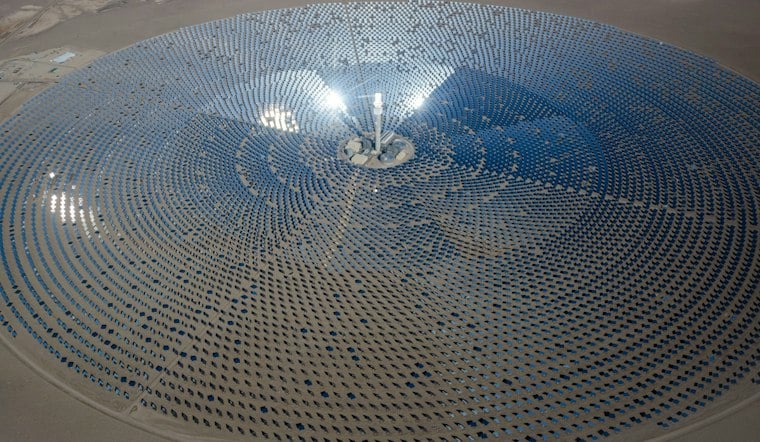
A solar power plant near Tonopah that cost more than $1 billion to build and once carried a $737 million federal loan guarantee has changed hands for just $7 million, closing out a years-long saga of leaking molten salt tanks, canceled contracts, and two separate bankruptcy filings. The buyer, Houston-based Sons of Liberty Construction, took over the Crescent Dunes Solar Energy Project in Nye County after the facility's second owner, Tonopah Solar Energy, LLC, filed for Chapter 11 protection earlier this year.
A Billion-Dollar Tower Brought Down by Cheap Panels
Tonopah Solar Energy filed its Chapter 11 petition on January 21, 2026, in the U.S. Bankruptcy Court for the District of Delaware under case number 26-10060, reporting roughly $173 million in secured debt owed to an affiliate lender and only about $598,000 in available cash, according to Stretto. The filing set up a structured court process to secure a $10 million debtor-in-possession loan and carry out an asset sale, per the same bankruptcy court documents. As the Las Vegas Review-Journal reports, the plant uses nearly 10,350 heliostats to reflect sunlight onto a roughly 640-foot-tall tower, heating molten salt to 1,050 degrees Fahrenheit so the facility could theoretically generate electricity even after dark.
That ambition is what drew the federal government in, backing SolarReserve's project with a $737 million loan guarantee in September 2011. The guarantee was funded under Section 1705 of the Energy Policy Act of 2005, a temporary program created through the American Recovery and Reinvestment Act of 2009 to help clean-energy projects overcome financing bottlenecks, according to the Congressional Research Service. The Department of the Interior approved the project on roughly 2,250 acres of Bureau of Land Management land in Nye County, about 13 miles northwest of Tonopah, in 2010, part of a broader push to expand renewable energy on Western public lands.
Leaking Tanks Doomed the Plant's Output
The plant's troubles started early. Crescent Dunes first ceased operations in 2016 after a hot salt tank leak, resumed generating electricity in 2017 following repairs, then shut down again in 2019 after a second tank leak, prompting NV Energy to terminate its power-purchase agreement that same year, per the Review-Journal's reporting. The plant went on to sustain three additional hot salt tank leaks, and owners responded by lowering the tanks' operating temperature, a fix that reduced both power output and revenue, the paper notes.
Throughout its operational life starting in 2015, Crescent Dunes never generated more than roughly 40% of its planned annual electricity production, according to Stretto's bankruptcy filings, as recurring leaks forced operators to run the system at lower temperatures and effectively cut output in half. Under its original 2009 agreement, NV Energy had contracted to buy Crescent Dunes power at roughly $135 per megawatt-hour at a time when competing photovoltaic solar projects in Nevada were offering power at approximately $30 per megawatt-hour, according to the Journal of Petroleum Technology. Fast-falling photovoltaic and battery storage prices left the molten-salt technology economically uncompetitive almost as soon as it came online.
First Bankruptcy, a Federal Settlement, and a Second Collapse
Tonopah Solar Energy filed for bankruptcy protection the first time during the summer of 2020, and the Department of Energy later announced a settlement to recover $200 million in taxpayer funds from the plant's ownership that same year, the Review-Journal reports. U.S. Bankruptcy Judge Karen Owens approved the holding company's reorganization plan in 2020, but the underlying financial problems never went away. Owners launched a marketing process to find a buyer in 2024 and relaunched that campaign again in 2025, according to the paper's reporting.
Before the 2026 bankruptcy, investment bankers contacted 253 prospective buyers and secured 13 signed confidentiality agreements, yet failed to produce a single qualifying bid other than Sons of Liberty Construction, per Stretto's court filings. In the months before the filing, Crescent Dunes stayed operating by selling power month-to-month to Nevada data center operator Switch under an agreement that ran through February 2026, according to EcoTechNews.
Sale Closes, New Owner Takes Over
Sons of Liberty Construction reached its deal to buy the plant for $7 million in February 2026, and the sale closed in late July, per the Review-Journal. Closing required formal regulatory sign-off from both the Federal Energy Regulatory Commission and the Bureau of Land Management, which holds title to the public land beneath the facility, the same EcoTechNews report notes. Once the sale closed, Sons of Liberty took over management and rebranded the operation as Tonopah Energy Center LLC, acquiring the physical assets free and clear of prior liens in an attempt at a turnaround.
NV Energy currently has no contract with the Crescent Dunes complex, according to the Review-Journal. Patrick Hogan, who said his firm, CMB Regional Centers, initially loaned $90 million for the project and later added another $80 million, told the paper the second loan was repaid but the first was not. Hogan estimated his side's legal fees at around $7 million and said he plans to spend another $7 million pursuing recovery, describing Crescent Dunes as a total disaster. The holding company has said Hogan's claims have no merit, and courts and tribunals have ruled against his side on the merits, the Review-Journal reports.
What's Next for the Site
An engineering assessment highlighted in 2023 estimated that fully dismantling Crescent Dunes and restoring the desert site, including removing more than 10,000 heliostat mirror structures and concrete foundations, would cost approximately $250 million, drastically exceeding an early $7 million bond estimate, according to SolarPACES. That gap leaves open whether Tonopah Energy Center will attempt a technological retrofit of the salt tanks, convert the site to conventional photovoltaic panels and battery storage, or simply salvage components, a question the new owners have not yet answered publicly.
The Department of Energy once called Crescent Dunes a blueprint for solar projects serving clean, affordable electricity, saying the plant could reliably deliver peak-period power to more than 75,000 Nevada homes. Kevin Smith, a figure tied to the project's early promotion, said at the time that the technology could even be placed in remote locations such as Africa or the California desert. More than a decade and over $1 billion later, the plant that was supposed to prove molten-salt solar could work changed hands for the price of a few suburban homes.



