

























































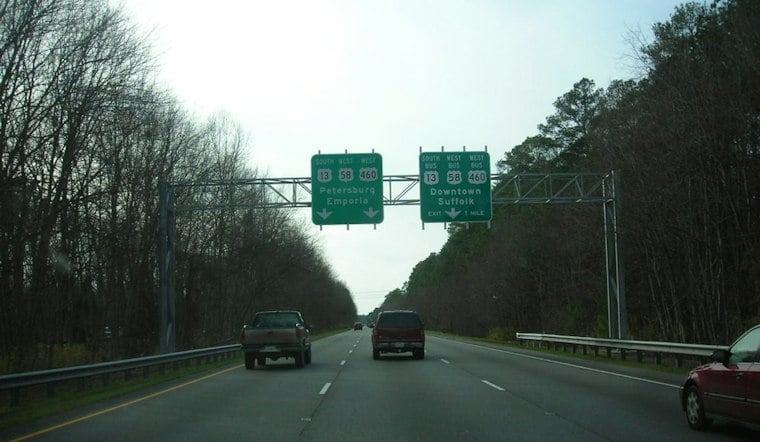
RaceTrac has acquired 6.05 acres at 2925 Pruden Boulevard in Suffolk, Virginia, paying $4,769,898 for land it plans to turn into a new travel center aimed at truckers rolling through the booming Route 460 corridor. The seller was Port 460 Owner, LP, a Delaware corporation tied to the massive industrial park taking shape next door.
A Travel Center Built for the Route 460 Freight Boom
According to WAVY.com, the land was sold through Port 460 Owner, LP, a Delaware corporation affiliated with the development of Port 460 Logistics Center, a large-scale industrial project rising nearby. RaceTrac's purchase was made through Del Lago Ventures, Inc., a Georgia corporation wholly owned by RaceTrac, according to an announcement from S.L. Nusbaum Realty Co. The planned travel center is expected to serve truck traffic along the Route 460 corridor while also offering visibility and access within one of Hampton Roads' most active growth corridors, serving both local residents and travelers passing through.
Brokers Larry Agnew and Sam Rapoport represented RaceTrac in the transaction, the same account notes. Agnew said S.L. Nusbaum Realty Co. facilitated another RaceTrac location in Virginia and thanked Chase Melton of RaceTrac's real estate department for helping complete the acquisition. Rapoport called the Suffolk deal strategic, saying it will support the region's growing transportation activity, with the new location expected to provide essential services to the transportation community and support the area's long-term economic growth.
Port 460 Logistics Center Keeps Growing Next Door
The Pruden Boulevard site sits in the shadow of Port 460 Logistics Center, a more than 500-acre, 5-million-square-foot industrial park developed by Matan Companies and Rockefeller Group. Developers completed Buildings 1 and 2, totaling 585,640 square feet, in July and began vertical construction on a 1.05-million-square-foot Building 3 with the tilt-up of its wall panels, as part of the project's first phase, which spans 2.4 million square feet across five buildings, according to Capdex. Freight carrier A. Duie Pyle bought 43 acres within the park in January to build a 200,000-square-foot warehouse and a 52-door Less-Than-Truckload cross-dock terminal that will link logistics connections across the Mid-Atlantic and Northeast, per A. Duie Pyle.
The logistics center is designed to capitalize on its proximity to the Port of Virginia, which handles more than 3.5 million TEUs annually and has completed multibillion-dollar harbor deepening projects, making it among the deepest ocean shipping ports on the U.S. East Coast, according to Rockefeller Group. Virginia has backed the corridor with state money too: in July 2024 the state committed $30 million from the Transportation Partnership Opportunity Fund to widen and modernize a 2.3-mile stretch of Route 460 and redesign its interchange near Port 460, as reported by the Washington Examiner.
RaceTrac's Growing Virginia Footprint
Suffolk is part of RaceTrac's growing Virginia footprint. RaceTrac operates more than 800 retail locations representing the RaceTrac and RaceWay brands in 13 states. The company has been expanding its travel center format. Its newly constructed travel centers typically span more than 8,000 square feet and generate roughly 40 local jobs per site, per CSP Daily News.
Years of Resident Pushback Over Industrial Rezoning
The land that is now drawing RaceTrac and other logistics players didn't get zoned for heavy industry without a fight. Suffolk City Council approved rezoning approximately 540 acres at Route 460 and Route 58 from commercial and agricultural use to M-2 Heavy Industrial in October 2023, amid strong opposition from local residents, according to 13News Now.
For RaceTrac, the land deal lands squarely inside a corridor where state transportation money, industrial tenants, and local opposition have all been converging for years — with the new travel center poised to serve as the fueling and convenience stop for the trucks the whole project is designed to attract.





