

























































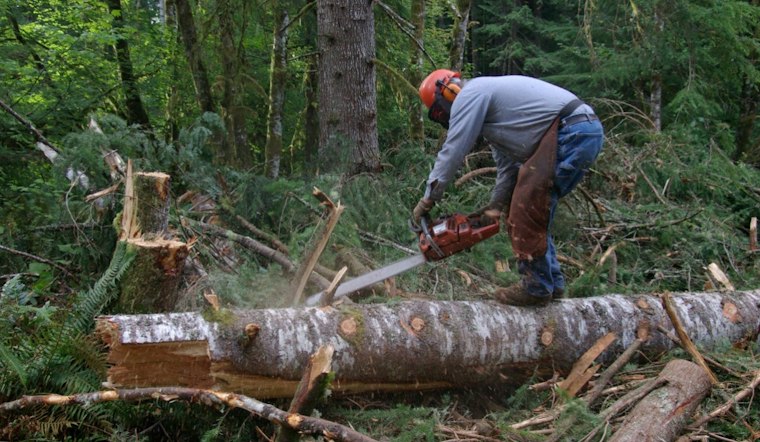
Chainsaws are buzzing through fire-scarred forest near Big Bear in June 2026, where volunteers with a veteran-led disaster response group have already dropped more than 350 dead and charred trees near Skyline Road. The work targets damage left behind by two major blazes, the 2022 Radford Fire and the 2024 Line Fire, and crews expect to remain on site for at least two more weeks.
The organization behind the effort is Team Rubicon, a veteran-led humanitarian group with roughly 200,000 volunteers across North America, according to CBS News Los Angeles. The outlet reports the group is clearing dozens of dead trees and thick vegetation as part of a mitigation plan addressing nearly four years of accumulated fire damage, working in conjunction with the U.S. Forest Service. In a separate segment, CBS News noted that Team Rubicon volunteers are also doing fire mitigation work in the San Bernardino Mountains.
Hundreds of Charred Trees Coming Down Near Skyline Road
The Big Bear push has moved quickly. Five days into the project, crews had already dropped more than 350 trees near Skyline Road, per the station's reporting, and they're not done. The same report notes the mitigation effort was also described as part of the America 250 celebrations, tying the local forest work to a broader national observance.
A related CBS segment captured volunteers clearing dead vegetation and trees specifically to mitigate wildfire risk in Big Bear, underscoring just how much fuel is still sitting in the forest from the Radford and Line fires years after the flames went out.
A Bigger Push Began Months Earlier
A Bigger Push Began Months Earlier This June, Team Rubicon deployed a large force to the area for what it called a massive tree removal project, with seven strike teams and roughly 40 volunteers fanning out across the forest on June 10, according to the Big Bear Grizzly. That effort aimed to fell hazardous and burned trees while opening up access for firefighters along South Shore trails and roads, and organizers told the paper they expected to clear about 700 trees by the end of that first week, with talk of returning in July or August to continue the push.
The June deployment and subsequent relief team were parts of the same Big Bear project, with the goal of clearing standing dead wood before it becomes fuel for the next fire.
Twin Peaks and Crestline Get Their Own Crews
Twin Peaks and Crestline Get Their Own Crews A smaller but steady operation has been underway above Twin Peaks and Crestline, where Team Rubicon volunteers are cutting and hauling dead branches and small trees from a 50-acre swath of forest, according to the Inland Empire Community Newspapers. That project marks a new partnership between Team Rubicon and Better Place Forests, with a typical workday drawing between 10 and 15 volunteers to the site, the outlet reports. The publication also notes that Team Rubicon has shifted in recent years from pure disaster response toward pre-disaster mitigation, with its Greyshirt volunteers completing dozens of wildfire mitigation projects across California in 2024 alone.
Part of a Wider Forest-Health Effort
The San Bernardino Mountains work fits into a much larger pattern of post-fire recovery across the region. The National Forest Foundation says it is implementing forest-health and fuel-reduction projects throughout the San Bernardino National Forest, having already completed fuel-reduction work on more than 400 acres in the Grass Valley project area, according to the organization's own reporting. The foundation also works on forest health and fuel reduction.
The scale of that backlog reflects a national problem. The United States averages roughly 70,000 wildfires and about 7 million burned acres a year, based on a 2020 National Interagency Fire Center report cited by Team Rubicon, a volume that leaves standing dead timber scattered across burn scars long after the fires themselves are extinguished. The San Bernardino National Forest has said it works year-round on prevention, preparedness and fuels-reduction programs to chip away at that risk.
Team Rubicon's volunteer model has shown up in burn scars well beyond the San Bernardino Mountains. The group has previously built defensible zones along a high-risk road in Glen Haven, Colorado. More recently, volunteers helped remove dead trees and brush from areas impacted by the Park Fire, according to Action News Now. For Big Bear residents watching the chainsaw crews work through the week, the hope is that clearing the dead wood now means less fuel waiting for the next spark.



