

























































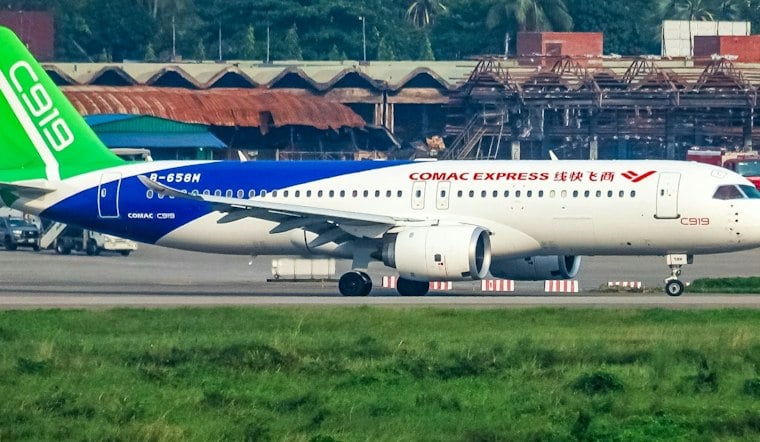
The Trump administration has been quietly slowing the flow of U.S.-made aircraft parts to China, using Beijing's dependence on American aviation suppliers as a bargaining chip in ongoing trade negotiations. The Commerce Department has slowed export licensing for airplane parts bound for China and limited the number of parts cleared for shipment to COMAC, the country's state-owned planemaker, according to people familiar with the matter.
The effort goes beyond routine paperwork delays. As reported by Reuters, U.S. officials have also considered a new export regulation that would make it easier to restrict landing gear and other aircraft components shipped to China. A draft version of that regulation includes a new licensing requirement for aviation hydraulic fluid supplied by U.S. manufacturers, according to sources. An unnamed source familiar with the matter said the measure is intended to prevent COMAC from stockpiling aircraft parts.
The pressure campaign comes as Washington and Beijing negotiate a thicket of economic issues, including U.S. access to Chinese rare-earth minerals, agricultural trade and artificial intelligence, with talks held in New York and Washington in September. The two countries have agreed to reduce tariffs on various goods and extended their trade truce to January 10, 2027, after it had originally been set to expire November 10, 2026 — giving negotiators extra runway to tackle tougher disputes. The arrangement reflects what officials describe as a new period of détente between the two countries, even as, per CNBC, uneven progress on soybeans, aircraft and rare earths shows there is little willingness on either side to cede strategic leverage.
A Pattern of On-Again, Off-Again Restrictions
This is not the first time Washington has reached for aviation leverage. The U.S. imposed new export restrictions on aircraft products in 2025, a round that also included ethane and electronic design automation software, though those restrictions lasted only a few weeks. In May, the U.S. suspended licenses covering GE Aerospace jet engines, Honeywell Aerospace navigation systems and other COMAC parts, and separately sent letters to manufacturers of aviation hydraulic fluid in China stating the fluid required a new export license — a requirement that also proved short-lived.
That May 2025 action, detailed by Reuters, suspended some licenses that had allowed U.S. firms to sell products and technology to COMAC for development of its C919 aircraft, including engine-related technology. The Commerce Department said at the time it had suspended existing export licenses or imposed additional license requirements while it reviewed exports of strategic significance to China. The C919's reliance on the LEAP-1C engine underscores how deeply COMAC's flagship jet still depends on Western suppliers.
Those restrictions did not hold. By July, the U.S. told GE Aerospace it could restart jet-engine shipments to COMAC, restoring licenses covering LEAP-1C engines for the C919 and CF34 engines for the smaller C909 regional jet, the outlet's reporting on the licensing reversal showed. The New York Times has tied the original move to China's own restrictions on exports of critical minerals, part of a broader standoff in which China controls rare-earth minerals needed by U.S. vehicle manufacturing, chipmaking and aerospace industries. Chinese rare-earth controls have, in turn, caused delays for producers of thermal coating sprays used to protect jet engines.
Boeing's 200-Jet Deal Hangs in the Balance
Hovering over the parts dispute is a stalled Boeing order. China agreed in March to purchase 200 Boeing jets, a commitment the two countries' leaders reaffirmed at their May meeting, according to CNBC's reporting. But China has sought several years of guaranteed spare parts for those aircraft, and the U.S. has been reluctant to provide such guarantees — planes are typically sold without general, long-term guarantees on parts. The status of China's spare-parts request remains unclear.
Simple Flying has reported that the standoff centers on China's push for long-term coverage of engines, spare parts, maintenance and servicing, terms Boeing has not been willing to extend. Meanwhile, access to parts and services for Chinese airlines remains subject to U.S. export requirements. Meanwhile, rival Airbus has continued to expand its footprint in China, holding roughly 55% of the Chinese market with more than 2,200 aircraft in service, and agreeing in April to sell China Southern Airlines 137 A320neo-family jets in a $21.4 billion deal, per the same outlet's reporting.
Industry Fears Planes as Trade-War Weapons
The possibility of export controls on Boeing plane parts has raised industry concerns about using aircraft as bargaining chips in trade negotiations. U.S. aerospace suppliers are considered critical both to the Boeing and Airbus jets operated by Chinese carriers and to COMAC's own plans to increase commercial jet production.
Those plans remain ambitious. China's airlines are expecting a combined 33 COMAC C919 deliveries in 2026, a significant jump from the 15 aircraft delivered in 2025, according to Aviation Week. COMAC is also pursuing ambitious commercial jet production plans. China is also pursuing domestic jet-engine development.
Earlier Reuters reporting covered U.S. export controls on Western-supplied parts for the C919, which is designed as a narrow-body rival to the Boeing 737 and Airbus A320. C919 flights have been limited to routes within mainland China and Hong Kong. The Commerce Department, the White House and the Chinese Embassy in Washington did not respond to requests for comment on the latest parts restrictions.





