

























































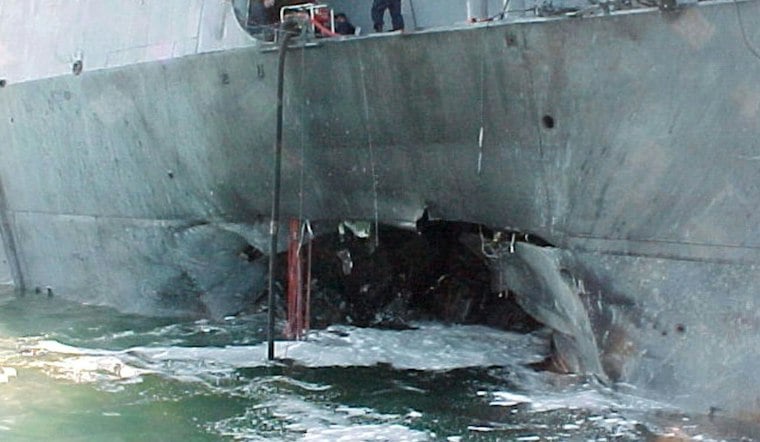
A Guantánamo Bay war court judge abruptly cut short pretrial hearings last Wednesday after the lead defense lawyer for accused USS Cole bomber Abd al-Rahim al-Nashiri suffered a medical emergency and had to be flown to Florida for urgent cardiac evaluation. The disruption lands just two and a half weeks before jury selection is scheduled to begin in what is Guantánamo’s longest-running capital case.
Army Col. Matthew Fitzgerald canceled the hearings after defense attorney Allison Miller's health crisis, according to Just Security. The naval base lacks advanced medical facilities and routinely medevacs patients to Florida for emergency treatment, underscoring just how fragile trial logistics remain weeks before the case is supposed to move forward. Al-Nashiri is accused of orchestrating the October 12, 2000 bombing of the USS Cole in the port of Aden, Yemen, an attack that killed 17 sailors, as reported by The Virginian-Pilot.
Miller is al-Nashiri's third capital defense lawyer. Lead attorney Richard Kammen resigned in 2017 after defense staff discovered listening devices hidden in private attorney-client meeting spaces at Guantánamo, and his successor, Anthony Natale, later retired from the case, per the same Just Security account. The revolving door of defense counsel has repeatedly derailed the case's progress over the better part of a decade.
A Trial Already Defined by Torture and Dropped Evidence
The case has been shaped for years by what happened to al-Nashiri before he ever reached Guantánamo. While in CIA custody from 2002 to 2006, he was subjected to waterboarding, mock executions with a power drill and a handgun, and prolonged stress positions, according to Just Security. Those interrogations cast a long shadow over the prosecution's evidence.
In August 2023, military judge Army Col. Lanny J. Acosta Jr. issued a ruling excluding al-Nashiri's 2007 confessions to FBI and NCIS investigators after finding they were tainted by the earlier CIA torture, as reported by Lawdragon. The ruling stripped prosecutors of key confession evidence. Beyond the Cole attack, al-Nashiri is also charged under military commission specifications with the bombing of the French oil tanker MV Limburg and a failed plot against the destroyer USS The Sullivans in February 2000, a plan that collapsed when the explosives-laden boat sank from overload, according to FindLaw.
Sanity Board Review Could Still Delay Jury Selection
Al-Nashiri's fitness to stand trial has emerged as another issue that could push back the proceedings. Defense forensic psychiatrist Terry Kuper evaluated al-Nashiri and diagnosed him with a traumatic brain injury and neurocognitive disorder, concluding he is mentally incompetent to stand trial, per Just Security's reporting. Al-Nashiri's lawyers attributed the brain injury to abuse in CIA custody. An earlier military medical board diagnosed al-Nashiri with PTSD and major depressive disorder.
The Virginian-Pilot reports that the judge ordered a sanity board evaluation, with a deadline of October 16. Al-Nashiri has been held by the United States since 2002 and was formally charged under the Military Commissions Act in 2011, according to Just Security.
Remote Witnesses and a Scramble for Jurors
Perhaps the most unusual wrinkle is how the government plans to present its case. With many trial witnesses expected, prosecutors have proposed that remote witnesses appear on a larger-than-life-size screen and answer questions from the courtroom, The Virginian-Pilot reports. Pretrial hearings already featured video testimony from the south of France, the United Arab Emirates and McLean in northern Virginia, with mixed results that included an inaudible witness, wobbly images and even a missile-alert interruption, according to the same account.
Defense attorney Jessica Manuele has asked the judge to move the trial to a U.S. courtroom. Lead prosecutor Clayton G. Trivett Jr. and his team plan to send a staff member with a laptop to willing witnesses who cannot travel, while the court can compel government employees to travel to Guantánamo Bay, the paper reports. Witnesses who refuse to appear at designated sites could be picked up by U.S. marshals, and remote witnesses will testify from Defense Department facilities, secure U.S. military bases and government offices. Three men convicted of terrorism crimes in federal court may also testify, though the base's naval commander might not allow them onto the installation for security reasons. Some surviving Cole sailors who may testify suffer from post-traumatic stress disorder, according to The Virginian-Pilot.
Lead prosecutor Clayton G. Trivett Jr. and his team plan to send a staff member with a laptop to willing witnesses who cannot travel, while the court can compel government employees to travel to Guantánamo Bay, the paper reports. Witnesses who refuse to appear at designated sites could be picked up by U.S. marshals, and remote witnesses will testify from Defense Department facilities, secure U.S. military bases and government offices. Three men convicted of terrorism crimes in federal court may also testify, though the base's naval commander might not allow them onto the installation for security reasons. Some surviving Cole sailors who may testify suffer from post-traumatic stress disorder, according to The Virginian-Pilot.
Jury selection is set to begin October 19, and the Pentagon plans to mobilize a pool of roughly 350 military officers worldwide, flying the first 36 pool members to Guantánamo that week to help select a final panel of 12 jurors and six alternates, per Just Security. The jury pool for military commissions is made up of military officers. Some lawyers have predicted the trial and any punishment phase could stretch through much of next year if al-Nashiri is convicted.
Global Fallout From the CIA's Secret Sites
For mainland media and victims' families who cannot make the roughly $800 roundtrip flight to the base, the War Department has arranged a live closed-circuit television feed of proceedings from Guantánamo's Expeditionary Legal Complex to Fort Meade, Maryland.
The Cole case is Guantánamo’s longest-running capital case, a milestone underscored in Hoodline's prior coverage of the 20-year detainee review involving another high-value prisoner subjected to the same black-site interrogation program.





