

























































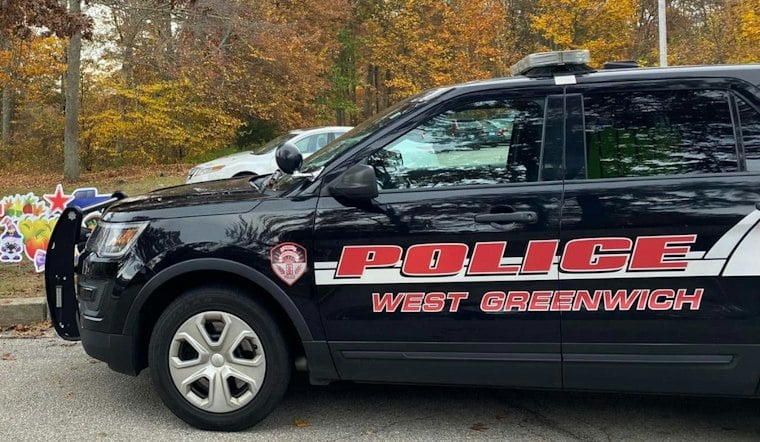
A West Greenwich woman's drunk-driving case took a far more serious turn after her passenger died nearly two weeks following the crash that hospitalized him. Barbara Sanford, 38, now faces a charge of driving while intoxicated resulting in death, after 55-year-old Joseph Rogowski succumbed to injuries he sustained when Sanford's pickup truck struck a tree on Falls River Road.
According to the WJAR report, the crash happened on September 9 when Sanford was driving on Falls River Road with two passengers in the vehicle. Rogowski, who was riding in the front seat, was taken to the hospital after the crash, while a rear passenger was uninjured, the station reports. The West Greenwich Police Department said Sanford was driving when the crash occurred and that the truck struck a tree.
At the scene, police suspected Sanford of driving while intoxicated, per the department's account relayed by the station. Officers administered field sobriety tests and offered her a breathalyzer, but she refused to take it, leading to a charge of refusal to submit to a chemical test alongside an initial charge of driving while intoxicated resulting in injury while Rogowski remained hospitalized.
Charge Upgraded After 13-Day Hospitalization
Rogowski died on September 22, 13 days after the crash, and prosecutors upgraded Sanford's lead charge to driving under the influence resulting in death. Under Rhode Island General Laws § 31-27-2.2, that felony carries a mandatory state prison sentence of 5 to 15 years, fines between $5,000 and $10,000, and a mandatory five-year license revocation upon conviction, according to the Rhode Island General Assembly. The station reports Sanford was held on surety bail following the upgraded charge.
Before Rogowski's death, Sanford's injury charge fell under a separate statute. Driving under the influence resulting in serious bodily injury is punishable by 1 to 10 years in state prison, fines from $1,000 to $5,000, and license revocation of up to two years under Rhode Island General Laws § 31-27-2.6, per the Rhode Island General Assembly.
Breathalyzer Refusal Carries Its Own Penalties
Sanford's decision to decline the breathalyzer triggered a separate civil process. Operating a vehicle in Rhode Island implies consent to chemical testing, and under state law, a first refusal is treated as a civil traffic violation carrying a license suspension of 6 to 12 months, fines of $200 to $500, 10 to 60 hours of community service, and mandatory alcohol counseling, according to Ellison Law LLC.
That refusal charge is handled separately from the criminal case. Drivers charged with chemical test refusal face an immediate administrative license suspension at arraignment before the Rhode Island Traffic Tribunal in Cranston, a civil process that runs apart from the felony DUI proceedings moving through criminal court, the firm's materials note.
Because Sanford refused testing, prosecutors will need to rely on field sobriety test results, officer testimony, and accident reconstruction to prove impairment beyond a reasonable doubt in Superior Court, according to a framework described by Bank & Munns. Refusing a breathalyzer is not an unusual choice among Rhode Island DUI suspects — Rhode Island Department of Transportation data shows roughly 70% of drivers arrested for DUI statewide decline chemical testing.
Statewide Numbers Show a Troubling Pattern
When drivers do submit to testing, the results tend to be stark. DUI suspects who agree to chemical tests register an average blood alcohol concentration of 0.16, double the state's legal threshold of 0.08, according to the Rhode Island Department of Transportation. State safety records further show that 84% of alcohol-impaired drivers involved in fatal crashes statewide had a blood alcohol concentration of 0.15 or higher.
Federal data underscores how heavily alcohol factors into Rhode Island's road deaths. National Highway Traffic Safety Administration figures show 37% of the state's 52 traffic fatalities in 2024 involved a driver with a blood alcohol concentration of 0.08 or higher, exceeding the national average of 30%, as reported by Patch.
The crash also lands amid a concerning statewide trend. National Safety Council data released in September revealed Rhode Island recorded 22 motor vehicle deaths in just the first six months of 2026, a notable mid-year increase after total traffic fatalities had dropped 29% statewide in 2025, according to Providence Business News.
West Greenwich itself is a sparsely populated, heavily wooded town in western Kent County, where winding rural roads like Falls River Road present roadside hazards that make single-vehicle tree impacts a recurring crash scenario in the municipality, according to background cited from the Rhode Island Supreme Court. The case against Sanford will now proceed through Kent County Superior Court on the felony charges, while the civil refusal matter moves separately through the Rhode Island Traffic Tribunal. Sanford's allegations remain pending, and she has not been convicted of any charge.





