

























































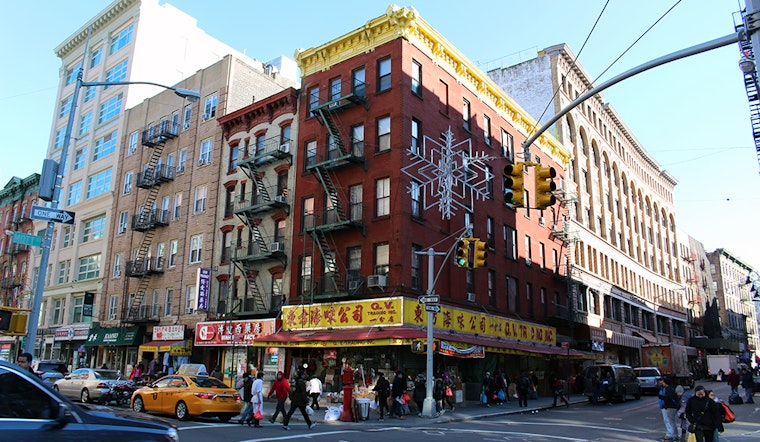
Little Italy was once home to almost 10,000 Italian Americans who immigrated to New York City in the late 1870s. At its prime, the neighborhood extended all the way to Houston Street on the north; Worth Street on the south; Lafayette Street on the west; and Bowery on the east.
It was densely packed, and full of tenements and food shops — some of which still exist today. Although the neighborhood is only a fraction of the size it once was, walking through its streets still serves as a small reminder of the city's cultural history.
Today, Little Italy is only three blocks long on Mulberry Street. In the mid-20th century, after restrictions were removed due to the U.S. Immigration Act of 1965, Chinese immigrants flooded into the adjacent neighborhood, causing the expansion of Chinatown and the loss of Little Italy.


As the largest enclave of Chinese people in the Western Hemisphere, Chinatown is now home to an estimated population of 90,000 to 100,000 people.


As bordering neighborhoods, Little Italy and Chinatown merge together rather seamlessly. Having traveled to both China and Italy, I love exploring this part of New York. It’s a bit strange, yet fascinating, to watch the storefronts suddenly change. I always feel as if I’ve just traveled arcross one continent to another. The other day, for instance, I had lunch at a Chinese restaurant and then crossed the street for cannoli and gelato.
It was all very nostalgic for me.



