

























































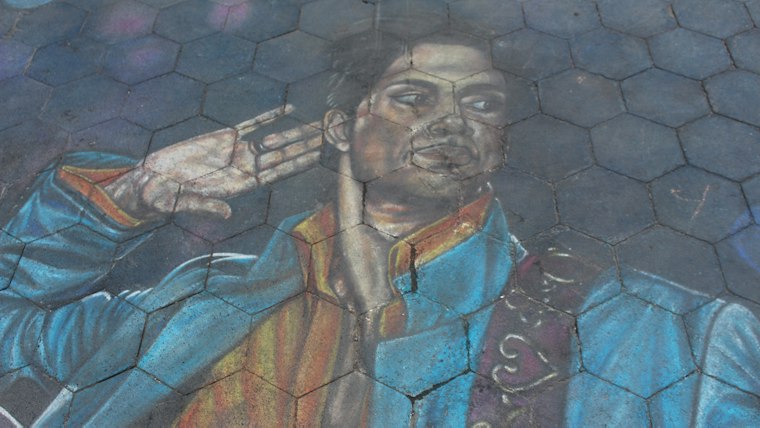
In a technology-driven age, where artists are flocking to all sorts of digital media, Hani Shihada keeps it old school by using New York City sidewalks as his choice of canvas. Wander through the city and you’ll eventually find him with soft pastels in his right hand, pushing colors into the rough surface of the ground.
Though his tools are modest, Hani has decades of experience under his belt. He began doing sidewalk art in the late '70s when he was still studying art in Rome. Because he couldn’t afford to pay for his schooling, he took to the streets in order to continue to pursue his passion. His “love affair with art in the public sphere” grew from there and has never stopped growing since then.
“My dream [has] really been fulfilled. I was really so afraid of not finding a job that I wanted to do. Something that makes me happy,” he states in a video interview with The Daily's 'Americana.'
Today, Hani is widely considered to be New York City’s original — and only — sidewalk artist.
Although chalk art is not a new practice (people have been doing it for over 400 years as a form of entertainment), Hani’s work is unique as it is not anamorphic. Many artists have to rely on a camera trick in order to make their pieces three-dimensional. Hani’s art, on the other hand, is neither stretched nor skewed. Rather, it’s 3-D from every angle.
Sidewalk piece by British chalk artist, Julian Beever, who creates chalk drawings using anamorphosis
On average, it takes Hani about three to five days to finish a painting. The work itself is ephemeral, but there is a mystic quality to sidewalk art that is not present in other forms of art.
“It belongs to the sidewalk. Nobody owns it and everybody owns it,” he states.
“This is why people feel so close to it and even protective about it…Even homeless people...[they say] ‘what are you doing. Have you no respect? Get off that painting.’”
Body photo courtesy of Lee Jordan; licensed via CC-SA 2.0



