

























































I was elated to see a decorated light pole on a side street in Long Island City. Covered in blue and yellow mosaic tiles, the base of the fixture flaunted a stylized interpretation of a sunflower, adding a bright pop of color to the otherwise dull gray of the city.
I’ve seen similar ones like it, made by Jim Power, the “Mosaic Man,” on the Lower East Side.

If you haven’t already taken notice of his colorful light poles, head over to the East Village and walk along the stretch of the street between Avenue A and Broadway, known as the Mosaic Trail. Most of Power’s work — made from tiles, coins and fragments of dishes — can be found on 8th Street.
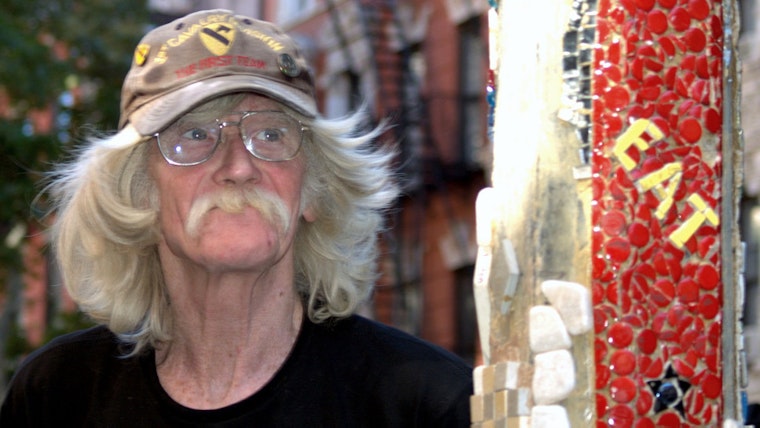
Over the years, Power has established a legendary reputation for himself through his artwork. But before he took to the streets with cutters, glue and pieces of salvaged dishware, Power served time in the military. After returning from the Vietnam War with undiagnosed Post-Traumatic Stress Disorder, he settled down in the East Village and worked briefly as a carpenter. However, like many other displaced veterans before him, Power eventually found himself homeless.

Photo via David Shankbone (CC BY 2.0)
It wasn’t until 1985 that he began working on his first mosaic. The creative process was largely therapeutic for Power, who enjoys working outdoors. Over the years, he continued to design pieces focused around the history of lower Manhattan; there's a piece dedicated to the long-gone Fillmore East rock club and a "gangster pole," which features portraits of Al Capone, Lucky Luciano and John Dillinger.

The former Fillmore East rock club (Photo via Fletcher6 | CC BY-SA 3.0)
According to Power’s website, the Mosaic Trail is one of the largest and longest-lasting examples of public art. Unfortunately, only a fraction of the original pieces remain due to vandalism and Rudolf Giuliani's anti-graffiti campaign, which took down 50 lamp posts during the late '80s and early '90s.
The remaining few were spared due to public protests, but it wasn't until 2004 that Michael Bloomberg officially granted Power permission to work on public property through a signed proclamation, which thanked him for "beautifying the city with distinctful, artful mosaics.”

In the years following the proclamation, Power has kept busy restoring and maintaining his work. Much to the delight of the community, he recently signed a contract with the city to take part in the $16 million restoration effort of Astor Place.
Prior to signing the agreement, Power tore down some of his mosaics as a “preemptive strike against the city," which had planned to remove and store seven of his pieces during the redesign process. Although the lamp posts were set to be preserved as historic artifacts, Power grew increasingly frustrated when he couldn’t get a firm commitment about when and where the artwork would be reinstalled.

A view of Astor Place in 2011 (Photo via DW labs Incorporated / Shutterstock.com)
Finally, after nearly a decade of construction and deliberation, the newly renovated Astor Place is officially set to be dedicated in September, and part of the Mosaic Trail has been restored along with it. Aided by monetary assistance from crowdfunding websites, Power began working on the poles this spring.
To celebrate the occasion, the Village Alliance will host Astor Alive! Festival, a free event taking place on September 16th and 17th. Among other updates, visitors will get to experience a revamped Cooper Triangle Park and a new Village Plaza along Cooper Square. Power will also debut his mosaic poles on September 15th.
Cover photo via David Shankbone (CC BY-SA 3.0)



