

























































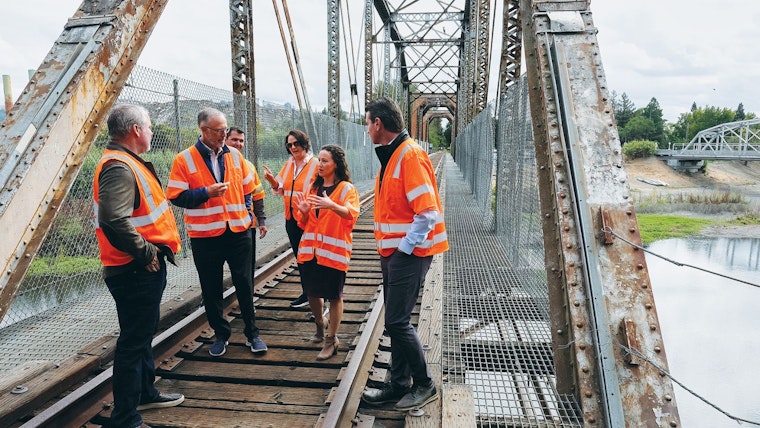
Today, the Sonoma-Marin Area Rail Transit District (SMART) announced the receipt of a $32 million grant, which signifies a significant milestone in the agency's journey to extend passenger rail services to Healdsburg and Cloverdale. This grant consists of $28 million for a Positive Train Control (PTC) system implementation and $4 million to replace high-emission freight locomotives with sustainable Tier IV switcher locomotives. With the invaluable support of Congressman Jared Huffman, this transformative project will strengthen accessibility to vital services while reinforcing greenhouse gas reduction and climate resiliency efforts.
Originally built over a century ago, this publicly-owned rail line has been essential for the region's transportation needs. Through reliable transportation services, communities can access necessities such as education, healthcare, and employment. As reported by SMART, extending rail services to Healdsburg, Cloverdale, and Windsor will unlock opportunities for residents along the entire SMART corridor.
According to Congressman Jared Huffman, the long-awaited grant was made possible by widespread community support for the northern extensions through the application process. In a statement, Rep. Huffman emphasized the role of SMART as a "vital artery" in connecting communities and commerce throughout the North Bay. Extension projects, such as this one, are vital for enabling the region to adapt to a changing climate and better serve those who rely on SMART's services.
Eric Lucan, SMART Board Chair, further highlighted the foundational significance of this milestone. He described the grant as a testament to the incredible momentum the project has achieved, driven by community support and the agency's steadfast commitment to extending rail services north. Each component of this Consolidated Rail Infrastructure and Safety Improvement (CRISI) funded project will contribute to better services and experiences for passengers and communities alike. The PTC Systems will enhance safety and efficiency on the rail line, while the Tier IV switcher locomotives will provide environmentally-friendly and reliable freight services.
Construction on the fully-funded extension to Windsor will resume this fall, while the Healdsburg rail extension has already secured $106 million of grant funds – an estimate of 65% of the required funds to complete the project. As SMART stated, passenger rail service is a vital part of the North Bay's economy, and extending the railway northward will yield benefits in the form of improved housing, business, and community infrastructure, as well as creating hundreds of construction jobs.
Upcoming projects include constructing a new second station serving Petaluma and 12 additional miles of multiuse pathway, which will be completed in early 2025. Bicycle and pedestrian pathway extensions, as well as connecting people to SMART passenger services for first- and last-mile transportation choices, will be included in the extensions to Windsor, Healdsburg, and Cloverdale. Upon completion, the pathway will be part of the Great Redwood Trail system, connecting communities from Marin to Humboldt County. SMART has already been a popular mode of transportation for various purposes, and with 15% of riders bringing bicycles aboard the trains, the extension projects will further serve the needs of a diverse range of passengers.
SMART recently launched SMART Connect, an on-demand microtransit shuttle service that links the SMART Sonoma County Airport Station to the Charles M. Schulz Sonoma County Airport.




