

























































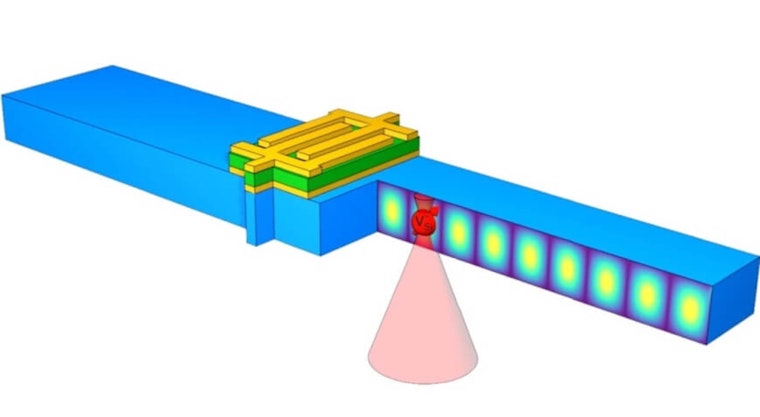
Acoustic resonators are key components in modern electronics, ensuring signal quality in devices such as smartphones, Wi-Fi, and GPS systems. Despite their significant role, current methods for analyzing their wear and tear are limited. However, new research conducted by the Harvard John A. Paulson School of Engineering and Applied Sciences (SEAS) and the OxideMEMS Lab at Purdue University sheds light on a potentially revolutionary approach. The researchers have explored the use of atomic vacancies in silicon carbide to analyze the health and quality of acoustic resonators. The advancements could also contribute to a new line of acoustically-controlled quantum information processing.
In the study, silicon carbide was described by Senior Author Evelyn Hu as a "readily available commercial semiconductor" that shows potential in transforming how we monitor and manage acoustic resonators. The Hu Group at Harvard SEAS, in partnership with Purdue University researchers, showed how atomic vacancies or defects could also aid acoustically-controlled quantum systems.
Today's methods for analyzing the properties of acoustic resonators often involve destructive, expensive techniques, such as high-power x-rays. This research, however, proposes for a more efficient and non-destructive alternative. Silicon carbide, a standard material in microelectromechanical systems (MEMS) production, becomes helpful when its naturally occurring atomic vacancies interact with sound waves, giving scientists the ability to monitor and control resonators with light signals. Co-author Aaron Day, a Harvard SEAS graduate student, explains that light fluctuation comes with valuable data on the acoustic environment around an atomic defect, creating a detailed acoustic wave map within the resonator.
Apart from this, these atomic defects in silicon carbide could serve as qubits in a quantum system. This proposes an entirely new way of controlling essential elements of quantum information processing. Through mechanical deformation of silicon carbide, precise qubits control can be achieved while extending the coherence times in the quantum state. Launching acoustic waves in silicon carbide opens up a path for learning the intrinsic properties of materials and controlling quantum states within. Hu noted that this unprecedented level of material manipulation is a significant step toward enhancing quantum systems.
The research project involved collaboration between Hu and Day at Harvard, and Professor Sunil Bhave and researcher Boyang Jiang at Purdue University's OxideMEMS Lab. The team thanks the National Science Foundation, specifically the RAISE-TAQS Award 1839164 and grant DMR-1231319, for their financial support. Their joint efforts have paved the way for new applications for silicon carbide and sound waves, opening doors for the advancement of acoustic resonator technology and quantum information processing.





