

























































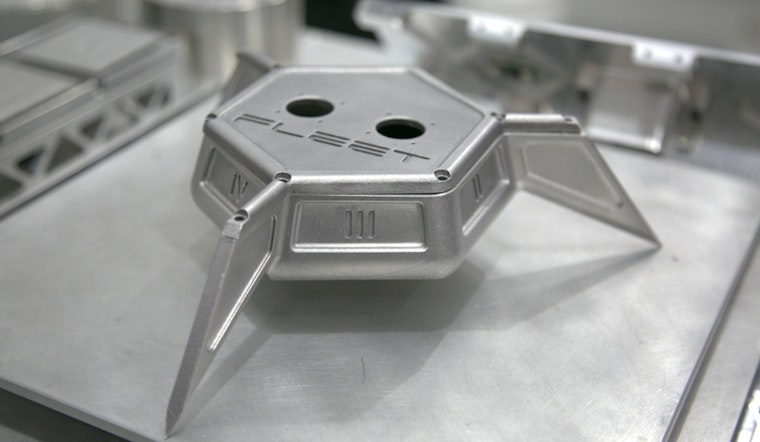
The lunar surface may soon reveal its hidden secrets as a SPIDER crawls its way into space. According to KXAN, the Seismic Payload for Interplanetary Discovery, Exploration & Research (SPIDER) is a diminutive yet potent instrument, akin to the size of a human hand, that will scan the moon's subterranean layers. The Australian company Fleet Space is collaborating with Cedar Park's Firefly Aerospace to deploy SPIDER aboard the Blue Ghost II lander, targeting a 2026 launch. Matt Pearson, Fleet Space’s Chief Exploration Officer, told KXAN, "For all we know, the subsurface of the moon may as well be made out of Swiss cheese like we really don’t know." This device holds promise for future colonization endeavors, extending its utility to both lunar and Martian landscapes.
Firefly Aerospace, pinpointed for their role in the upcoming mission, will also dispatch an array of experiments onboard their lunar landers in 2024 and 2026. As KXAN reports, Farah Zuberi, the mission manager for the Blue Ghost lunar landers constructed by Firefly, noted the complexity of adapting the landers to accommodate diverse payloads such as SPIDER. "Each lunar payload is so different, it has unique interfaces, it has unique missions," Zuberi said. The forthcoming Blue Ghost I is slated to touch down in the Mare Crisium region on the moon in 2024, while the successor, Blue Ghost II, will venture to the moon's far side with SPIDER in tow.
On the heels of an exciting period of growth, Fleet Space Technologies has just completed an A$50M Series C funding round, as per Fleet Space Technologies. This investment solidifies the company's A$350 million valuation after successfully scaling its EXOSPHERE technology. Whether deployed on Earth or the moon, EXOSPHERE and SPIDER are set to offer fresh perspectives and contribute to the responsible exploration and potential settlement of new worlds.
The 2026 lunar mission is not only a feather in the cap for Fleet Space but a significant step in international space collaboration. SPIDER, backed by an A$4M grant from the Australian Space Agency, might become Australia's galactic claim to fame as it aids in the search for water ice deposits on the Moon. "Humanity is on the brink of making tremendous strides in our scientific understanding of the lunar regolith by using advanced seismic technologies to acquire deeper insights about the Moon’s subsurface. Technologies like SPIDER, will become key enablers of our long-term efforts to sustain life on the Moon and beyond," Pearson stated in an announcement obtained by Fleet Space Technologies. Integrating SPIDER into Firefly’s Blue Ghost Mission 2 emphasizes the technological prowess and international space cooperation inked by recent agreements between the leaders of Australia and the United States.





