

























































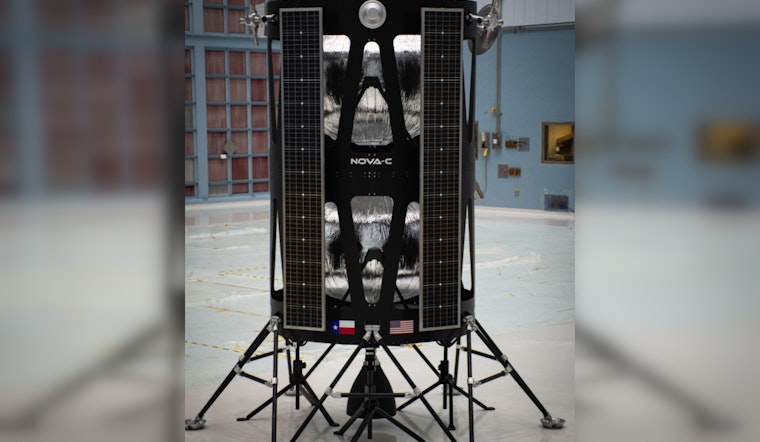
As Houston lays claim to its storied past with the Apollo missions, a new chapter in lunar exploration is set to be written by Intuitive Machines, a local space upstart with its sights fixed squarely on the moon. With a tentative launch date set for January 12, Intuitive Machines' Nova-C lander aims not only to etch its name into history as the first commercial craft to achieve a soft landing on the lunar surface but also to signal the return of American technological prowess to the dusty plains untouched by Earthly feet since Apollo 17 in 1972.
The stakes for the mission, appropriately dubbed IM-1, cannot be overstated—not only for intuitive machines but for a burgeoning industry watching closely. As Tim Crain, co-founder and chief technology officer of Intuitive Machines, pointedly put it in a statement obtained by the Houston Chronicle, "This is about to hit the real universe. And then we'll find out." These challenges aren't mere abstractions; they're echoes of the crashes suffered this year by Japanese and Russian lunar efforts—stark reminders of the razor's edge on which space exploration balances.
Intuitive Machines' Nova-C lander, standing at over 14 feet tall and weighing close to 1,500 pounds, is slated to conduct two weeks of research on the moon, as detailed to Houston Public Media. The spacecraft counts amongst its tasks studying the plumes of debris stirred up by its gentle touchdown, crucial for safeguarding future manned missions and their equipment. Moreover, in a dramatic flourish that Houston itself would appreciate, Nova-C will capture footage of its descent by unfurling cameras back at itself, creating an interstellar "selfie" that promises to be as much a tool for science as a captivating morsel for the public's imagination.
Yet it's not just cameras looking upwards but also human eyes as Houston becomes the epicenter of lunar exploration yet again. More than fifty years after the iconic Apollo missions, Houston will once again guide a voyager upon the moon's desolate expanse. IM-1 will be monitored from a Clear Lake office building merely a stone's throw from the Johnson Space Center, but in Intuitive Machines' very own mission control, Nova Control. There is no shortage of confidence or engineering acumen behind the mission; Steve Altemus, CEO of Intuitive Machines and former deputy director for the Johnson Space Center, shared an infectious enthusiasm in a statement to the Houston Chronicle, declaring, "NASA has actually ceded the infrastructure development to the commercial sector of space. It's just an incredible challenge. And to be the first for the United States to return to the moon in 50 years, why wouldn't I jump in?"
If the stars align and Nova-C touches down successfully, intuitive machines will join an elite group of moonlanders and inaugurate a new era of space travel where commercial endeavors stride alongside national programs.





.jpg)