

























































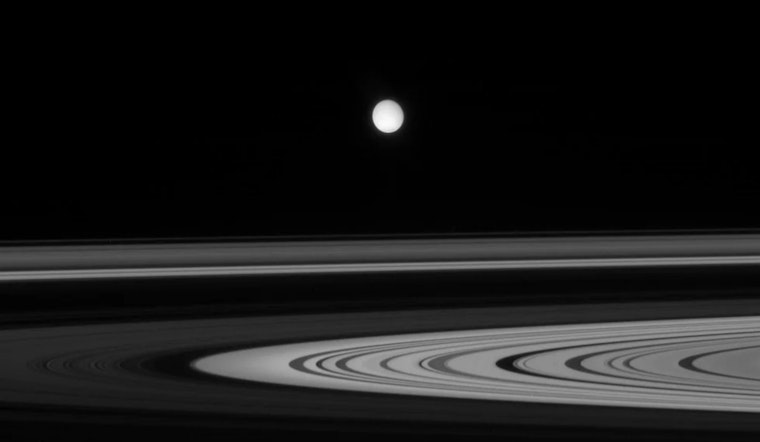
A joint Harvard-NASA study has vaulted Saturn's moon Enceladus to the top of the list for extraterrestrial life prospects within our solar system, according to a report published in Nature Astronomy. The study, spearheaded by Jonah Peter, a biophysics graduate student at the Griffin Graduate School of Arts and Sciences, has confirmed the presence of hydrogen cyanide—a toxic gas that is nevertheless fundamental to the formation of life—emitting from the water vapor plumes on Enceladus's surface.
Previous missions, like NASA's Cassini-Huygens, have informed researchers that Enceladus harbors organic compounds in its ice grains, but the discovery of hydrogen cyanide suggests the possibility of habitability is even greater, despite it being poisonous on Earth, the presence of hydrogen cyanide in Enceladus's plume is a significant marker as it is essential for the synthesis of amino acids which are organic compounds crucial to the development of life, its molecular versatility earns it the nickname "Swiss army knife" of amino acid precursors," according to the Harvard Gazette. Though far from suggesting life currently exists on the moon, this evidence indicates Enceladus meets basic conditions for habitability.
Not only is Enceladus ripe with these essential molecular ingredients, but the research, significantly advanced by Peter's tenure at NASA’s Jet Propulsion Laboratory, shows this celestial body boasts an ocean underneath its ice surface abundant in chemical energy sources. These sources include several organic compounds, some paralleling those on Earth that fuel organisms. “Our results demonstrate that Enceladus is host to some of the most important molecules for both creating the building blocks of life, and for sustaining that life through metabolic reactions,” Peter told the Harvard Gazette.
The paper's 2017 findings pointed to the presence of carbon dioxide, methane, and hydrogen, elements indicating potential for methanogenesis—a process where microbes produce methane and one that might have been crucial for the development of life on Earth, yet Peter's latest investigation takes this further uncovering an array of oxidized organic compounds that suggest a multitude of chemical pathways could sustain life in the subsurface ocean of Enceladus because oxidation helps drive the release of chemical energy, crucial for life processes. Though the existence of life forms has yet to be confirmed, this study opens doors to experimentally testing such chemical pathways for life's genesis in laboratory settings.
Scientists caution, however, that hard evidence of life on Enceladus is still beyond our grasp. Nevertheless, the study lays out possible chemical routes for the formation of life, routes that scientists can now explore with experimental rigor.





