

























































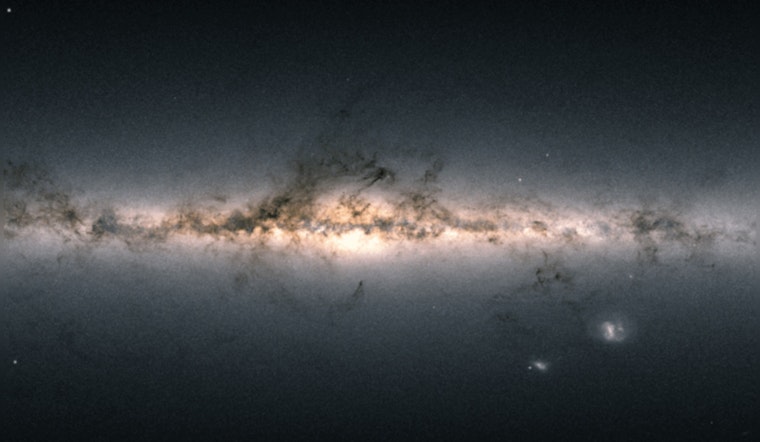
In an intriguing twist of cosmic affairs, MIT physicists have measured the movement of stars at the outskirts of our galaxy and found they're cruising at a more leisurely pace than stars hustling near the Milky Way's bustling center — hinting at a possible shortfall in the galaxy's dark matter stash. According to a study published in the journal 'Monthly Notices of the Royal Astronomical Society', the discovery casts doubt on previous estimates which suggested a beefier concentration of this elusive substance at the galactic core.
The MIT team harnessed data from the Gaia space telescope, partner to the ground-based APOGEE survey, crunching numbers on over 33,000 stars, some almost 100,000 light years away; by plotting the speeds and distances they compiled a new spin on the galaxy's rotation curve that went against the grain, departing from the expected flat line to a downward dip, Lina Necib, assistant professor of physics at MIT, was quoted in the statement saying "What we were really surprised to see was that this curve remained flat, flat, flat out to a certain distance, and then it started tanking," highlighting the stars' unexpected deceleration.
This unanticipated stellar slog in the Milky Way's outer lanes has rattled the astrophysics community, prompting a recalibration of the dark matter map that would characterize the galactic core as lighter than what scientists assumed, making waves by challenging the consensus carved out over decades. Necib told MIT News, "There is something fishy going on somewhere, and it's really exciting to figure out where that is, to really have a coherent picture of the Milky Way."
The study, inflamed by newfound data from Gaia including stars as far as 30 kiloparsecs from the Milky Way's gravitational heart, propels this research beyond the 2019 efforts of Anna-Christina Eilers, who hinted at a similar pattern though her dataset concluded at a merer 25 kiloparsecs, at such extreme distances, according to MIT physicist Anna Frebel, "we're right at the edge of the galaxy where stars start to peter out," — echoing the sentiment that we find ourselves at the threshold of uncharted spatial territories, where fewer cosmic cues guide our understanding.
The shake-up in stargazing is happening with the backing of the National Science Foundation. They are supporting initiatives to map the Milky Way in unprecedented detail and unravel the mysteries of dark matter, which remains a puzzle in astronomical research.





