

























































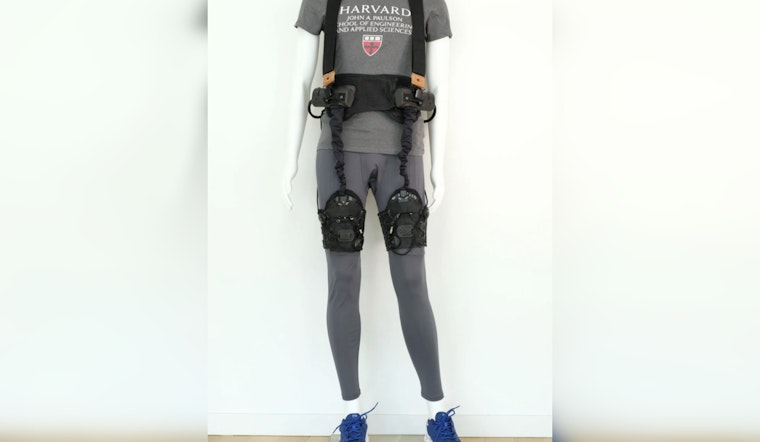
In a major breakthrough for Parkinson's disease patients, Harvard John A. Paulson School of Engineering and Applied Sciences (SEAS) and Boston University's Sargent College of Health & Rehabilitation Sciences have come up with a high-tech solution to one of the disease's most challenging symptoms. As reported by the Harvard Gazette, a soft robotic exosuit targeted at alleviating 'gait freezing,' enables smoother movement for those afflicted by this often incapacitating symptom.
Despite the range of treatments currently available, consisting of drugs, surgery, and behavioral strategies, many Parkinson's patients still suffer significant disruptions to their mobility. The robotic garment, which aids in extending the wearer's stride by gently nudging the hips during leg swings, could spell the end for this irritating symptom, providing hope for over 9 million people worldwide grappling with Parkinson’s disease.
“We found that just a small amount of mechanical assistance from our soft robotic apparel delivered instantaneous effects and consistently improved walking across a range of conditions for the individual in our study,” Conor Walsh, a professor at SEAS, told the Harvard Gazette. The study's findings, demonstrating the potential of soft robotics in treating Parkinson's Gait Freezing, have been published in Nature Medicine.
Following trials with a 73-year-old participant who faced over ten debilitating freezing episodes daily, this device showed game-changing promises. Dependent on a scooter for mobility and struggling with the limitations of available treatments, the intervention of the exosuit enabled the man to walk without freezing indoors and minimize incidents outdoors significantly. "The suit helps me take longer steps and when it is not active, I notice I drag my feet much more. It has really helped me, and I feel it is a positive step forward. It could help me to walk longer and maintain the quality of my life," the participant conveyed during one of the study visits to researchers.
This innovation leverages cable-driven actuators and sensors worn around the waist and thighs, employing motion data and algorithms to sync assistive forces with muscle movement. The SEAS team, in collaboration with experts in various fields, managed to harness technology to address the persistent issue of gait freezing, which has long mystified medical professionals.
As the research garners attention, it paves the way to not only improve mobility but also presents opportunities to dissect the underlying mechanisms of gait freezing. "Because we don’t really understand freezing, we don’t really know why this approach works so well," Terry Ellis, a professor at Boston University, was quoted saying in the Harvard Gazette article. Nevertheless, the outcomes hint at a revolutionary 'bottom-up' approach to tackling Parkinson’s debilitating freeze.





