

























































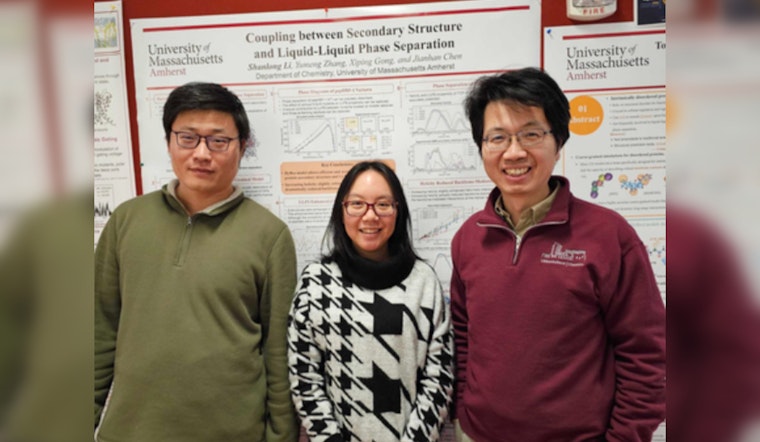
In a significant stride within the realm of molecular biology, researchers at the University of Massachusetts Amherst are shedding light on the behavior of intrinsically disordered proteins (IDPs), notorious for their role in a myriad of diseases including cancer and neurodegenerative disorders. These elusive proteins, comprising approximately one-third of all human proteins, and with a two-thirds representation in cancer-associated proteins, have been challenging to model due to their complex, unstructured nature.
According to details furnished by UMass Amherst's news release, Professor Jianhan Chen's team has developed a sophisticated simulation technique, advancing our understanding of how IDPs drive phase separation—a key biological process that until about 15 years ago was not recognized as being fundamental in cellular function. “Phase separation is a really well-known phenomenon in polymer physics, but what people did not know until about 15 years ago was that this is also a really common phenomenon in biology,” reported Professor Chen.
The study, appearing in the Journal of the American Chemical Society, showcases the fruits of the computational biophysics and biomaterials lab led by Chen. The newly created model, known as the hybrid resolution (HyRes) force field, harnesses the power of GPU acceleration, allowing researchers to simulate the behavior of IDPs more effectively and accurately than ever before. This breakthrough, integral to one chapter of lead author Yumeng Zhang's doctoral research at UMass Amherst and his upcoming postdoctoral work at MIT, offers potential paths for developing interventions for diseases linked with these disorderly proteins.
Fascinating insights on the condensate stability of two significant IDPs were achieved using Chen's HyRes simulations. “I actually did not anticipate that it could do such a good job at describing phase separation because it’s a really difficult phenomenon to simulate,” Chen declared. This tool not only fills a void in the existing simulation capabilities for IDP phase separation but also lays the groundwork for exploring how single mutations can affect these processes.
Chen and his research squad are now stretching their ambitions to include larger-scale simulations involving more complex biomolecular mixtures. His next aim involves piecing together a similar model for nucleic acids to address instances where phase separation includes both proteins and nucleic acids, seeking to shed light on a greater number of systems—a sentiment echoed by one postdoctoral researcher in Chen's laboratory, Shanlong Li.
Gravitating beyond the bench, this development is suspected to invite a new era of therapeutic strategies aimed at treating diseases spawned by the dysfunction of disordered proteins. It underscores the power of computational innovation to unravel molecular mysteries, empowering scientists to venture deeper into the cellular cosmos that dictates human health.





