

























































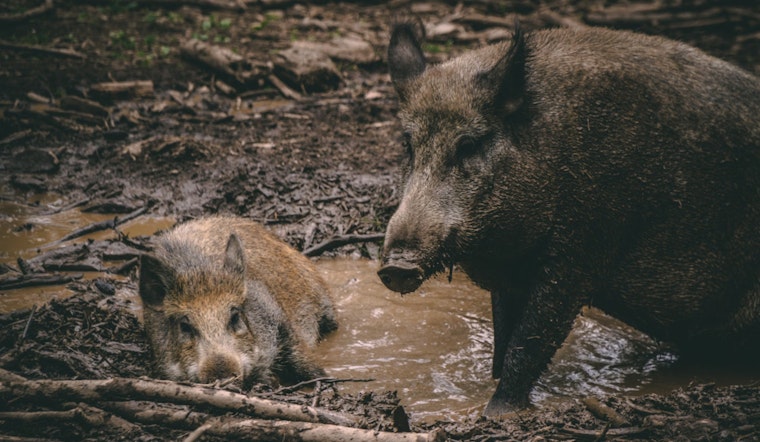
In Texas, the boar war rages on, with an unlikely twist in the narrative. While the feral hog problem in Texas has been labeled as the worst in the nation, causing a financial ruckus to the tune of $2.5 billion in agricultural damages annually, a recent study from Aarhus University in Denmark dares to upend the long-held belief that these "invasive" creatures are an ecological disaster on hooves.
According to the Houston Chronicle, the Danish researchers have dug into the data and now claim that these feral hogs are no more detrimental to Texas' plant life than the state's native animals. The study, which appeared in Science Magazine, suggests we maybe should think twice before rushing to exterminate these bristly beasts. It turns out, according to the researchers' findings, that traits like how selective the mammal is about its diet are more strongly correlated with the animal’s effect on plant life, effectively debunking the myth that just because the hogs aren't from around here, they're bad news for the local flora.
Meanwhile, researchers from the University of Georgia, working on behalf of Captain Experiences – a company that provides hunting and fishing junkets – have painted a far less flattering picture. They've counted 2,425 feral hog reports in Texas alone, with the porcine marauders roaming 99.6% of the state's counties, as reported by KHOU. Yes, Texas has the dubious honor of leading the national pack in this category, leaving the second-place state of Georgia wallowing behind with just 1,377 reports.
A postdoctoral researcher, Erick Lundgren, took to X to underline the importance of the shocking study, stating that people need to be "very cautious with how we assign notions like ‘harm’ to the impacts of introduced organisms." He lamented about the prevailing logics of invasion biology, which, according to him, are quick to dub anything done by a non-native species as 'harmful' merely because they do not 'belong.' It's a sentiment that's a far cry from the battle cries heard around Texas as officials and landowners grapple with the feral hogs' rampant destruction.
Delighted to see this paper finally published! Thank you to @JCSvenning, the fantastic coauthor team, and to @ScienceMagazine. [1/14] 🧵https://t.co/nKup5qqrE5
— Erick Lundgren (@ejlundyyy) February 2, 2024
The feral hogs, these ravenous rooters that can grow up to 5 feet long and tip the scales at 400 pounds, have long been the bane of Texan farmers and ranchers. Despite this, the study from Aarhus University found that these feral pigs, described as "dietary generalists," can actually increase plant diversity – a notion that's likely to raise eyebrows as high as the tallest Texan sunflower. "At times doubling native plant diversity by suppressing competitive dominants," these hogs may just be the wild card in a complex ecological deck. Still, you would be hard-pressed to find enthusiastic support for welcoming them with open arms, or open fields, for that matter.





