

























































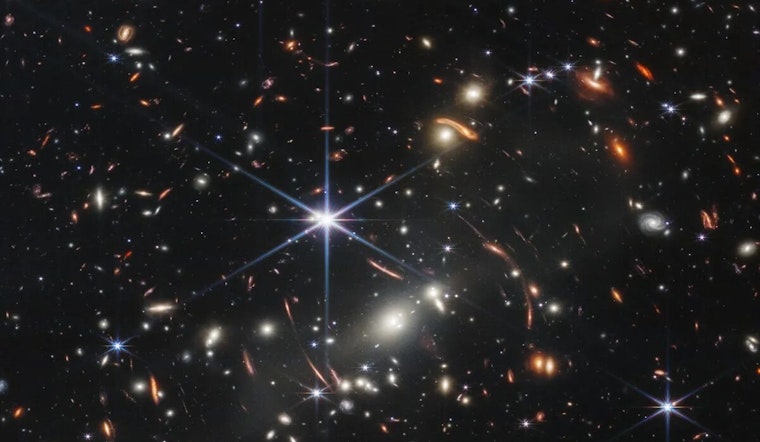
Astronomers at the University of Texas have been peering through the James Webb Space Telescope (JWST) and finding something boggling: ultramassive galaxies in the early universe that, based on current scientific understanding, shouldn't exist in their behemoth forms yet. These galaxies, shining with a light suggesting a mass on par with our present-day Milky Way, have been detected in the nascent cosmos, where, according to the established hierarchy of cosmic development—small to large—these giants appear far before their time.
Julian Muñoz, an assistant professor of astronomy at The University of Texas at Austin, explained the predicament, stating, "When we say mass, there's a trickery here." He continued, "We can't go and weigh a galaxy in space. So we have to translate the light we see with our telescopes, into how many stars, how heavy are the stars, and these ultra massive galaxies are galaxies that are way too heavy," according to KXAN.
However, further investigation suggests that the JWST observations of these numerous ultramassive galaxies do not necessarily overturn decades of cosmological thought. A more recent study co-authored by Muñoz indicates that while the surprising presence of these cosmic behemoths does not mandate a revision of the standard cosmological model, it certainly raises questions about the formation and evolution of the first galaxies. Muñoz said, "We’re opening a window to the unknown. We are now able to test our theories about the universe where we haven’t been able to before," as per the University of Texas at Austin.
Professor Muñoz said, "The stuff that falls into the black hole (is) emitting light. And because these black holes are at the center of galaxies, you actually get a lot of stuff falling in a lot of stuff emitting light," he told KXAN.
Some might wonder if we are exchanging one conundrum for another: the problem of ultramassive galaxies for the problem of an overabundance of black holes. "And in a way, I find it equally exciting," Muñoz said in a statement obtained by KXAN. "Because too many black holes still mean that there’s something we don’t understand."





