

























































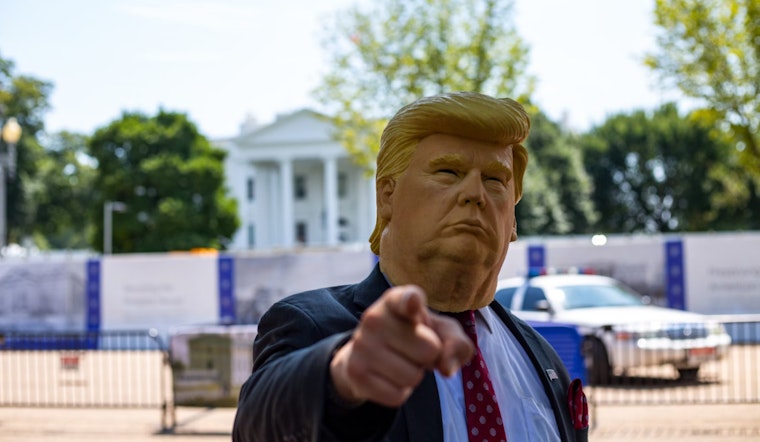
In a landmark decision, New York Supreme Court Justice Arthur Engoron slapped former President Donald Trump and his family-run Trump Organization with a hefty bill. According to The Washington Post, on Friday, Engoron ordered Trump to pay more than $350 million in penalties as a consequence of a civil fraud trial pursued by New York Attorney General Letitia James.
Probing deep into the administration's financial dealings, the trial unveiled a variety of misrepresentations that Justice Engoron called out as misleading to banks and other financial institutions. Notably, Trump's estimated wealth was inflated in these dealings, with false property values taking center stage. Trump, for his part, has remained defiant throughout the process, dismissing the trial and its findings as a "Complete and Total sham," according to an outburst on his Truth Social platform. In his words, the trial represented "an illegal, unAmerican judgment against me, my family, and my tremendous business."
But the verdict isn't a solitary blow against Trump alone; his sons Donald Trump Jr. and Eric Trump are feeling the sting as well. Justice Engoron has imposed $4 million fines on both of the former president's elder sons, further barring them from corporate directorships within New York for two years. In reported statements obtained by Fox 5 Atlanta, Attorney General James called the verdict "a tremendous victory" and a bastion of accountability for any individual, irrespective of power or wealth.
Amid the hefty financial burdens, the ruling also temporarily excommunicates Trump from New York's corporate echelon. For the next three years, Trump is prohibited from taking up officer or director roles in any corporation based in New York, a hit to his status as a business mogul. Engoron was unmincing in his language, stating that without such penalties and controls, Trump and his company were "likely to continue their fraudulent ways." Such sentiments were echoed by Trump's attorneys, who decried the ruling as "manifest injustice," signaling their intention to challenge the verdict as soon as the opportunity arises.
The implications of the ruling are vast, potentially shaking the foundation of Trump's empire. Even so, what stands out is the confrontation between the Trump narrative of boundless success and the judicial framing of misconduct. In the end, the fight seems to be between Trump's view of his financial empire and an established legal system placing its thumb on the scale, demanding rectitude in dealings both public and private.





