

























































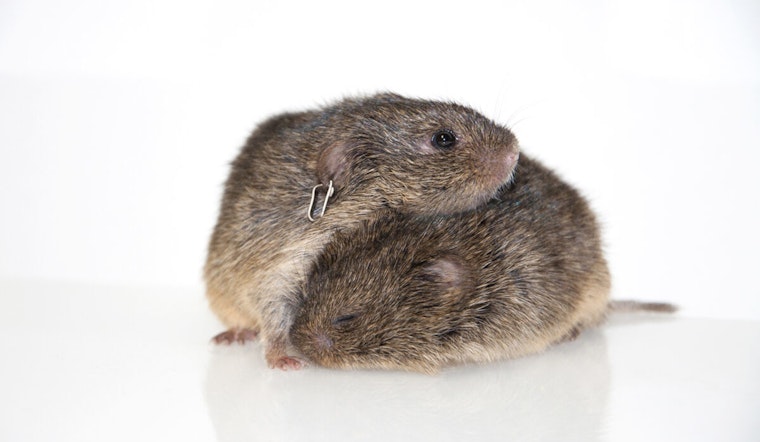
A groundbreaking study conducted by scientists, including Steven Phelps of The University of Texas at Austin, has provided insight into the complex neural tapestry woven by intimacy and mating. As reported by UT News, the research, employing prairie voles known for their monogamous bend, reveals a brain-wide flurry of activity spanning 68 distinct regions during pair bonding—a process encompassing mating and the formation of enduring attachments.
The discovery pivots on a meticulous mapping of brain circuits that Phelps and his team linked to a triphasic behavioral arc, starting with mating, moving through bonding, and culminating in the establishment of a long-term bond. Earlier beliefs in vast neurological differences between sexes during such processes were upended; male and female voles exhibited remarkably synced brain activity patterns throughout. Phelps conveyed the surprise, noting, "The prevailing hypothesis was to always clearly differentiate brain activity during mating and bonding between the sexes."
Fascinatingly, the study, which parsed over 200 prairie voles, highlights that male ejaculation emerged as the most potent predictor of activity across the identified brain regions. This suggests that the experience may usher in an emotionally significant state that resonates profoundly in both males and females. Phelps said, "The brain and behavior data suggest that both sexes may be having orgasm-like responses, and these 'orgasms' coordinate the formation of a bond."
Previously unlinked to bonding, the 68 brain regions identified are now the beacons guiding future human brain studies where intimacy's tapestry is to slowly, but surely be unraveled. To understand how close relationships take root and persist in our species, researchers now possess a newfound neuroanatomical chart. Phelps emphasized the collective eureka moment, saying, "If true, it would imply that orgasms can serve as a means to promote connection, as has long been suggested in humans."
This pioneering venture into the brain's intricate dance with intimacy was made possible by collaborative efforts including Morgan Gustison, formerly of UT Austin, Rodrigo Muñoz-Castañeda of Weill Cornell Medical College, and Pavel Osten of Cold Spring Harbor Laboratory. Importantly, funding support stemmed from the National Institutes of Health, an indication of the value placed on deepening our understanding of the most fundamental human connections.





