

























































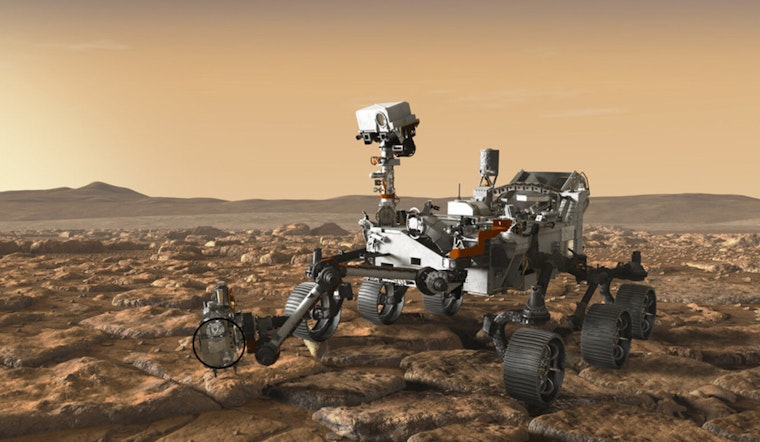
Over on the Red Planet, NASA's Perseverance rover, affectionately known as "Percy," is doing more than just taking a joyride. The rover has been busy collecting bedrock samples, with 20 of its onboard titanium tubes now packed with cores from ancient Martian terrain. Scientists are jazzed about these samples as they harbor potential clues to the life-bearing capacity of the planet's past.
But here's the kicker - for the first time, MIT scientists have managed to figure out the original orientation of these Martian rocks, which might just help to crack the case on Mars' magnetic history. Geologists used the rover’s engineering data, like the drill's position when capturing samples, to accurately estimate how these rocks were once aligned in their natural state. This information could be pivotal in understanding Mars' ancient magnetic field, which, if proven to have existed, would point to more life-friendly conditions in the planet's past. "There are so many science questions that rely on being able to know the orientation of the samples we're bringing back from Mars," Elias Mansbach, a graduate student at MIT, said in a statement obtained by MIT News.
Perseverance is currently poking around Jezero Crater, a spot that was once believed to be flowing with water. According to Benjamin Weiss, a professor of planetary sciences at MIT who is a member of Perseverance's science team, understanding the planet's magnetic field could be key to solving the mystery of Mars' climatic shift from warm and wet to cold and dry. In a harsh turn of events, the planet's atmosphere may have been stripped away by solar winds following the loss of its magnetic field. "We want to know what happened, and why," Weiss said in an interview detailed by MIT News.
The MIT team collaborates with NASA engineers, ingeniously using intricate measurements to analyze the orientation of each sample. This strategy involves three angles known as the hade, azimuth, and roll - similar to a boat's pitch, yaw, and roll. They harnessed the rover's onboard camera and laser to fine-tune their method, even resorting to having the rover make an "L" shaped mark on the rock with its laser to identify its original orientation. Their clever techniques have led to determining the orientations of all 20 bedrock samples with a precision that rivals, even outdoes, what's typically achieved on Earth. Mansbach confidently remarked to MIT News, "We're working with engineers now to automate this orienting process so that it can be done with other samples in the future."
With the success of this innovative approach, the excitement is now building for Perseverance's next moves. Weiss foreshadowed a thrilling future for Martian exploration as the rover gears up to leave the crater in pursuit of the planet's oldest rocks. "It's an incredible opportunity to be able to orient these rocks, and hopefully uncover a lot of these ancient processes," Weiss revealed to MIT News. The implication is clear: what Percy extracts and stores in its metal tubes could redefine our understanding of the red dusty giant next door.





