

























































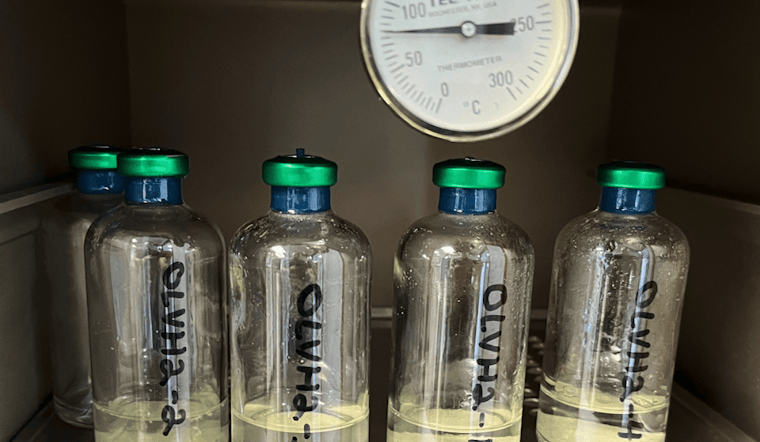
University of Texas at Austin scientists are opening a new frontier by extracting hydrogen gas from iron-rich rocks – making strides in the pursuit of a non-fossil fuel hydrogen source that leaves a minimal carbon footprint. The groundbreaking research, propelled by a $1.7 million grant from the Department of Energy, is experimenting with natural catalysts that could potentially revolutionize the hydrogen industry, according to an announcement from the university.
Leading the charge, UT Jackson School of Geosciences' Toti Larson remarked, "We’re producing hydrogen from rocks." Larson, a research associate professor, further explained that this innovative technique for producing geologic hydrogen, which is not dependent on carbon-emitting fossil fuels, is uncharted territory at the industrial level. The project is also working in tandem with the University of Wyoming scientists to examine the method's effectiveness on various rock types across the U.S.
Hydrogen, already a key player in the energy sector due to its clean burn, has its current mass production tied to natural gas. The UT research aims to alter this narrative by tapping into iron-rich rocks as the new hydrogen source. Larson emphasized the potential impact of their efforts, saying, "If we could replace hydrogen that is sourced from fossil fuels with hydrogen sourced from iron-rich rocks, it will be a huge win."
The catalysts under investigation could substantially lower the temperature at which hydrogen is produced from these rocks, employing a process known as "serpentinization" that normally unfolds at high temperatures. These catalysts leverage elements like nickel and others in the platinum group to spur on this natural geologic process, that predominantly, happens over millions of years. Esti Ukar, also a research associate professor at Jackson School, said, "If we could help generate larger volumes of hydrogen from these rocks by driving reactions that would take several million years to happen in nature, I think geologic hydrogen could really be a game changer."
Laboratory tests have already yielded positive results, and with the injection of funds from the Department of Energy Advanced Research Projects Agency-Energy (ARPA-E), the project is upscaling experiments while also studying the efficiency of different types of iron-rich rocks found across North America. Research efforts include applying the catalysts on basalts from the Midcontinent Rift in Iowa, banded iron formations in Wyoming, and ultramafic rocks in the Midwest.
This enterprising exploration into geologic hydrogen is one of many initiatives at the Bureau of Economic Geology looking into the subsurface generation and storage of hydrogen. The collective objective is to facilitate a transition to cleaner energy sources that can satisfy both industrial demands and environmental conservation goals. More details on the research can be found in the University of Texas at Austin's official news release.





